
Reviewed · PARIS TOURS
Paris : Atelier des Lumières admission ticket
The most striking thing about Atelier des Lumières is the building itself: a former foundry in Paris transformed into a vast room for projected art. Instead of walking from one framed canvas to the next, you watch Picasso and Henri Rousseau spread across walls, pillars, and floors in a changing show set to music and movement.
I like the two exhibitions on one ticket, since Picasso gives you bold, jagged energy while Rousseau offers a calmer journey through plants, animals, and dreamlike scenes. I also like the continuous broadcasts, which make this easier to fit into a busy Paris day. The main caution is practical: strollers, baby carriages, luggage, and large bags are not allowed, and the experience is not suitable for children under 2 or people with epilepsy.
Key points to know before you go
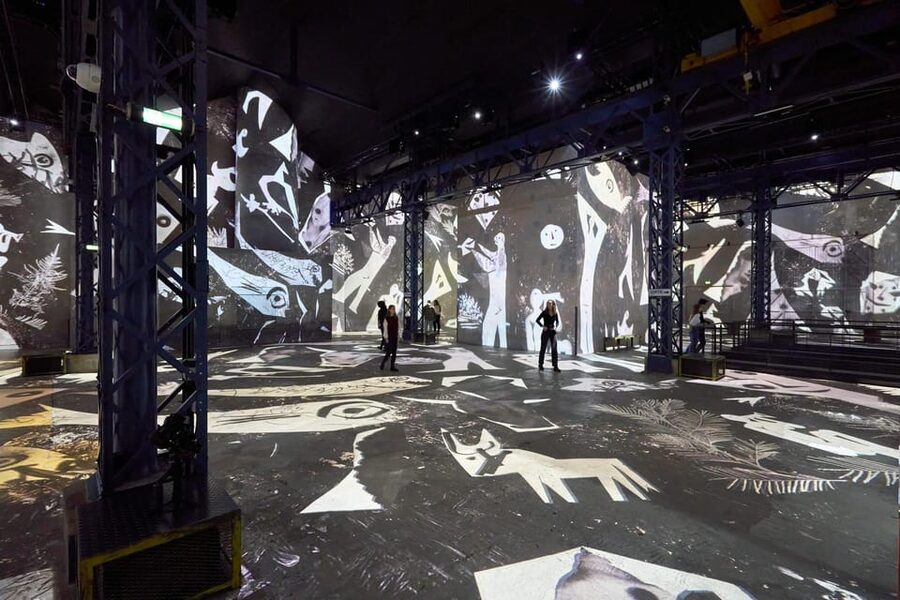
- A former foundry becomes the gallery: The industrial building gives the projections room to spread across a huge interior.
- Two artists, two very different moods: Picasso brings bullfights, cabarets, fractured forms, and Guernica, while Rousseau brings jungles, animals, and dreamlike color.
- Shows run continuously: You do not need to catch one single performance time, though you should check the available start times when booking.
- Children have their own creative space: Atelier des Enfants introduces ages 4 to 12 to digital art through Rousseau-inspired activities.
- The ticket is valid for one day: You can plan a short visit or stay for more than one cycle, depending on the schedule and your interest.
- Plan light: Large bags, luggage, strollers, and baby carriages are not permitted inside.
Entering a former foundry in Paris
Atelier des Lumières does not feel like a conventional museum. Its setting is a converted foundry, and that industrial shell matters. The broad walls and open interior give the projected images space to move around you rather than sit in one fixed rectangle.
You can watch from different points in the room. One moment, a painted face may fill a wall. A few seconds later, color and form may flow across the floor or climb a pillar. I would treat the building as part of the presentation, not just a container for it.
This format changes the pace of looking at art. In a standard gallery, you control the order and speed of your visit. Here, the image, music, and movement guide your attention. That can make familiar works easier to approach, especially if Picasso usually feels hard to understand from a small reproduction in a book.
It also means this is not the place for quiet, close study of brushwork or canvas texture. You are seeing digital versions of works in a large, moving setting. The reward is scale and atmosphere, not the original object.
A few other Paris half-days to compare
- Paris: Louvre Museum Timed-Entrance Ticket
★ 4.6 · 71,977 reviews - Disneyland® Paris 1-Day Ticket
★ 4.6 · 49,412 reviews - Paris: Versailles Palace and Gardens Full Access Ticket
★ 4.6 · 41,579 reviews
Picasso through bullrings, cabarets, and fractured forms
The main presentation, Picasso, Art in Motion, follows Picasso from his native Spain to France, where he spent most of his life. Its route through his work includes the bullring, Paris nightlife, the shapes and colors of Les Demoiselles d’Avignon, and the force of Guernica.
That sequence gives you a useful way to approach an artist whose career can otherwise seem overwhelming. Picasso changed styles often, and the show presents those changes as movement rather than as a long list of dates and labels. You are encouraged to notice shifts in color, shape, mood, and subject.
The bullring scenes connect the exhibition to Spain and to one of Picasso’s recurring subjects. The Paris cabaret material brings a different tone, with the city’s nightlife providing a setting for his people and performers. Then the show turns toward more fractured forms, where bodies and faces are broken into sharp planes.
Les Demoiselles d’Avignon is an especially good fit for this large-screen format. The work’s force comes partly from its unusual shapes and hard visual decisions. When those forms are enlarged and placed around you, you can grasp the painting’s visual impact before trying to explain it.
The section connected with Guernica carries greater weight. Picasso’s painting is tied to the horror of war, and the presentation gives it a powerful closing point within the Picasso program. I would not expect the digital show to replace seeing the original in a museum, but it can help you understand why the work has such lasting force.
You may find the presentation more emotional than academic. There is no mention of a personal guide leading you from work to work, so you should arrive ready to form your own reading. If you want detailed dates, technical notes, or a close view of original materials, pair this visit with a traditional museum rather than using it as your only Picasso stop in Paris.
Henri Rousseau and the country of dreams
The second program, Le Douanier Rousseau, Au pays des rêves, shifts the mood completely. Rousseau was a self-taught painter and an early figure in naive art in France. His pictures draw on close observation of vegetation and animals from elsewhere, including what he saw at the greenhouses and menagerie of Paris’s Jardin des Plantes.
This exhibition is likely to appeal to you if you enjoy art that feels direct, strange, and dreamlike. Rousseau’s plants and animals are not presented as a strict scientific record. They become part of an imagined world, with dense foliage and unusual creatures creating a childlike but carefully observed mood.
The contrast with Picasso is one of the best reasons to stay for both programs. Picasso’s section moves through conflict, experimentation, and broken forms. Rousseau’s work gives you a slower, more fanciful change of tone. Seeing them together makes the ticket feel like more than a single artist presentation.
Rousseau’s connection to Paris is also useful. The pictures may suggest distant places, but the exhibition explains that his ideas came in part from the city’s botanical gardens, greenhouses, and animal collections. That detail keeps the show from becoming only a fantasy. It links the imagined scenes to a real source of observation.
Again, the projected format favors overall effect. You can take in the rhythm of leaves, animals, and color across the former foundry, but you will not study the exact surface of an original painting. I would choose this experience for a fresh way to encounter Rousseau, not for a formal lesson in painting technique.
How the continuous programs shape your visit
The exhibitions run as continuous broadcasts. This is a real advantage in Paris, where a day can be derailed by a late train, a long lunch, or an unexpected museum queue.
Your ticket is valid for one day, and you should check the available starting times before booking. The supplied information does not give a fixed total visit length, so allow enough time to see both artist programs rather than rushing through one section.
A useful plan is to enter with no expectation that you must arrive at the exact beginning of a performance. Since the material repeats, you can find your bearings, watch part of one section, and then stay for the next cycle if you want a fuller experience.
That flexibility has limits. A continuous broadcast does not mean every moment is equally easy to follow from the entrance. If you arrive partway through, you may want to stay until the program reaches its beginning again. Check the schedule and plan around your energy, especially if you are visiting with children.
The room is designed for looking rather than for a guided walking route. You are not being taken from gallery one to gallery two by a guide. Instead, you choose where to stand and when to move. That makes the visit independent and simple, but it also means you should not expect personal explanations or a question-and-answer session.
Same city, a completely different afternoon:
- Paris: Evening River Cruise with Music
★ 4.4 · 22,721 reviews - Paris: Eiffel Tower Entry Ticket with Optional Summit Access
★ 4.4 · 20,035 reviews - Paris: Eiffel Tower Summit or Second Floor Access
★ 4.3 · 17,248 reviews - Paris: Louvre Guided Tour with Reserved Access & Boat Cruise
★ 4.3 · 16,353 reviews
Atelier des Enfants for ages 4 to 12
Families get an added feature with access to Atelier des Enfants, a space made for children from 4 to 12. Here, children become creators rather than simply watching the art pass over the walls.
The activities introduce digital art through the world of Le Douanier Rousseau. That connection is smart because Rousseau’s plants and animals are easy starting points for young imaginations. Children can approach the exhibition through making and play instead of being asked to stand quietly in front of paintings.
The family value is clear. Adults can enjoy the main programs while children have a dedicated way to take part in the artistic idea. Still, do not assume the entire visit is designed for very young children. Children under 2 are not considered suitable for the experience, and strollers and baby carriages are not allowed.
For a family visit, pack lightly and explain that the main room is a digital art setting, not a normal museum with small objects behind glass. That expectation can make the difference between a fun outing and a difficult one.
Who will get the most from this format
I would recommend Atelier des Lumières to you if you want to see major artists in a way that feels different from a standard museum visit. It works especially well if you enjoy music, moving images, large-scale color, and art that you can experience from several points in a room.
It is also a good choice for families with children in the 4 to 12 age range, thanks to Atelier des Enfants. The two artists provide useful variety: Picasso offers drama and bold visual change, while Rousseau gives children and adults a more fanciful world to explore.
You may be less satisfied if your priority is seeing original paintings in person. A projection can show you a work at a huge scale, but it cannot provide the physical surface, frame, pigment, or age of the original. For that, you need a museum with original collections.
The warning for people with epilepsy is important. The presentation uses moving projected images, so this is not an experience to book if flashing or rapidly changing visuals create a health risk for you.
Wheelchair access is available. The restrictions on large bags and luggage still apply, so accessible admission does not remove the need to arrive with only what you can carry easily.
Is the $20 ticket good value?
At $20 per person, the ticket is fairly priced if you plan to see both current programs and spend enough time to let the presentation unfold. You are paying for admission to the building and its current exhibitions, plus access to the children’s area, not for a short single artwork display.
The value is strongest when you compare it with the range of the experience. You get two artists from very different parts of art history, a purpose-built setting in a former foundry, and a format that lets you watch the material more than once during the day if the schedule allows.
The value is weaker if you only have time for a quick look at one program. The ticket still gives you entry, but the full point is the contrast between Picasso and Rousseau. I would protect enough time to see both before deciding that the price fits your plans.
The reserve-now-and-pay-later option can also help if your Paris schedule is still changing. You can hold a place without paying immediately, and free cancellation is available up to 24 hours in advance for a full refund. Keep the deadline in mind rather than treating the booking as endlessly flexible.
Practical limits worth knowing
The biggest packing rule is simple: do not bring luggage, large bags, strollers, or baby carriages. If you are arriving directly from a train station or airport, this may not be the right first stop unless you have somewhere to leave your bags.
The experience is open seven days a week, which gives you more choice than a museum with a weekly closing day. Still, availability and starting times can vary, so check the date and time options before you set the rest of your day around it.
The ticket is valid for one day, not for an unlimited period across your Paris stay. Make sure the date you select matches your plans.
There is no guide name to look for in the information provided, and the experience is not described as a guided tour. You should expect a self-directed visit built around continuous digital presentations.
The rating is 4.5 from 91 reviews, a strong signal that the general format works for many people. I would still pay attention to the drawbacks, especially the bag restrictions, the lack of original artworks, and the health warning for people with epilepsy.
Should you book Atelier des Lumières?
Book it if you want a lively alternative to a conventional Paris museum, especially if Picasso and Rousseau appeal to you or you are visiting with children ages 4 to 12. The two programs give you real variety, and the continuous schedule makes this an easy addition to a full day.
Skip it if you want to examine original canvases in quiet galleries, need to bring a stroller or large bag, or are sensitive to moving and flashing images. At $20, it is good value when you stay for both presentations and use the children’s space if it suits your family.
FAQ
Where is Atelier des Lumières located?
It is located in the Ile-de-France region of France, in a former foundry that now houses digital, contemporary, and projection-based art exhibitions.
What exhibitions are included?
Admission includes the current programs Picasso, Art in Motion and Le Douanier Rousseau, Au pays des rêves.
How long is the ticket valid?
The ticket is valid for one day. Check availability for the starting times offered on your chosen date.
Does the ticket include activities for children?
Yes. Admission includes Atelier des Enfants, a dedicated space for children ages 4 to 12 that introduces digital art through the world of Le Douanier Rousseau.
Is the experience wheelchair accessible?
Yes, the activity is wheelchair accessible.
Are strollers and large bags allowed?
No. Baby strollers, baby carriages, luggage, and large bags are not allowed.
Can I cancel my booking?
Yes. You can cancel up to 24 hours in advance for a full refund. A reserve-now-and-pay-later option is also available.
Just listed in Paris
- Chartres Cathedral 5 Hours Tour from Paris with Private Transport★ 4.5 · 49 reviews
- Paris: Giverny & Versailles Small Group or Private Tour★ 4.5 · 49 reviews
- Paris: Louvre photoshoot or Seine bridges Eiffel Tower walk★ 5.0 · 49 reviews
- Private tour of the Champagne area, meet local producers and taste their Champagne, start from your hotel in Paris.★ 5.0 · 50 reviews
- Paris: Choux Pastry and Chocolate Éclair Making Class★ 4.9 · 50 reviews
- Paris Eternelle Notre-Dame Virtual Reality Tour★ 4.5 · 50 reviews
- Normandy D-Day Landing Beaches Private Day Trip from Paris★ 5.0 · 50 reviews
- Disneyland® Paris 1 Day with Round-Trip Train Tickets from Paris★ 4.0 · 50 reviews
Paris Tours, compared.



Versailles Palace and Gardens Full Access Ticket
Read our review →

Eiffel Tower Entry Ticket with Optional Summit Access
Read our review →

Louvre Guided Tour with Reserved Access & Boat Cruise
Read our review →