
Reviewed · MONTMARTRE & SACRE-COEUR TOURS
Paris: Le Marais & Montmartre Jewish History Walking Tour
Paris reveals two very different sides of Jewish life on this 210-minute walking tour. In Le Marais, you trace community, trade, persecution, and memory. In Montmartre, you follow the artistic world of Jewish writers and artists before finishing above the city at Sacré-Cœur.
I like the small groups of up to nine people, which make it easier to ask questions and hear the guide on busy streets. I also like the way the tour joins two neighborhoods that are usually sold as separate experiences, using the 30-minute public transport ride as a bridge between Jewish history and bohemian Paris.
The main consideration is the amount of walking. The route lasts about three and a half hours, includes stairs and hills in Montmartre, and is not suited to wheelchair users or people with mobility impairments. The tour also focuses on exteriors, so you will not go inside the synagogue or other monuments.
Key points to know before you book
- Two neighborhoods, one connected story: Begin in historic Le Marais, then cross Paris to Montmartre for its Jewish artistic legacy.
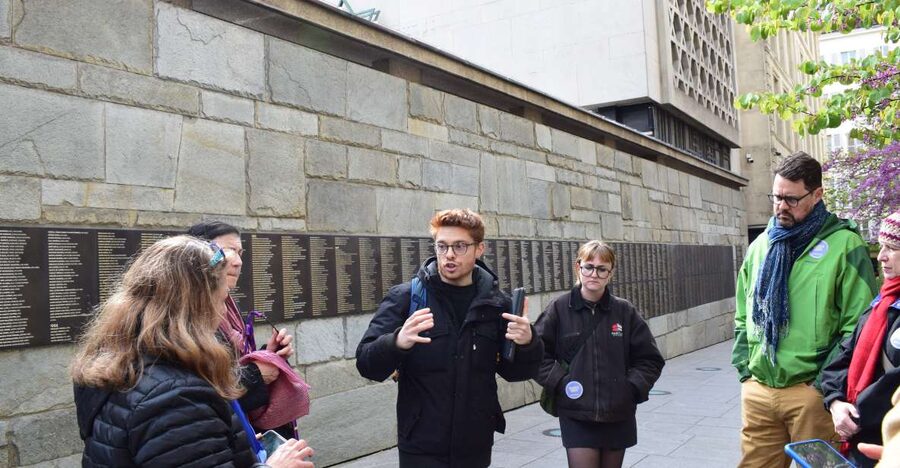
- A serious stop at the Shoah Memorial: The exterior visit brings wartime persecution and remembrance into the center of the walk.
- Agoudas Hakehilos Synagogue from outside: You can admire Hector Guimard’s Art Nouveau design, but indoor access is not included.
- A guide-led history lesson: Guides including Benjamin, Benoit, Pierre-Louis, Achilles, and Pilu have been praised for clear English, strong historical context, and thoughtful handling of sensitive subjects.
- Falafel and food tips near the finish: The route ends near places to eat, and guides may point you toward Jewish food businesses and local specialties.
- Sacré-Cœur views at the end: The walk closes at Square Louise-Michel, with broad views over Paris after the climb through Montmartre.
Why this Paris walk is different
Many Paris walking tours stay in one district and build a story around buildings, food, or famous people. This one makes a larger argument: Jewish Paris cannot be understood through one neighborhood alone.
Le Marais gives you the long view. Jewish communities have lived in and around this part of Paris from the Middle Ages to the present, though their presence has changed greatly over time. Montmartre brings a different set of stories, centered on artists, writers, cafés, studios, and creative circles in the late 19th and early 20th centuries.
That contrast is the tour’s best idea. In the morning or afternoon, you may be looking at streets shaped by community life and religious practice. A short public transport ride later, you are climbing through a district linked with modern art and literary culture.
I would not choose this tour simply to tick off famous Paris sights. Choose it if you want a guide to explain what happened here, why Jewish communities formed in these areas, and how memory still shapes the city.
The 4.8 rating from 170 reviews reflects a clear pattern: the guides are the strongest part of the experience. Benjamin, Benoit, Pierre-Louis, Achilles, Pilu, and others have been praised for presenting difficult material with care, answering questions, and connecting French history to Jewish history without turning the walk into a dry lecture.
More Historical Tours in Paris
- Paris: Louvre Museum Entry with History of Mona Lisa
★ 3.9 · 2,823 reviews - Paris: Dark History and Ghostly Guided Walking Tour
★ 4.7 · 1,000 reviews - Le Marais/Paris – The Historic, Trendy, Jewish, LGBT district
★ 5.0 · 341 reviews
Starting in Le Marais
The tour begins at one of two possible meeting points, BHV Marais or L’Elephant Du Nil, depending on the option you book. Check the exact location carefully. One practical warning is worth taking seriously: BHV has four entrances, so finding the right one may take a few minutes.
Arrive 15 minutes early. You cannot join once the group has left, and this is not the kind of tour where you want to begin flustered after searching for the guide.
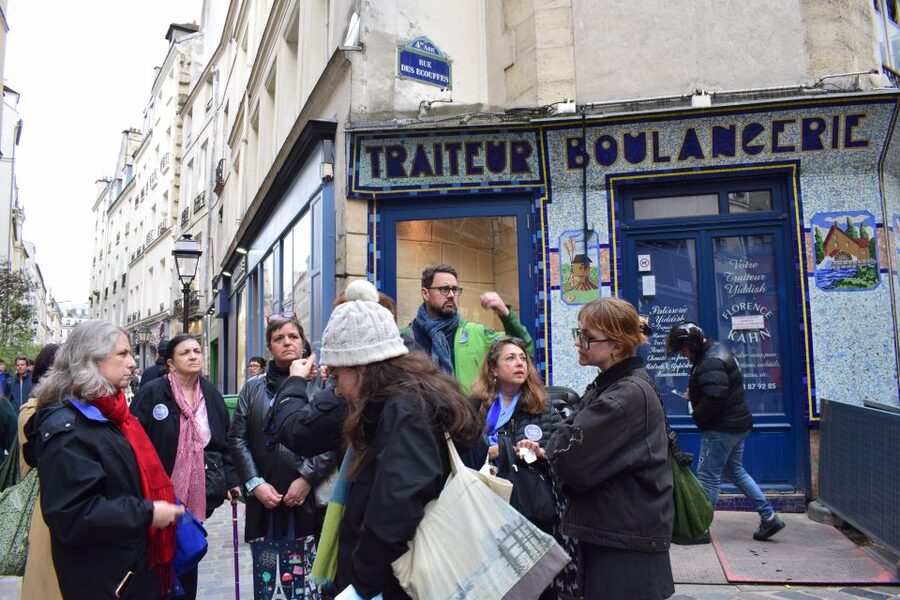
Once together, you head into Le Marais for roughly 90 minutes. The district is now known for food, fashion, galleries, and its LGBTQ community, but the guide shifts your attention to the older Jewish quarter and the layers beneath its present-day appearance.
This is not a preserved historical village. Parts of the neighborhood have been renovated, altered, or absorbed into modern Paris. That can disappoint you if you expect a clearly marked Jewish quarter with original streets and buildings at every turn.
At the same time, that modern setting makes the discussion more useful. You see how a living neighborhood changes rather than viewing Jewish Paris as a museum display. Guides explain the roles of homes, shops, businesses, and community spaces, helping you picture everyday life rather than focusing only on grand monuments.
Village Saint-Paul and the old neighborhood

Le Village Saint-Paul forms part of the Le Marais walk. The stop is brief in the published schedule, but its value comes from the surrounding commentary rather than a long indoor visit.
Your guide uses the streets to explain how Jewish life took shape in Paris across the centuries. Expect stories about community, commerce, identity, and the pressures placed on Jewish residents at different points in French history.
This is where a strong guide makes a real difference. The walk covers a large span of time, from medieval Jewish life through the modern community and the Second World War. You are not simply receiving dates. The best guides, including Benjamin and Pierre-Louis, have been praised for making the past relevant to Paris as it looks today.
The pace can be adjusted in a private or small-group setting, but you should still expect to remain on your feet. One review describes a guide making room for a camera battery change and allowing rests, though that should not be treated as a guarantee for every departure.
Agoudas Hakehilos Synagogue from the street
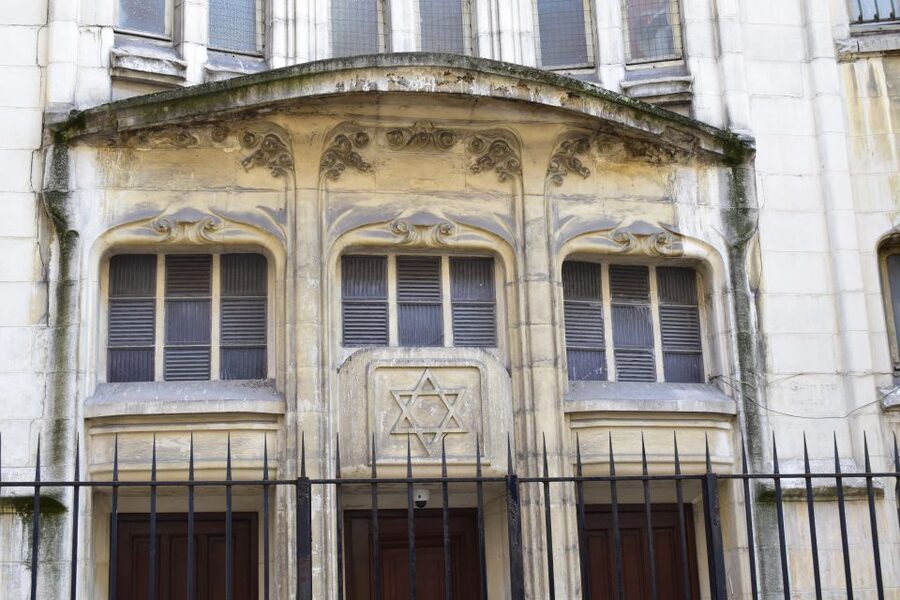
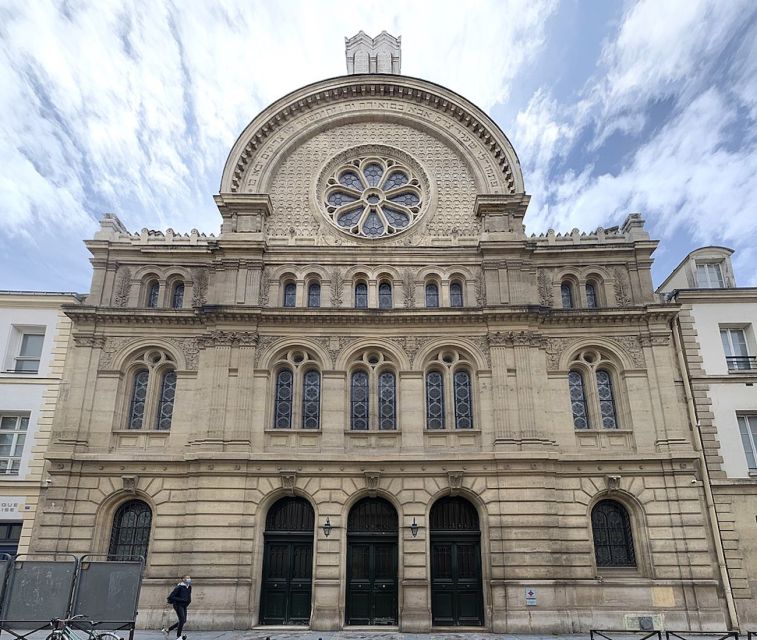
One of the most distinctive architectural stops is Agoudas Hakehilos Synagogue, designed by Hector Guimard. Guimard is best known for the flowing Art Nouveau entrances of the Paris Métro, and the synagogue gives you another chance to see his curved, decorative style.
The building is admired from the exterior only. Indoor synagogue visits are not included, and entry to monuments or historical sites generally does not form part of the tour.
That limitation matters. If you want to see the interior or attend a service, you will need to make separate arrangements. Still, the exterior stop works well for a walking tour because the guide can connect the building’s design to the community that commissioned and used it.
You also get a pause from the broad sweep of political history. Architecture makes the story tangible. Instead of hearing only about institutions and events, you are looking at a place built for Jewish communal life.
More Walking Tours in Paris
- Paris Top Sights Half Day Walking Tour with a Fun Guide
★ 5.0 · 2,893 reviews - Montmartre Hidden Gems and Scenic Highlights Walking Tour
★ 5.0 · 2,684 reviews - Montmartre Hill French Gourmet Food and Wine Tasting Walking Tour
★ 5.0 · 2,588 reviews - Paris Île de la Cité and Notre-Dame Walking Tour With Crypt
★ 5.0 · 2,272 reviews
The Shoah Memorial and its difficult message
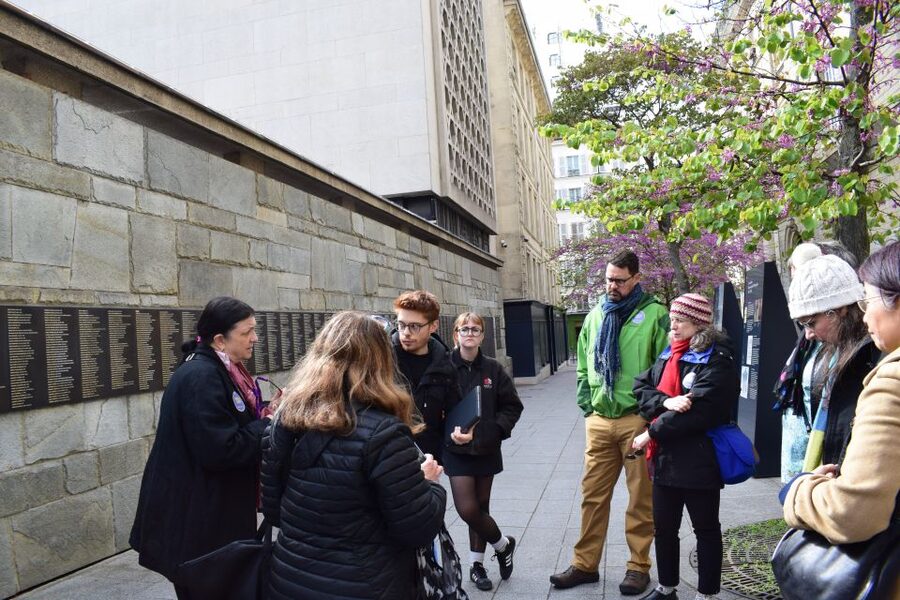
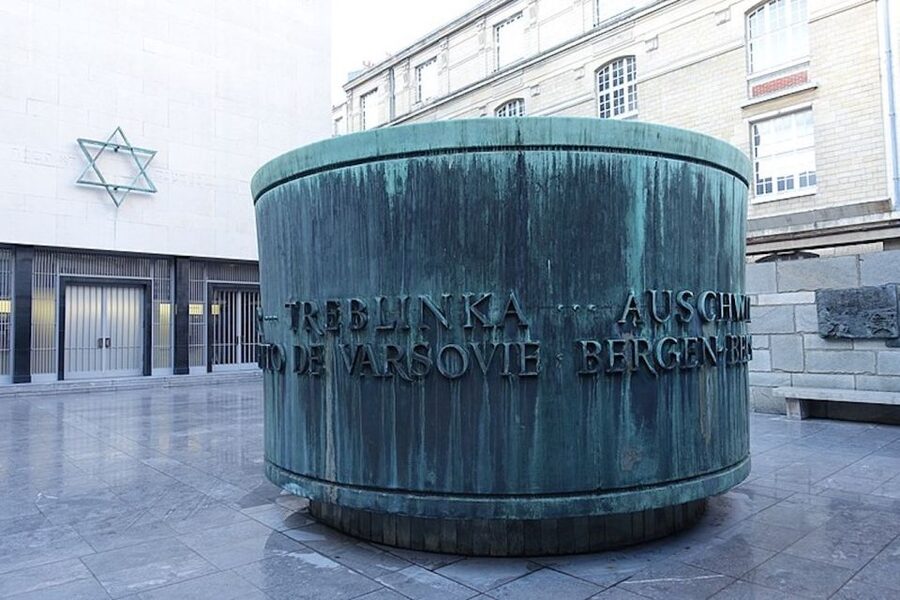
The Shoah Memorial is the most solemn stop in Le Marais. The tour explores it from the exterior, including its historical significance, rather than offering an included museum visit.
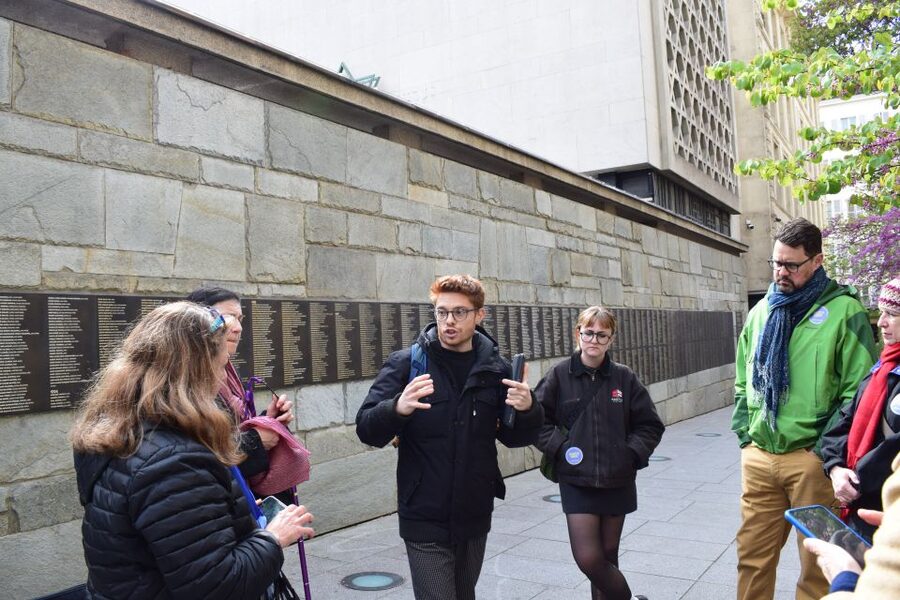
This part of the walk deals with the destruction of Jewish life during the Holocaust and with the people remembered in Paris. The memorial’s wall of names and crypt have left a strong impression on visitors, and the stop often becomes the emotional center of the first half.
Expect the tone to change here. The earlier streets may feel lively and contemporary. At the memorial, the guide asks you to consider persecution, deportation, loss, remembrance, and the French people who helped Jewish neighbors escape or survive.
This is a subject that needs care, especially given current events and continuing arguments about memory and responsibility. The guides have generally been praised for handling it with appropriate sensitivity. That does not make the material easy, but it does make the conversation worthwhile.
Allow yourself time to pause. You do not need to photograph everything or rush through the stop. The value lies in listening and understanding why this place matters.
From Hôtel de Ville to Montmartre
The Le Marais portion finishes near Hôtel de Ville, Paris’s City Hall. From there, the group uses public transport for about 30 minutes to reach Montmartre, and transport tickets are included.
This change of district is practical as well as thematic. You leave the historic Jewish quarter and travel toward a neighborhood associated with artists, writers, and new creative movements.
The transfer does mean the tour is not a continuous walk. You will be navigating public transport with the group, so keep close to the guide and be ready to board promptly. It also gives your feet a short break before the second walking section.
Some people may prefer a tour devoted entirely to Le Marais. If your main aim is Jewish religious history, the Montmartre section may feel less direct. The benefit is that you see how Jewish identity also appeared in artistic and intellectual life, not only in religious buildings and neighborhood businesses.
Montmartre beyond the postcard
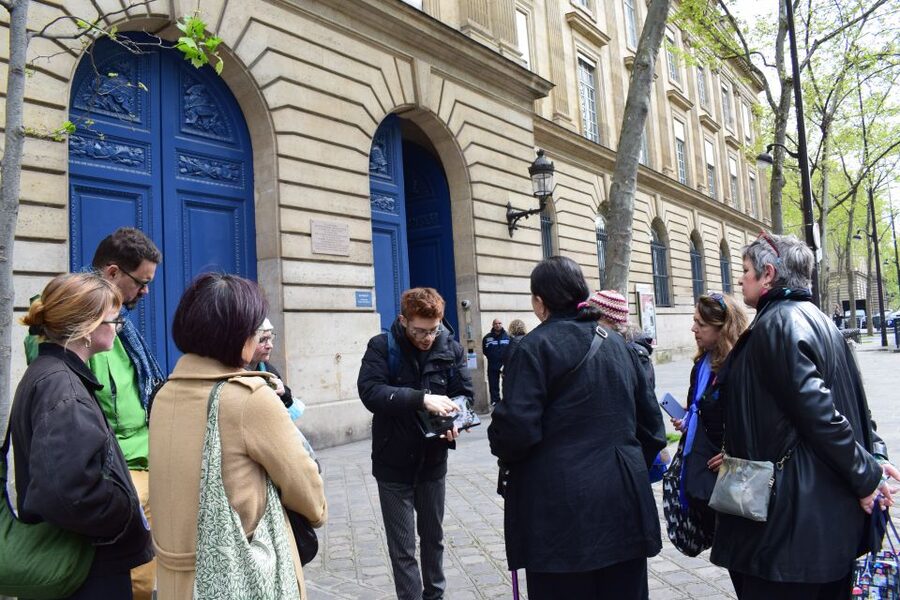
The second walking section lasts about 90 minutes. Montmartre is famous for steep streets, artists’ studios, cafés, and Sacré-Cœur, but this route asks you to look past the familiar postcard.
The guide tells stories about Jewish artists, writers, and thinkers who helped shape the neighborhood’s creative circles in the late 19th and early 20th centuries. The emphasis is on the connections between Jewish voices and the wider artistic culture of modern Paris.
The itinerary includes 7 Rue Ravignan and Le Bateau-Lavoir. These addresses are linked with Montmartre’s artistic world, and the guide uses them to explain how studios and creative communities encouraged new ideas.
You will not be entering every site. This is an outdoor history walk, so the places work as points of reference. That approach suits anyone who enjoys seeing the setting while building a mental picture through stories. It may feel thin if you expect museum displays, original interiors, or extensive time inside historic buildings.
The route passes the Musée de Montmartre and continues toward 16 Rue du Mont-Cenis. These stops help fill out the neighborhood’s artistic geography. Instead of treating Montmartre as a single scenic hill, the guide shows how streets, workspaces, and meeting points formed a creative network.
The climb is part of the experience, but it is also the tour’s main physical challenge. Wear shoes with good grip and avoid carrying a heavy bag. Rain can make the pavement unpleasant, and heat can make the uphill section tiring. The tour operates in changing weather, so a light waterproof layer is sensible.
Sacré-Cœur and the final view
The route reaches Sacré-Cœur Basilica, one of Paris’s most recognizable landmarks. The basilica itself is a sightseeing stop rather than an included interior tour, and the walk ends at Square Louise-Michel.
The reward is the open view over Paris. After several hours of street-level history, you can look back across the city and connect the two districts you have visited.
The view does not erase the harder subjects discussed earlier. That is what makes the ending effective. The tour closes by linking Jewish identity, artistic expression, memory, and the city itself rather than finishing with a simple list of facts.
You may want to remain in Montmartre after the official end. The tour does not include a meal, but the route finishes near restaurants and food businesses. Several guides have offered food advice, and falafel is a recurring suggestion for anyone wanting to continue the Jewish Paris theme after the walk.
How much history do you get?
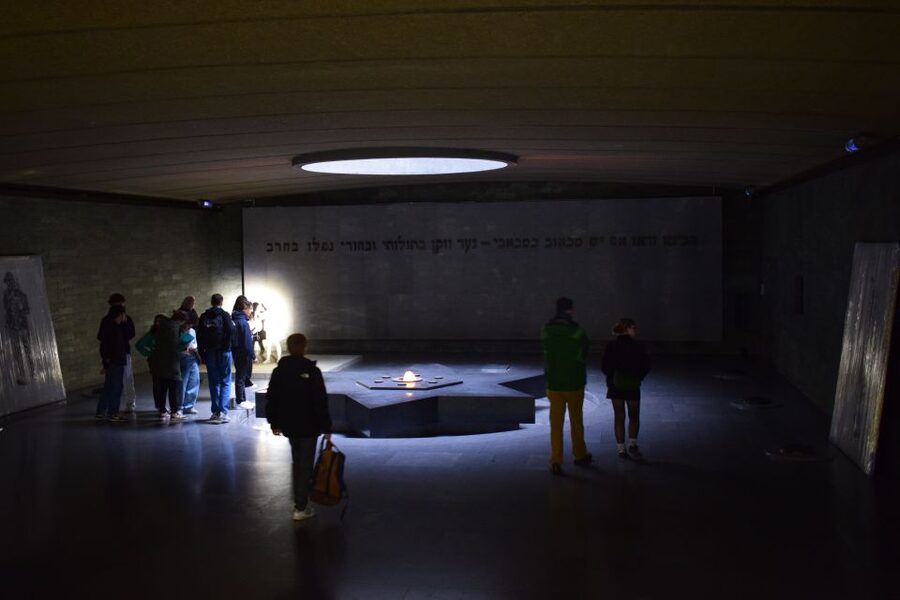
The amount of material is impressive for three and a half hours. Guides have covered Jewish life in France from ancient or medieval periods through the modern community, while also explaining French history and the Nazi occupation.
That range is useful, but it requires concentration. You are moving through centuries quickly, and the experience is not a slow architectural stroll. If you like asking questions, a small group gives you more room to stop and clarify a point.
The strongest guide reports describe Benjamin as courteous and clear, Benoit as engaging and helpful with wider Paris advice, and Pierre-Louis as an excellent English speaker who brings the past into focus. Achilles has also been praised for making a long sweep of Jewish history feel relevant without trying to cover every subject at once.
Guide assignments can vary, so you should not book on the assumption that one particular person will lead your departure. Still, the repeated praise for several guides suggests that the provider has a solid pool of English-speaking historians and storytellers.
The material also demands maturity. This is not a light sightseeing walk, and parts of the Shoah Memorial discussion are painful. You will get more from it if you are prepared to listen carefully and allow space for difficult questions.
Is $80 a fair price?
At $80 per person, the tour is not the cheapest way to see Le Marais or Montmartre. You can walk through both neighborhoods on your own for free, and the basilica’s exterior and Paris views cost nothing.
The price pays for interpretation, structure, and the connection between places. You receive a three-and-a-half-hour guided experience, public transport tickets, and a group limited to nine people. For a first visit to Paris, that can be a good trade if you want context rather than a checklist of streets.
The value is strongest for people who would otherwise struggle to connect the memorial, synagogue, old Jewish quarter, and Montmartre’s artistic addresses. It is less compelling if you already know Jewish Paris well or prefer to spend your time inside museums and religious buildings.
Private groups are available, which may suit families or people with specific interests. A private format can also make it easier to control the pace, though the listed experience does not promise a special route or additional indoor access.
Free cancellation up to 24 hours before the start and reserve-now, pay-later booking add useful flexibility. They do not change the physical demands of the walk, so consider those before booking rather than relying on cancellation as a backup.
Who should take this tour?
I would recommend it to you if you have an interest in Jewish history, French history, architecture, memory, or the relationship between identity and art. It also suits visitors who want a guide to frame Le Marais beyond its food shops and fashionable streets.
The tour works particularly well for couples, families with older children, and small groups who enjoy asking questions. The English-language format and the repeated praise for clear explanations make it approachable even if you do not have a strong background in French or Jewish history.
I would be cautious if you have limited mobility. The route covers two districts, includes public transport, and ends after an uphill walk in Montmartre. Wheelchair users and people with mobility impairments are specifically advised not to book.
I would also think twice if you want a food tour, a synagogue interior visit, or extended time inside museums. You may pass food businesses and receive recommendations, but food is not included. The synagogues and historical sites are viewed from outside.
Should you book it?
Book this walk if you want serious history told on the streets where it happened, with enough time to connect Le Marais and Montmartre. The Shoah Memorial, Guimard synagogue exterior, Jewish businesses, artistic addresses, and Sacré-Cœur view create a thoughtful three-and-a-half-hour route.
Skip it if you dislike hills, group transfers, or outdoor-only sightseeing. For the right audience, $80 buys more than a stroll. It gives you a clearer understanding of how Jewish life, French memory, and Parisian art intersect, while leaving you near Montmartre restaurants and city views when the walk ends.
FAQ
How long does the Jewish history walking tour last?
The tour lasts 210 minutes, or three and a half hours. It includes about 1.5 hours in Le Marais, a 30-minute public transport transfer, and about 1.5 hours in Montmartre.
Where does the tour begin?
There are two possible starting locations: BHV Marais or L’Elephant Du Nil. The exact meeting point depends on the option booked.
Is the tour conducted in English?
Yes. The tour has a live English-speaking guide.
Does the tour include entry to the synagogue?
No. The synagogue is viewed from the outside, and indoor synagogue visits are not included.
Is entry to the Shoah Memorial included?
The route includes an exterior visit and guided explanation of the Shoah Memorial. Entry to monuments and historical sites is not included.
Are public transport tickets included?
Yes. Public transport tickets for the journey from the Le Marais area to Montmartre are included.
Is the tour suitable for wheelchair users?
No. The experience is not suitable for wheelchair users or people with mobility impairments.
How early should I arrive?
You should arrive at the meeting point 15 minutes before the scheduled start. It is not possible to join after the tour has begun.
More Historic Sites in Paris
- Paris City of Fashion History Private Guided Walking Tour
★ 5.0 · 221 reviews - History of Paris City Center w/ Notre Dame Semi-Private 12ppl Max
★ 5.0 · 194 reviews - Paris Walking Tour , Historical Sites .
★ 5.0 · 150 reviews - Paris – Historic City Center Walking Tour
★ 5.0 · 134 reviews
More Montmartre & Sacre-Coeur Tours in Paris
- Paris: Moulin Rouge Cabaret Show Ticket with Champagne
★ 4.7 · 16,088 reviews - Paris: Dinner Show at the Moulin Rouge
★ 4.8 · 3,333 reviews - Seine Dinner Cruise, Eiffel Tower Access and Moulin Rouge Show
★ 4.0 · 2,310 reviews - Paris: Montmartre Cheese, Wine & Pastry Guided Walking Tour
★ 4.8 · 2,255 reviews
Just listed in Paris
- Chartres Cathedral 5 Hours Tour from Paris with Private Transport★ 4.5 · 49 reviews
- Paris: Giverny & Versailles Small Group or Private Tour★ 4.5 · 49 reviews
- Paris: Louvre photoshoot or Seine bridges Eiffel Tower walk★ 5.0 · 49 reviews
- Private tour of the Champagne area, meet local producers and taste their Champagne, start from your hotel in Paris.★ 5.0 · 50 reviews
- Paris: Choux Pastry and Chocolate Éclair Making Class★ 4.9 · 50 reviews
- Paris Eternelle Notre-Dame Virtual Reality Tour★ 4.5 · 50 reviews
- Normandy D-Day Landing Beaches Private Day Trip from Paris★ 5.0 · 50 reviews
- Disneyland® Paris 1 Day with Round-Trip Train Tickets from Paris★ 4.0 · 50 reviews
Montmartre & Sacre-Coeur Tours, compared.

Moulin Rouge Cabaret Show Ticket with Champagne
Read our review →

Montmartre Hidden Gems and Scenic Highlights Walking Tour
Read our review →
Montmartre Hill French Gourmet Food and Wine Tasting Walking Tour
Read our review →
Seine Dinner Cruise, Eiffel Tower Access and Moulin Rouge Show
Read our review →
Montmartre Cheese, Wine & Pastry Guided Walking Tour
Read our review →
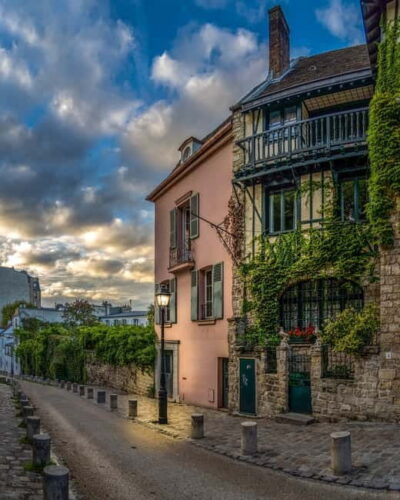
Montmartre Highlights Walking Tour with a Local Guide
Read our review →Browse the lists this tour appears in