Reviewed · PRIVATE
Private battle of Dunkirk Operation Dynamo Tour
Dunkirk’s story becomes far clearer when you move between the Commonwealth War Graves cemetery, the broad beach at Malo-les-Bains, and the port’s East Mole. This private tour links those places by car and explains how the 1940 evacuation unfolded from both French and British points of view.
I like the personal scale and the strong guides, including Emmanuel, Elise, Fred, Freddy, and Onno. I also like the practical transport, bottled water, and visual aids such as maps and wartime photographs. The main drawback is simple: at about two hours, you are paying mainly for guiding and private transport, not a long list of included attractions. The museum is separate.
Key points to know before booking
- See the three places that explain the evacuation: The cemetery, Malo beach, and the East Mole each show a different part of Operation Dynamo.
- Expect a guide-led history lesson, not a museum visit: The Dunkirk Museum is not included, but it is an excellent companion before or after the tour.
- Private transport keeps the visit easy: Hotel pickup and drop-off are offered at selected hotels, with transport by private vehicle when booked.
- Guide quality is the main value: Emmanuel, Elise, Fred, Freddy, Onno, and other guides are praised for clear explanations, warmth, and flexibility.
- Plan for a short, focused visit: The tour lasts about two hours, with roughly 20 minutes at the cemetery, 25 minutes on the beach, and 20 minutes at the port.
- Check the group limit carefully: The general description mentions groups of up to 15, while the additional details specify up to 3 people in a car or 8 in a minivan.
Why these three Dunkirk stops matter
Operation Dynamo is easy to reduce to a famous image: small civilian boats crossing the Channel to rescue stranded troops. The reality was larger and more confused. British and French forces were pressed into a shrinking pocket around Dunkirk while soldiers waited on beaches, at piers, and around the port under German attack.
This tour gives you three physical reference points. The cemetery introduces the human cost. Malo-les-Bains shows the exposed beach where troops waited for evacuation. The East Mole explains how men were moved from land to ships.
I find that sequence useful because it turns a broad military story into a map you can understand. You are not just hearing that an evacuation took place. You are seeing where soldiers gathered, where many were buried, and how the port fitted into the operation.
The guides also place the evacuation in a wider French setting. That matters. Several guides are specifically praised for explaining both the British and French sides, along with what happened to Dunkirk itself afterward. You may also hear about the modern city and notable buildings, not only the battlefield.
A few other France half-days to compare
- Paris: Private Photoshoot at the Eiffel Tower
★ 4.7 · 2,636 reviews - Top Private Cruises in Paris with French Champagne and surprises
★ 5.0 · 1,553 reviews - Private Paris Airport Arrival Transfer – CDG & ORLY Airports
★ 4.5 · 1,119 reviews
Entering the Dunkirk Memorial cemetery
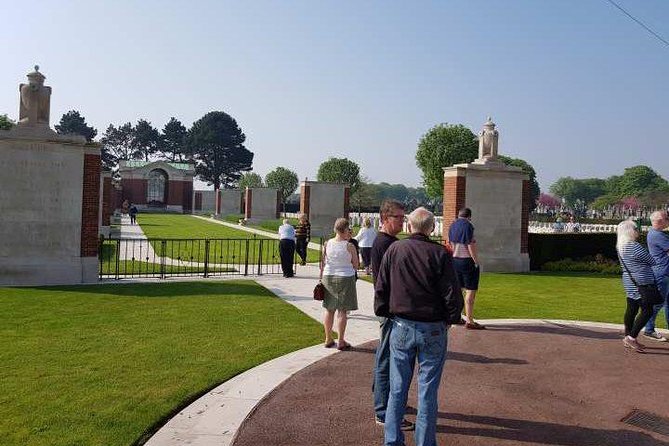
The first stop is the Commonwealth War Graves Dunkirk cemetery, reached through the columns of the Dunkirk Memorial. The visit begins inside the memorial, where an etched glass feature provides an introduction before you move to several graves in the Second World War plot.
You have about 20 minutes here, and admission is free. That short time works best as an opening rather than a full cemetery study. Your guide can establish names, dates, and the setting, then connect the graves to the larger events you will see later.
I like beginning here because it slows the pace. The beach and port can feel broad and open, while the cemetery gives the story a human scale. It also helps you approach the evacuation as a dangerous military retreat, not simply a famous rescue.
The stop may feel brief if you want to read every inscription or spend quiet time among the graves. If that is important to you, ask how much time can be devoted to the cemetery when arranging the tour. The published schedule gives an approximate 20 minutes.
The guides often make this stop more useful with extra visual material. One guide used a binder of photographs and maps, a practical aid when trying to picture the coastline and wartime positions. Ask questions as you go. The private format gives you room to do that, unlike a large group visit.
Malo-les-Bains beach and the long evacuation line
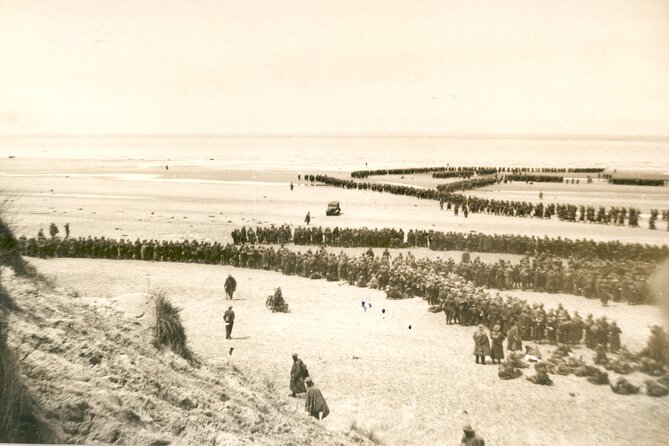
At Malo-les-Bains, you reach the beach where large numbers of soldiers waited for days under German attacks. From here, the view extends along the roughly 20-kilometre beach from which about 100,000 soldiers were taken to England.
This is the emotional center of the tour for many people. The beach is not a preserved battlefield in the usual sense. It is an open public shore, and that is precisely the point. Your guide helps you imagine the queues, confusion, exposed positions, and repeated attempts to reach evacuation vessels.
The 25-minute stop is long enough for an explanation and a look across the coast. It is not a long beach walk. If you are hoping to search for wartime remains or spend an hour by the water, this tour will feel too compressed.
Bring a jacket, even in a season that looks mild. Dunkirk can be windy, and weather may change how much you enjoy the stop. One guide noted that the beach looked completely different on a sunny, calm day than it had during a rough visit. That is practical advice: wind can make this exposed stop feel much colder than the town.
The beach also connects well with Christopher Nolan’s film Dunkirk. Guides have taken visitors to a street used in the film and explained some of the production links. Film references are a pleasant extra, but the tour’s main purpose remains the real 1940 evacuation.
The East Mole and the port operation
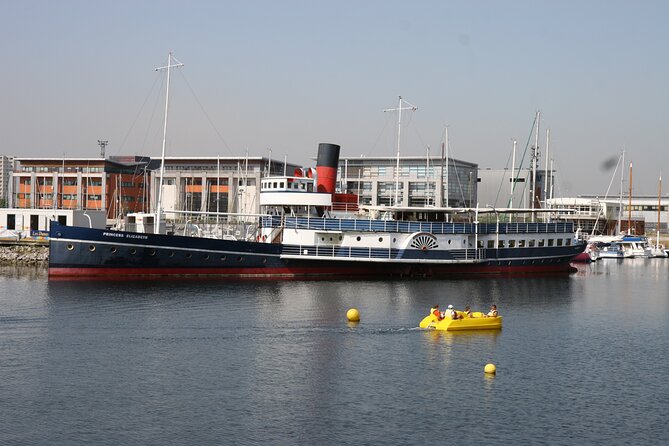
The final scheduled stop is the Grand Port Maritime of Dunkirk, specifically the East Mole, the main point of evacuation during Operation Dynamo. You spend about 20 minutes here, with free admission.
This is where the mechanics of the evacuation come into focus. At the beach, you see where troops waited. At the East Mole, you learn how soldiers could be organized and moved toward ships. The guide explains how the port evacuation was arranged and why this access point mattered.
The East Mole is especially useful for visitors who know the popular story but not the logistics. An evacuation involving hundreds of thousands of troops required routes, order, timing, and ships moving through a dangerous zone. The guide’s explanation gives structure to that effort.
The published route does not include the defensive positions around Gravelines, the Aa Canal, or the shrinking perimeter held by British and French forces. One visitor suggested those areas as a possible expansion, and that is a fair limitation to keep in mind. If you want the full military picture, ask about those places or combine this tour with further independent visits.
Some descriptions also indicate that the guide may show other Dunkirk landmarks and explain the city’s later story. Treat that as guide-dependent rather than guaranteed, since the three main stops are the cemetery, beach, and port.
Same city, a completely different afternoon:
- Paris: Louvre Museum Timed-Entrance Ticket
★ 4.6 · 71,977 reviews - Disneyland® Paris 1-Day Ticket
★ 4.6 · 49,412 reviews - Paris: Versailles Palace and Gardens Full Access Ticket
★ 4.6 · 41,579 reviews - Paris: Evening River Cruise with Music
★ 4.4 · 22,721 reviews
The guides are the main reason to choose a private tour
The strongest part of this experience is the guide. Emmanuel is repeatedly described as passionate, flexible, and able to make the subject work for families with children and teenagers. Elise is praised for presenting both French and British viewpoints with enthusiasm. Fred and Freddy are noted for military knowledge, vivid stories, and polite, engaging manner.
Onno is described as personable and fun, with useful movie connections. Alyce has been praised for explaining the French view and adapting the route around the beach, East Mole, and cemetery. The guide assigned to you may vary, so you should not book expecting one particular person unless the provider confirms that guide.
Private touring changes the feel of the visit. You can ask about a relative, a military unit, the film, the city, or a point on the map without holding up a busload of people. Guides have also adjusted timing for special schedules and made last-minute changes for personal needs.
That flexibility is useful, but it does not mean every request can be guaranteed. The core visit is short, and the listed stops need to fit into roughly two hours. If you want a longer military study, the guide’s expertise may leave you wishing for more time.
What the $193.50 group price really buys
The listed price is $193.50 per group, not per person. That can be reasonable for a small party, especially if three people share a private car. For two or three people, you are paying for a dedicated guide, a private vehicle, local transport, and the ability to shape the conversation around your interests.
The value is less convincing for one person or for anyone expecting admission to several attractions. The cemetery and East Mole are listed with free admission, and the beach does not add a ticket cost. Food and drinks are not included, although bottled water is provided.
One criticism of the tour is that the three locations are close together and the history lesson is brief. That concern is worth taking seriously. You should choose this experience for the guide’s interpretation and the convenience of moving between sites, not because it includes expensive entry tickets.
The group-size information needs checking before you book. The headline describes a private group of up to 15, but the detailed conditions specify a maximum of 3 people for a car tour or 8 for a minivan tour. If your party is larger, confirm the vehicle and capacity directly with the provider.
Add the Dunkirk Museum to make the story clearer
The Dunkirk Museum is not included, and that is the most useful addition to your day. The museum can give you objects, photographs, maps, and background before the vehicle tour places you at the actual sites.
A good plan is to visit the museum before the tour if you want the stops to make immediate sense. You will then recognize key names and events as the guide points out the beach and port. Visiting afterward also works if you prefer to start with the real places and then fill in the details indoors.
Do not assume the private tour replaces the museum. The guide provides explanation and local context, but the museum offers a different kind of evidence. Plan extra time if Operation Dynamo is a main reason for your visit to Dunkirk.
Who will get the most from this experience
This tour suits you if you have only a morning or afternoon in Dunkirk and want a clear introduction without arranging local transport. It also fits families well. The guides have successfully held the attention of children and teenagers, and the private setting makes it easier to adjust explanations to different ages.
It is a strong choice for people interested in the Second World War, military logistics, the French experience, or the film Dunkirk. It is also useful for visitors who prefer a guide to bring maps and photographs rather than reading every detail alone.
You may want something else if you want a full-day battlefield study, extensive walking, or a tour of the surrounding defensive line. The scheduled route is focused and compact. Gravelines, the Aa Canal, and other outer positions are not part of the stated itinerary.
The tour is offered in English. Service animals are allowed, most people can participate, and the meeting point is near public transportation. Hotel pickup and drop-off are available at selected hotels, so confirm that your accommodation qualifies.
Timing, meeting point, and cancellation
The listed start point is 1874 Rue des Chantiers de France, 59140 Dunkerque, France, and the activity ends back at the meeting point. If hotel pickup is important, check the selected-hotel condition before booking rather than assuming every address is covered.
Confirmation is provided when you book. Free cancellation is available up to 24 hours before the local start time. Cancellations or changes made within 24 hours are not accepted for a refund.
The tour is often booked well ahead, with an average booking lead time of 52 days. That suggests you should reserve early if your Dunkirk visit is tied to a ship schedule, a fixed hotel stay, or a wider northern France itinerary.
My recommendation for booking
I would book this tour if you want the three key Dunkirk locations explained by a local guide, especially if you are traveling with family or have limited time. The private vehicle, hotel pickup option, visual aids, and chance to ask questions make the short visit efficient.
I would not book it expecting a full battlefield survey or a museum ticket. Add the Dunkirk Museum, confirm the vehicle size, and ask about pickup and any extra areas you hope to see.
For most people with a serious interest in Operation Dynamo, this is a worthwhile two-hour introduction. Its value rests on the guide, and the available guides have shown a strong ability to make the evacuation understandable, personal, and connected to the places around you.
FAQ
How long does the Operation Dynamo tour last?
The tour lasts approximately two hours.
What places are included?
The main stops are the Commonwealth War Graves Dunkirk cemetery, Malo-les-Bains beach, and the Grand Port Maritime of Dunkirk, including the East Mole.
Is the Dunkirk Museum included?
No. The Dunkirk Museum is not included in the tour, though it is recommended for people interested in Operation Dynamo.
How much does the private tour cost?
The listed price is $193.50 per group.
How many people can join?
The general description allows a private group of up to 15, but the detailed conditions specify up to 3 people for a car tour or 8 people for a minivan tour. Confirm the capacity when booking.
Is transportation included?
Private transport is included if booked, and hotel pickup and drop-off are offered at selected hotels.
Is food included?
No. Food and drinks are not included unless specifically stated. Bottled water is provided.
Is the tour offered in English?
Yes. The experience is offered in English.
Can I cancel for a refund?
Yes. You can cancel at least 24 hours before the local start time for a full refund. Changes or cancellations within 24 hours are not accepted for a refund.
Just listed in France
- Paris: Giverny & Versailles Small Group or Private Tour★ 4.5 · 49 reviews
- Half-Day Walking Food Tour in Nice with Lunch★ 5.0 · 49 reviews
- Chartres Cathedral 5 Hours Tour from Paris with Private Transport★ 4.5 · 49 reviews
- Marseille: Frioul Archipelago Catamaran Cruise with Lunch★ 4.4 · 49 reviews
- Paris: Louvre photoshoot or Seine bridges Eiffel Tower walk★ 5.0 · 49 reviews
- Private tour of the Champagne area, meet local producers and taste their Champagne, start from your hotel in Paris.★ 5.0 · 50 reviews
- Bonifacio: sunset catamaran trip and aperitif★ 4.6 · 50 reviews
- Paris: Choux Pastry and Chocolate Éclair Making Class★ 4.9 · 50 reviews
Private, compared.


Top Private Cruises in Paris with French Champagne and surprises
Read our review →
Private Paris Airport Arrival Transfer – CDG & ORLY Airports
Read our review →
Paris Private Arrival Transfer from Charles de Gaulle (CDG) or Orly (ORY)
Read our review →
Private Montmartre Food Tour with Wine, Cheese & Pastries
Read our review →
Louvre Museum Timed Entry Ticket – Optional Private Guide
Read our review →