
Reviewed · PARIS TOURS
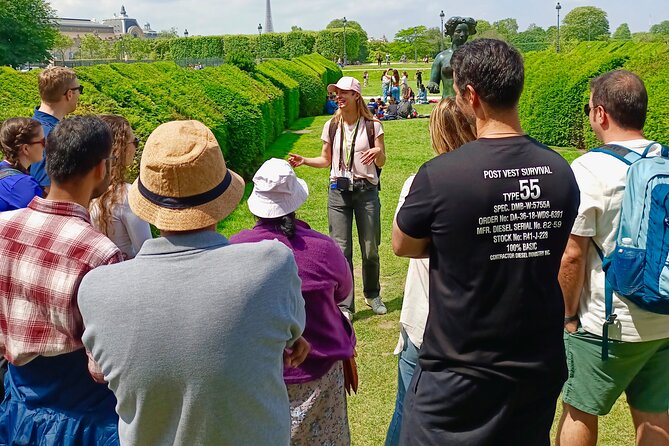
Paris – Latin Quarter Free Tour in English (Tip-Based)
Paris’s Latin Quarter packs Roman ruins, medieval churches, famous bookshops, grand monuments, and student life into a compact part of the city. This tip-based walking tour links those pieces in roughly two hours, beginning at Fontaine Saint-Michel and ending at Place de la Contrescarpe.
I like the route’s range, from the narrow Rue de la Huchette to the grand Pantheon. I also like the choice of morning or afternoon timing, plus guides such as Bruce and Sanna, who are praised for making French history lively and clear.
The main consideration is the pace. The tour covers many stops, and several are brief. You’ll get a strong introduction rather than long visits inside each church, museum, or monument. Also, contributions are accepted only by card or electronic payment, with VAT added.
Key points to know before you go
- Roman Paris and medieval Paris in one walk: See Les Thermes de Lutèce, Saint-Julien-le-Pauvre, and streets that preserve the shape of old Paris.
- A useful two-hour orientation: The route gives you a clear sense of where to return for the Pantheon, Cluny Museum, churches, cafés, and bookshops.
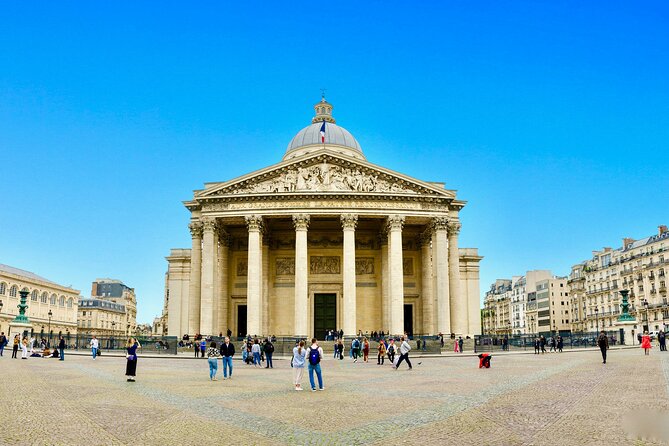
- The Pantheon is the main event: Hear how a religious building became France’s great mausoleum, with figures such as Victor Hugo and Marie Curie buried inside.
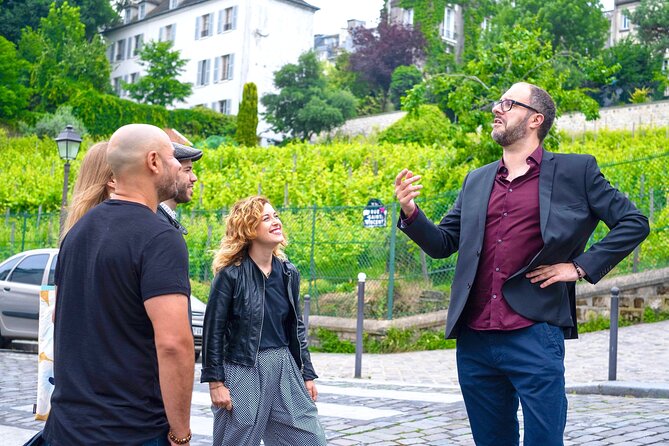
- English-speaking guides set the tone: Bruce and Sanna are among the guides praised for clear, engaging storytelling.
- The ending helps with dinner plans: Place de la Contrescarpe is filled with restaurants, bars, and cafés in the heart of the quarter.
- Bring electronic payment for your tip: Contributions are accepted only by credit card, debit card, or electronic payment, and VAT is added.
Why the Latin Quarter makes a fine first walk
I like the Latin Quarter because it gives you several versions of Paris at once. The district takes its name from the Latin once used by scholars and students, and education has shaped this area since the Middle Ages.
You begin at Fontaine Saint-Michel, a large fountain beside the Seine. It was built during the grand rebuilding of Paris, the massive 19th-century project that changed the city from a medieval maze into the broad, orderly capital you see today.
That opening gives the guide a useful theme. You’ll hear how Paris changed over about 70 years, then walk into streets that still preserve the older city. The contrast is the point: grand urban planning outside, tight lanes and ancient foundations inside.
The tour is especially useful if you are new to Paris. You get names, landmarks, and basic context before deciding where to spend more time later. Since the walk ends in a lively dining area, it also works well as a midday introduction before lunch or an afternoon stroll before dinner.
A few other Paris half-days to compare
- Paris: Louvre Museum Timed-Entrance Ticket
★ 4.6 · 71,977 reviews - Disneyland® Paris 1-Day Ticket
★ 4.6 · 49,412 reviews - Paris: Versailles Palace and Gardens Full Access Ticket
★ 4.6 · 41,579 reviews
From Fontaine Saint-Michel to the old lanes
At Fontaine Saint-Michel, allow a few minutes to find the group and guide. The meeting point is at Place Saint-Michel in the 5th arrondissement, near public transportation and easy to identify by the fountain.
From there, the route turns toward Rue de la Huchette. This is one of the oldest streets in Paris, and the guide uses it to explain Old Paris, including the narrow lanes that once made the medieval city feel crowded and enclosed.
The stop is short, only about five minutes, so do not expect a long architectural inspection. Its value is visual and atmospheric. You see how quickly Paris changes from an open square into a tight street where the past feels close to the surface.
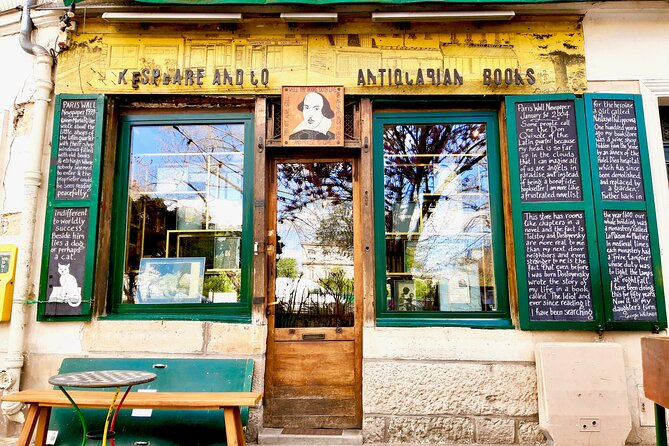
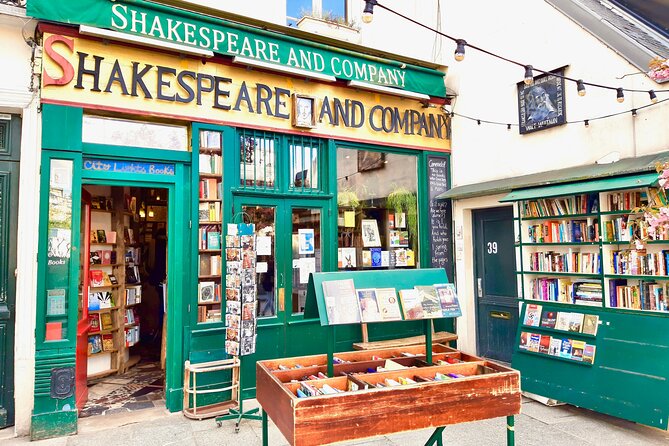
The walk then reaches Shakespeare and Company, the famous English-language bookshop near the Seine. The shop is tied to writers of the 1920s, including Ernest Hemingway, James Joyce, and F. Scott Fitzgerald.
The tour focuses on the stories behind the writers and the lost generation. It does not include a stated admission or extended browsing period, so treat this as an exterior and cultural stop rather than a bookstore visit. If the shop interests you, note it as a place to return to after the tour.
Notre-Dame and two very old churches
Next comes a view of Notre-Dame de Paris. The stop lasts about five minutes, making it primarily a viewpoint and orientation point rather than a cathedral visit.
That brief pause still matters. Notre-Dame helps you understand the historic center of Paris, and the surrounding riverfront makes a natural connection between the Latin Quarter, the Île de la Cité, and the city’s early development.
The route also points out Paris’s oldest tree, dating to 1601. The local custom is to touch its leaves and make a wish. It is a small detail, but this kind of stop gives the walk a human scale. You are not only looking at famous buildings. You are also noticing the odd traditions and ordinary street features that are easy to miss alone.
At Eglise Saint-Julien-le-Pauvre, you see one of Paris’s oldest buildings. The modest church once shared the city’s educational role with Notre-Dame, when the Latin Quarter was becoming a center for study.
The church is not presented as a grand showpiece. That is part of its appeal. Its importance comes from age and connection to the early intellectual life of Paris. If you prefer quiet, older buildings to grand interiors, this stop may be one of your favorites.
Dali’s sundial and Saint-Severin’s Gothic interior
The Salvador Dali sundial is one of the route’s more unusual stops. Dali loved the Latin Quarter and gave Paris this work, which represents the Camino de Santiago de Compostela.
It is a quick stop, but it breaks up the parade of churches and monuments. You get a small piece of modern art in a medieval setting, along with a connection to one of Europe’s best-known pilgrimage routes.
Eglise Saint-Severin offers a stronger interior visit. This 13th-century Flamboyant Gothic church is known for its vaulted ceilings and palm-tree-like columns. The guide explains the design while you look upward, which is exactly the sort of detail that can turn a quick church visit into a memorable one.
There is also a chance that the pipe organ will be played during your visit. That is not guaranteed, so do not plan the tour around it. Still, the possibility adds a welcome bit of luck to the stop.
The itinerary allots about ten minutes here. That is enough to see the main features, but not enough for a slow architectural study. If Gothic churches are a priority, mark Saint-Severin for a separate return visit.
Same city, a completely different afternoon:
- Paris: Evening River Cruise with Music
★ 4.4 · 22,721 reviews - Paris: Eiffel Tower Entry Ticket with Optional Summit Access
★ 4.4 · 20,035 reviews - Paris: Eiffel Tower Summit or Second Floor Access
★ 4.3 · 17,248 reviews - Paris: Louvre Guided Tour with Reserved Access & Boat Cruise
★ 4.3 · 16,353 reviews
Roman baths and the Cluny Museum
Les Thermes de Lutèce takes you further back, to the Roman occupation of Paris. After the Romans invaded in 52 B.C., they established a city and built public baths. The remains here once formed part of a much larger complex open to citizens.
This stop gives the Latin Quarter a longer time scale. In one walk, you move from Roman public life to medieval education, 19th-century urban planning, and modern literary culture.
The Roman baths are also a good reminder that Paris was not created in one period. The city grew layer by layer. What you see today is often built around, above, or beside something far older.
The nearby Musée de Cluny is now Paris’s Medieval Museum. Its ornate 15th-century building holds stories from medieval Paris, and the exterior alone helps explain how the district developed.
The tour lists only about five minutes here, with no admission included. That means you should not expect to tour the museum’s collection. Instead, use the stop as a preview. If medieval art, Roman remains, or old Paris appeal to you, Cluny deserves extra time on another day.
La Sorbonne and the intellectual quarter
La Sorbonne brings the walk back to the district’s academic identity. The university dates to 1257 and is described as the third-oldest university in the world.
The guide connects the university to the Latin Quarter’s long role as a center of education and culture. This is more useful than simply passing a famous name. You begin to understand why the area has attracted students, teachers, writers, political thinkers, and artists for centuries.
The stop lasts about ten minutes. It is mainly an exterior and storytelling stop, so do not expect a campus tour or guaranteed interior access. Even so, the location helps tie together earlier stops at Saint-Julien-le-Pauvre, Shakespeare and Company, and the medieval museum.
I find this part of the route valuable because it gives the neighborhood a living identity. The Latin Quarter is not only a museum district. It remains linked to study, books, cafés, and public debate.
The Pantheon, the route’s grand finale
The Pantheon receives the longest stop, about 15 minutes, and for good reason. It began as one of France’s great religious buildings and later became the country’s most important mausoleum.
The word Pantheon means all the gods, and the building’s history reflects a major change in French public life. A church became a national memorial, with leading French figures buried inside.
The guide discusses names such as Victor Hugo and Marie Curie, along with many others. This is the point where political history, literature, science, and national identity come together.
You should be clear about what is included. The tour provides the guide’s explanation and an exterior visit, but admission to the Pantheon is not included. The itinerary says admission tickets are free at each stop, which means you should not read this as included entry into paid interiors.
Still, the Pantheon is an excellent place for a guide to pause. Its size and purpose are easy to appreciate from outside, while the stories give you reasons to return and go inside later.
Saint-Etienne-du-Mont and Hemingway’s Paris
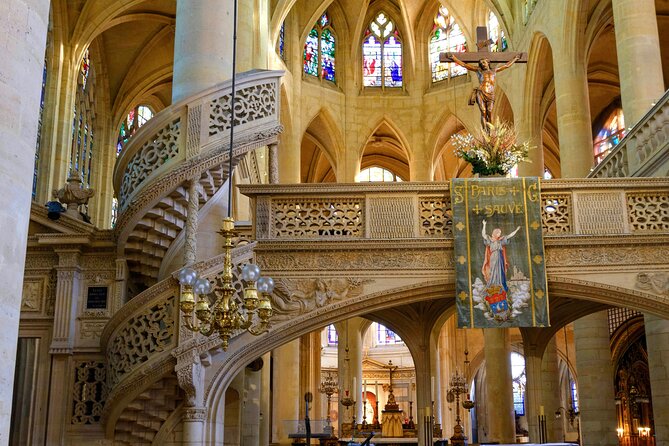
The walk continues to Saint-Etienne-du-Mont, a majestic 15th-century church. Inside is the tomb and knuckle relic of Saint Genevieve, the patron saint of Paris.
The guide links Saint Genevieve to the fall of the Roman Empire and the takeover of Paris during that unsettled period. This adds a personal figure to a broad historical subject. Instead of hearing only about armies and political change, you hear about someone remembered for helping shape the city’s fate.
The church is another place where ten minutes gives you an introduction, not a full visit. You can see the setting and hear the main story, then decide if you want to return for a slower look at the interior and relics.
The final literary stop is Ernest Hemingway’s first home office in Paris. Hemingway was deeply attached to the Latin Quarter, and the neighborhood helped inspire his later writing about Paris.
The stop works best if you care about literary history, but it is still useful for anyone interested in how writers experience a city. The guide connects a specific address with the wider world of cafés, books, and young artists that made the quarter famous.
Ending at Place de la Contrescarpe
The tour ends at Place de la Contrescarpe, a pleasant square in the center of the Latin Quarter. Restaurants, bars, and cafés surround the area, so you can continue the outing without crossing town.
This is a smart ending. You are not left beside an isolated monument with no idea where to go next. Instead, you finish in a place suited to a meal, coffee, or evening drink.
I would plan the end of the walk around that fact. If you choose the 11:00 a.m. start, the timing may work well before lunch, though the tour is listed as approximately two hours and actual timing can depend on the group. An afternoon start gives you an easy transition into dinner.
Price, group size, and the tip system
The displayed price is $3.62 per group of up to nine people, but this is not the full cost of the experience in the usual sense. It is a tip-based tour, and contributions are accepted only through credit cards, debit cards, or electronic payments. VAT is added to contributions.
That makes the low booking price useful as a small reservation charge, not a reason to assume the walk is effectively free. You should decide in advance what you feel the guide’s work is worth and be ready to pay electronically at the end.
The maximum group size is 50 people. That is a reasonable size for a city walk, but it is not an intimate private tour. A larger group may make narrow streets and church interiors feel less personal, and you may need to stay close to hear every explanation.
The tour is offered in English and includes a certified expert guide plus the historic walking experience. Most people can participate, and service animals are allowed. Confirmation arrives at booking, and free cancellation is available if you cancel at least 24 hours before the local start time.
Who should book this Latin Quarter walk?
I would choose this tour if you want a broad first look at the Latin Quarter without paying for several separate admissions. It suits first-time visitors, history fans, readers interested in Hemingway, and anyone who wants help connecting Roman, medieval, religious, academic, and modern Paris.
It is also a good choice if you prefer stories to silent sightseeing. Guides including Bruce and Sanna are praised for clear, engaging explanations, and Sanna is especially noted for her attention to Parisian history and French culture.
You may want something else if you prefer long museum visits, a very small group, or a slow photographic walk. The itinerary has many stops, and most are limited to five or ten minutes. You will see a lot, but you will not study every interior.
Wear comfortable shoes and keep your attention on the guide during the short street stops. Have a transit plan for reaching Place Saint-Michel, and keep electronic payment ready for your contribution. Since the tour is often booked well ahead, with an average lead time of 27 days, reserve early if your Paris dates are fixed.
Should you book it?
Book this walk if you want a lively orientation to one of Paris’s most layered districts, especially at the very low initial price. The route is unusually varied: Roman baths, a Gothic church, an old university, a famous bookshop, Notre-Dame, the Pantheon, Dali, and Hemingway all appear within one outing.
I would treat it as a well-structured introduction, not a replacement for entering the Pantheon, Musée de Cluny, or the churches at leisure. For a first day in the Latin Quarter, it offers strong value and a practical ending at Place de la Contrescarpe. Just remember that the real payment is your electronic tip, and the group may include as many as 50 people.
FAQ
How much does the Latin Quarter tour cost?
The listed price is $3.62 per group of up to nine people. It is a tip-based experience, and VAT is added to contributions.
How long does the tour last?
The walking tour lasts approximately two hours.
Where does the tour begin?
It begins at Fontaine Saint-Michel, Place Saint-Michel, 75005 Paris, France.
Where does the tour end?
It ends at Place de la Contrescarpe, 75005 Paris. The square has restaurants, bars, and cafés.
What language is the tour offered in?
The tour is offered in English.
Are admissions to the sights included?
The experience includes a guided historic walking tour, but admission tickets to attractions are not included.
What is the cancellation policy?
You can cancel at least 24 hours before the local start time for a full refund. Cancellations or changes made less than 24 hours before the start are not accepted for a refund.
Just listed in Paris
- Chartres Cathedral 5 Hours Tour from Paris with Private Transport★ 4.5 · 49 reviews
- Paris: Giverny & Versailles Small Group or Private Tour★ 4.5 · 49 reviews
- Paris: Louvre photoshoot or Seine bridges Eiffel Tower walk★ 5.0 · 49 reviews
- Private tour of the Champagne area, meet local producers and taste their Champagne, start from your hotel in Paris.★ 5.0 · 50 reviews
- Paris: Choux Pastry and Chocolate Éclair Making Class★ 4.9 · 50 reviews
- Paris Eternelle Notre-Dame Virtual Reality Tour★ 4.5 · 50 reviews
- Normandy D-Day Landing Beaches Private Day Trip from Paris★ 5.0 · 50 reviews
- Disneyland® Paris 1 Day with Round-Trip Train Tickets from Paris★ 4.0 · 50 reviews
Paris Tours, compared.



Versailles Palace and Gardens Full Access Ticket
Read our review →

Eiffel Tower Entry Ticket with Optional Summit Access
Read our review →

Louvre Guided Tour with Reserved Access & Boat Cruise
Read our review →