
Reviewed · PARIS TOURS
Le Marais District & Jewish Quarter Guided Walking Tour 12ppl Max
The best part of this walk is the way it links several different Parises in one compact route. You move from a 17th-century Jesuit church and aristocratic mansions to the Jewish Quarter’s bakeries and shops, then finish beside the bold pipes of the Centre Pompidou.
I like the 12-person limit, which gives you a much better chance to hear the guide and ask questions. I also like the mix of royal architecture, Jewish history, art, shopping streets, and local tips. Guides such as Hugo, Eden, Adrien, Tamari, and Manu have earned especially warm praise for their clear storytelling and personal style.
The main consideration is that this is a walking tour, not an indoor museum visit. You will not enter synagogues, and admission to the Musée Carnavalet or Centre Pompidou is not included. Some sights may also be viewed only from outside because of security rules.
Key points about this Marais walking tour
- Small groups of no more than 12: A useful middle ground between a private tour and a large crowd.
- A strong two-part theme: The walk covers both aristocratic Marais architecture and the active Jewish Quarter.
- Excellent guide feedback: Hugo, Eden, Adrien, Tamari, Manu, and others are praised for warmth, humor, detailed history, and practical advice.
- A compact route through major sights: You see Place des Vosges, Hôtel de Sully, Rue des Rosiers, Musée Carnavalet, Centre Pompidou, and Hôtel de Ville.
- A rain-or-shine outing: Bring comfortable shoes, water, and weather protection.
- A good first look at the district: The tour ends in a useful area for lunch, shopping, museums, or further wandering.
Why the Marais works so well as a walking tour
The Marais is one of Paris’s most rewarding districts for walking because its story changes every few minutes. A grand mansion may give way to a narrow lane. A quiet courtyard may sit just behind a busy shopping street. A church built for royal-era Paris may be only a short walk from contemporary art and Jewish bakeries.
This tour gives you that contrast without asking you to cross the city between sights. In about two and a half hours, you get a clear introduction to the district’s architecture and its people, along with enough free time afterward to return to the places that catch your eye.
I would use this tour early in a Paris stay. Once you understand the Marais’s layout, you can come back on your own for the Carnavalet museum, lunch on Rue des Rosiers, shopping on Rue des Francs Bourgeois, or a longer walk toward the Seine.
The pace should suit anyone with moderate fitness who can walk and remain standing for most of the outing. It is not recommended if you have a walking disability or use a wheelchair. Large bags and suitcases are not allowed, so plan to arrive with only what you need.
More Walking Tours in Paris
- Paris Top Sights Half Day Walking Tour with a Fun Guide
★ 5.0 · 2,893 reviews - Montmartre Hidden Gems and Scenic Highlights Walking Tour
★ 5.0 · 2,684 reviews - Montmartre Hill French Gourmet Food and Wine Tasting Walking Tour
★ 5.0 · 2,588 reviews
Saint-Paul-Saint-Louis and the royal Marais
The meeting point is at Saint-Paul in the 4th arrondissement. The tour begins at the Church of Saint-Paul-Saint-Louis, a 17th-century church built by the Jesuits and influenced by Rome’s Gesù church.
This is a smart starting point because it introduces the Marais as a district shaped by royal power, religious orders, and grand building projects. The church’s design also gives you an early lesson in how Paris absorbed Italian Baroque ideas while developing its own architectural style.
The scheduled stop is brief, about 10 minutes. That means you should not expect a long architectural lecture or a full religious-art visit. Instead, the church serves as an opening scene, with the guide pointing out the details that are easy to miss when you pass by alone.
Security restrictions can affect entry into buildings, so treat any interior visit as subject to conditions on the day. The tour’s main value here is the explanation, not an extended church visit.
Hôtel de Sully and Place des Vosges
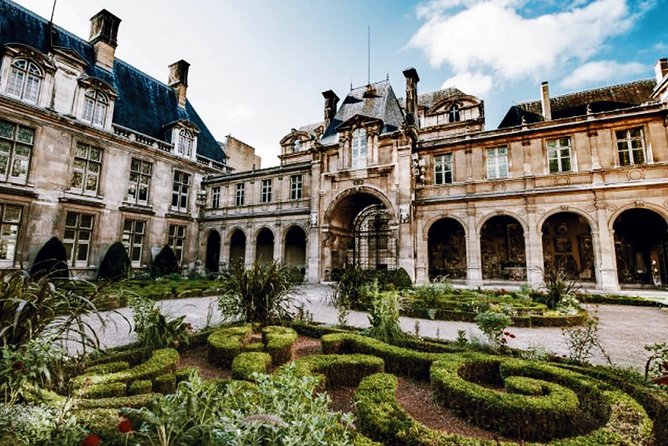
From the church, you walk to the courtyard and garden of the Hôtel de Sully. Built between 1624 and 1630, this mansion combines Renaissance planning with Baroque touches. It reflects the period when the Marais became a fashionable address for the nobility.
The courtyard is more important than a quick exterior photograph might suggest. Your guide can help you read the building as part of a wider pattern: wealthy families built private mansions, called hôtels particuliers, throughout this section of Paris. Many are easy to overlook because they sit behind gates and plain street fronts.
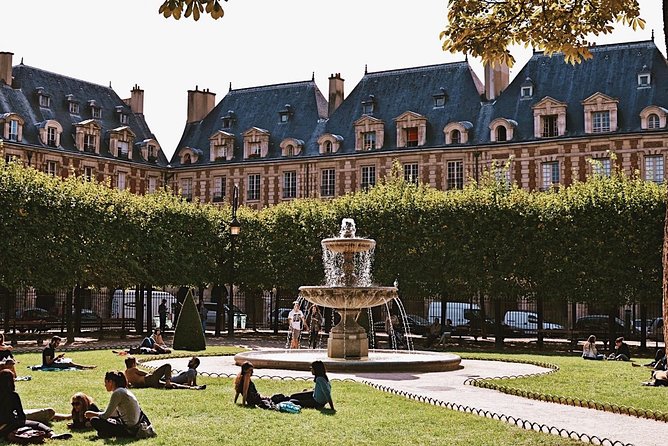
The route then reaches Place des Vosges, the oldest planned square in Paris. Its regular red-brick façades, arcades, and balanced layout make it one of the city’s most pleasing public spaces.
Allow yourself a moment here. A guided walk can explain the square’s place in the city, but the real pleasure is simply seeing how the buildings frame the open space. It is also one of the tour’s best photo stops, though the short scheduled visit means you may want to return later if you want a slower look.
Place des Vosges is a good example of why this tour works: you get an important sight, a bit of urban history, and a clear sense of the Marais before moving into its Jewish Quarter.
Rue des Francs Bourgeois and the mansion-lined streets
The walk continues along Rue des Francs Bourgeois, one of the Marais’s main shopping streets. Today, it is lined with fashion shops and boutiques. Its past is less polished, and the guide uses the street to explain how the district changed over time.
The Marais was once outside the central core of Paris. Later, it became a favored area for aristocratic residences. In the 19th and 20th centuries, parts of it fell into poor condition before later restoration and renewal changed its image again.
That shift is one of the most useful themes of the outing. You are not just looking at attractive façades. You are seeing how a neighborhood can move from royal address to neglected quarter to fashionable destination.
As you walk, look for the mansions tucked among shops and cafés. Some now house museums or public institutions. The guide can point out architectural details that you might otherwise pass without noticing, including entrances, courtyards, and decorative façades.
The tradeoff is that Rue des Francs Bourgeois can feel busy and commercial. If you want a quiet, slow architectural walk, this section may feel rushed. If you like seeing how historic streets function in modern Paris, it adds useful context.
Same city, a completely different afternoon:
- Paris: Louvre Museum Timed-Entrance Ticket
★ 4.6 · 71,977 reviews - Disneyland® Paris 1-Day Ticket
★ 4.6 · 49,412 reviews - Paris: Versailles Palace and Gardens Full Access Ticket
★ 4.6 · 41,579 reviews - Paris: Evening River Cruise with Music
★ 4.4 · 22,721 reviews
Musée Carnavalet and Paris told through one neighborhood
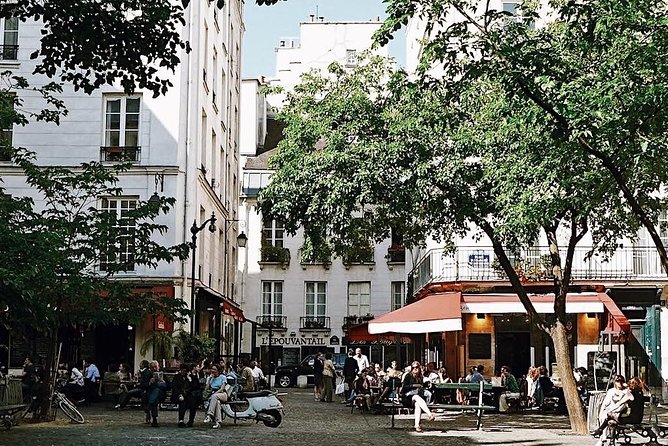
The route passes the Hôtel Carnavalet, a rare Renaissance building in Paris, and the Musée Carnavalet, which focuses on the history of the city.
The museum is not included in the tour price, and the scheduled stop is only around 10 minutes. You will therefore see the building and receive an introduction rather than take a proper museum visit.
I consider this a strength rather than a problem, as long as you understand the format. The guide can explain why the museum matters and help you decide if it deserves a separate visit. If you enjoy city history, set aside another part of your schedule for the museum instead of trying to squeeze it into this walk.
The Carnavalet stop also reinforces the tour’s broader approach. The Marais is used as a window into Paris itself, from royal development and religious architecture to neighborhood life, persecution, war, preservation, and modern culture.
Rue des Rosiers and the Jewish Quarter
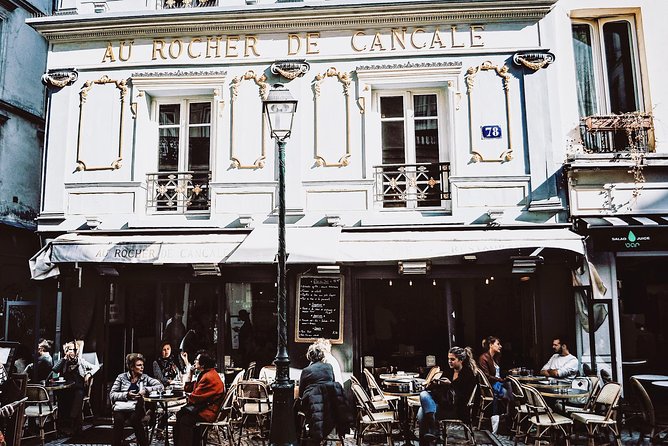
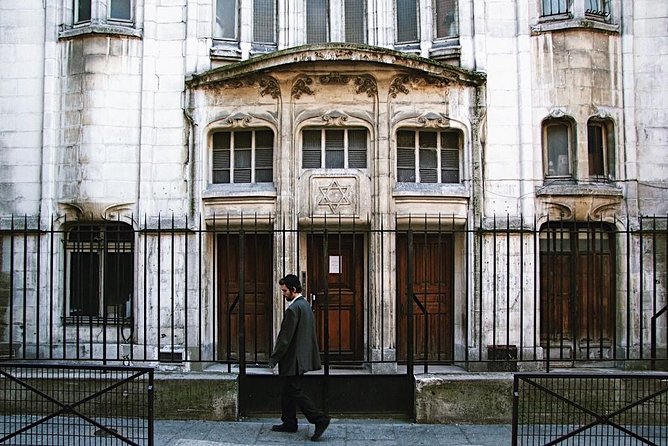
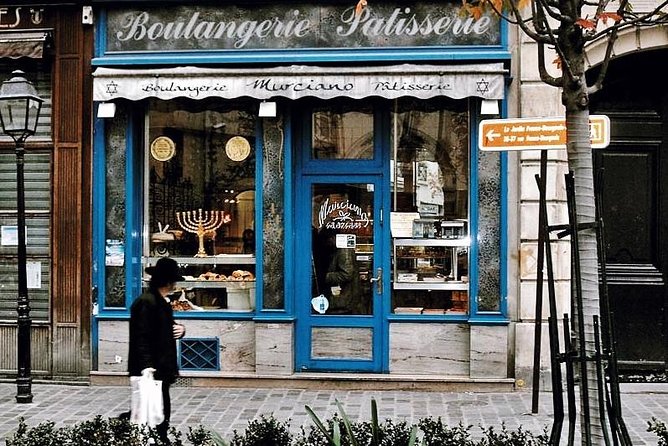
The Jewish Quarter is the emotional center of the walk. Rue des Rosiers runs through the Pletzl, the Yiddish name for this part of the Marais. It is known for bakeries, food shops, and boutiques, but the guide also explains the long and difficult story of Jewish life in Paris and across Europe.
This portion is not limited to the Holocaust. The historical discussion reaches further back, covering the hardships Jewish communities faced over many centuries. That wider frame matters because it prevents the quarter from being treated as a single-period memorial site.
You will see the street as a living part of Paris, not a preserved exhibit. Shops and food businesses continue to operate here, and the neighborhood remains an active center of community life.
The tour does not include entry into synagogues. Access is restricted to worshippers because of security measures, so you should book this walk for its street-level history and interpretation, not for synagogue interiors.
Rue des Rosiers is also a useful place to gather ideas for a later meal or snack. The tour is not a food tour, and tastings are not listed as included, but the guide may help you understand which parts of the street are worth revisiting.
Jardin des Rosiers and a quieter wartime story
One of the more affecting stops is the Jardin des Rosiers, a small garden tucked behind shops and surrounding historic buildings. It honors Joseph Migneret, a school principal who hid dozens of students in his home during the Second World War and was later arrested and killed.
This quiet place adds a human scale to the Jewish Quarter section. After walking along a commercial street, you step into a modest garden connected to a very personal act of courage.
The stop is short, about 10 minutes, but it gives the guide room to discuss the war, Jewish persecution, and the risks taken by people who tried to protect others. I appreciate that the route includes a story like this rather than relying only on famous buildings.
The garden may be easy to miss if you explore the Marais alone. That is one practical reason to take a guided walk here. The district rewards wandering, but some of its most meaningful spaces are not obvious from the main street.
Centre Pompidou and the modern edge of the route
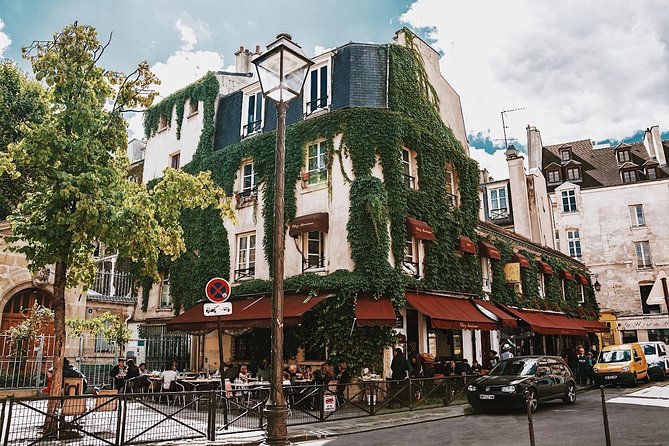
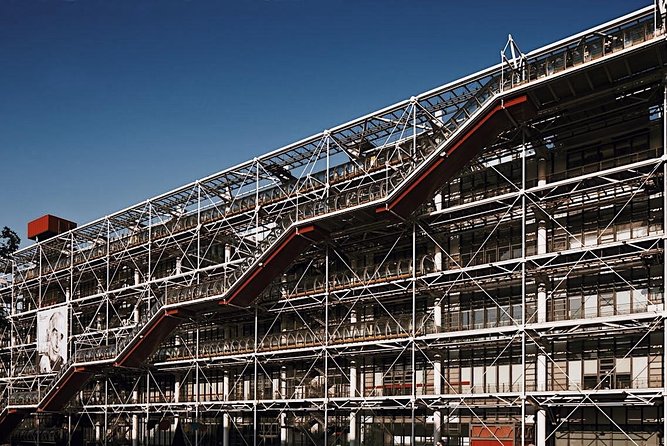
Near the end, the tour turns toward the Centre Pompidou. Its high-tech exterior, with visible pipes and structural elements, is a sharp contrast to the Marais’s mansions and old churches.
The building was conceived as a multicultural center bringing art and literature together. You will see the exterior and hear about its place in modern French cultural policy, but admission is not included.
This is another stop where expectations matter. If you want to visit the museum’s modern art collection, plan a separate ticket and several hours. The walking tour gives you orientation and architectural context, not a gallery visit.
I like placing the Pompidou near the end because it shows that the Marais is not frozen in the past. The district includes old religious buildings, aristocratic residences, contemporary shops, and one of Paris’s most recognizable modern structures.
Hôtel de Ville and Saint-Gervais-Saint-Protais
The walk finishes at Hôtel de Ville, Paris’s city hall and the headquarters of the municipality since 1357. The building helps close the tour with a look at civic Paris after the earlier focus on churches, mansions, and neighborhood life.
Nearby, you will see the Église Saint-Gervais-Saint-Protais. It was the first example of French Baroque style in Paris and served as a parish church until 1975. Today, it is connected with the Monastic Fraternities of Jerusalem.
These final stops make the route feel complete. You finish near major public transport connections and in a useful part of central Paris, rather than being left in an isolated corner of the district.
The official end is in Le Marais, Paris. From there, you can continue toward the Seine, return to Rue des Rosiers, visit a museum, or explore more shops. The tour does not provide hotel pickup or drop-off, so use the Paris transit network, a taxi, or Uber to reach the start if needed.
What the guides add to the experience
The guide is the main variable on any walking tour, and this experience has received especially strong praise for the people leading it.
Hugo is repeatedly singled out for his command of Paris and Jewish Quarter history, friendly manner, and practical restaurant suggestions. Eden is described as warm, funny, and open to questions. Adrien is praised for energy, storytelling, and the ability to make the neighborhood feel alive.
Other guides named in the feedback include Tamari, Manu, Agustina, Angelina, Georgia, Sergio, Emma, and Alasdair. Their backgrounds and styles may differ, but the common thread is a focus on explanation rather than simply pointing at buildings.
You should not book expecting a guaranteed specific guide unless the booking terms allow you to request one. Still, the range of positive comments suggests that guide quality is a major strength of this experience.
The small group helps here. With no more than 12 people, you can usually hear the guide more easily than on a large coach-style walking tour. You also have a better chance to ask about museums, food, shopping, or places to return later.
Is $59.69 a fair price?
At $59.69 per person, this is not the cheapest way to walk through the Marais. You can explore the streets for free with a map and a guidebook.
The value comes from the route design and the interpretation. In 2.5 hours, you cover several major sights and get a connected explanation of the district’s royal, religious, Jewish, wartime, artistic, and civic stories. A private tour would normally cost more, while a large group tour may offer less room for questions.
The price does not cover museum admission, food, transportation to the meeting point, hotel pickup, or gratuities. Those exclusions are normal for a guided walking tour, but you should include them in your budget.
I think the price is fair if you want a strong introduction and would otherwise miss the courtyards, garden, and historical links between the sights. It is less appealing if you prefer to move at your own pace or plan to spend much of the day inside museums.
Practical advice before you book
The tour runs in all weather, so dress for the forecast. Comfortable shoes are essential, and you should bring water, an umbrella in wet weather, and a hat in summer.
Give the operator your mobile phone number with the country code when booking. The tour requires at least two people to operate. If that minimum is not met, you will be offered another date or a full refund.
National celebrations can change the route. The alternative route will still cover the main highlights, but refunds or discounts are not provided for such changes.
You can cancel for a full refund up to 24 hours before the start time. Cancellations or changes made inside that window are not refunded or accepted.
Who should book this walk?
I would recommend it to first-time Paris visitors, history fans, families with older children, and anyone who wants a clear introduction to the Marais before exploring alone.
It is also a good choice if you have visited the district before but mainly saw the shopping streets. A guide can lead you into courtyards, explain overlooked façades, and take you to the Jardin des Rosiers, places you might skip on a self-guided stroll.
The tour suits people who enjoy context and conversation more than long indoor visits. It is less suitable for anyone needing accessible routes, anyone carrying luggage, or anyone hoping to enter synagogues or spend substantial time inside museums.
Should you book the Marais and Jewish Quarter tour?
Book it if you want one well-planned walk that connects Place des Vosges, aristocratic mansions, Jewish community life, wartime memory, modern art, and Paris city government.
The strongest reason to choose it is the guide-led storytelling, especially if you are lucky enough to have someone with the energy and detail associated with Hugo, Eden, or Adrien. The main limits are the short visits, outside-only viewing at some sights, and the lack of included museum entry.
For most people, I would take this tour early in a Paris visit, then return to the Musée Carnavalet or Rue des Rosiers afterward. It gives you the district’s shape and meaning without trying to turn every stop into a full museum tour.
FAQ
How long is the Le Marais and Jewish Quarter tour?
The walking tour lasts approximately 2 hours and 30 minutes.
What is the maximum group size?
The group is limited to 12 people.
Is the tour offered in English?
Yes. It is led by an English-speaking professional guide.
Where does the tour start?
The meeting point is at Saint-Paul, 75004 Paris, France.
Where does the tour end?
The tour ends in Le Marais, Paris, near Hôtel de Ville and the surrounding sights.
Are museum or synagogue admissions included?
No. Admission to the Musée Carnavalet and Centre Pompidou is not included, and the tour does not include entry into synagogues.
Can I cancel for a full refund?
Yes. You can cancel at least 24 hours before the start time for a full refund. Cancellations made less than 24 hours in advance are not refunded.
Just listed in Paris
- Chartres Cathedral 5 Hours Tour from Paris with Private Transport★ 4.5 · 49 reviews
- Paris: Giverny & Versailles Small Group or Private Tour★ 4.5 · 49 reviews
- Paris: Louvre photoshoot or Seine bridges Eiffel Tower walk★ 5.0 · 49 reviews
- Paris: Choux Pastry and Chocolate Éclair Making Class★ 4.9 · 50 reviews
- Private tour of the Champagne area, meet local producers and taste their Champagne, start from your hotel in Paris.★ 5.0 · 50 reviews
- Paris Eternelle Notre-Dame Virtual Reality Tour★ 4.5 · 50 reviews
- Normandy D-Day Landing Beaches Private Day Trip from Paris★ 5.0 · 50 reviews
- Disneyland® Paris 1 Day with Round-Trip Train Tickets from Paris★ 4.0 · 50 reviews
Paris Tours, compared.



Versailles Palace and Gardens Full Access Ticket
Read our review →

Eiffel Tower Entry Ticket with Optional Summit Access
Read our review →

Louvre Guided Tour with Reserved Access & Boat Cruise
Read our review →
Moulin Rouge Cabaret Show Ticket with Champagne
Read our review →Browse the lists this tour appears in