
Reviewed · GIVERNY TOURS
Giverny Monet House and Gardens Skip the line Walking tour
Giverny is where Claude Monet turned daily gardening into an artistic tool. This tour links the sleepy village, his pink house, and the famous water garden, so you can see the Japanese bridge, lily ponds, and flowers that shaped some of his best-known paintings. I like the skip-the-line entrance and the small-group limit of 15, which can make a crowded visit easier to manage.
I also like the village walk and the personal stories about Monet, his family, and fellow artists such as John Singer Sargent, Paul Cézanne, and Mary Cassatt. The main caution is that the experience can lose its ease in peak season. Crowds, translation problems, or a guide who does not use an audio system can make it harder to hear.
Key points to know before booking
- Monet’s real home and garden: See the pink house, cheerful kitchen, Japanese print collection, flower beds, lily ponds, and Japanese bridge.
- A village walk comes first: Your guide introduces Giverny before you enter the Fondation Claude Monet.
- Skip-the-line access matters: The special entrance can save time when the site is busy.
- Small group, with a limit of 15: A smaller party should make it easier to stay with your guide, though actual group size and organization can vary.
- Two hours with admission included: The tour covers the guided visit, but food, drinks, transport, and tips are extra.
- Season changes the experience: April through October brings flowers, but October can be quieter in the beds and wetter underfoot.
Why Giverny feels like stepping into a Monet painting
The appeal here is immediate. You are not simply looking at reproductions of Monet’s paintings in a gallery. You are seeing the setting he shaped, tended, and painted for decades.
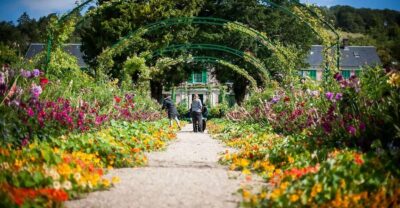
The property is maintained by the Fondation Claude Monet. Its flower gardens run in front of the house, while the Japanese-style water garden sits across the road. Roses, hollyhocks, poppies, and honeysuckle are especially important from spring into early autumn. The exact display changes with the month, so the garden you see in May will not look like the garden you see in October.
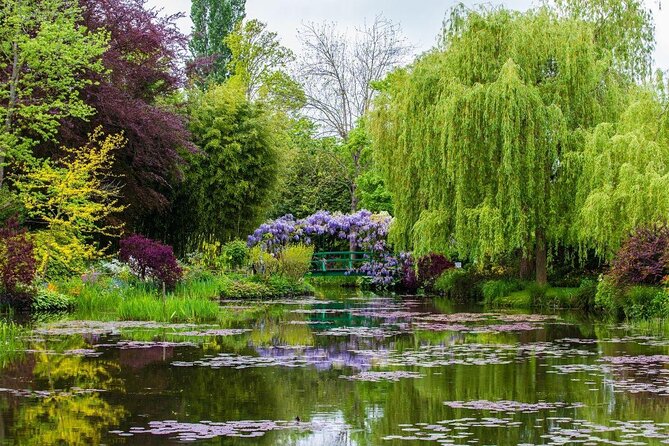
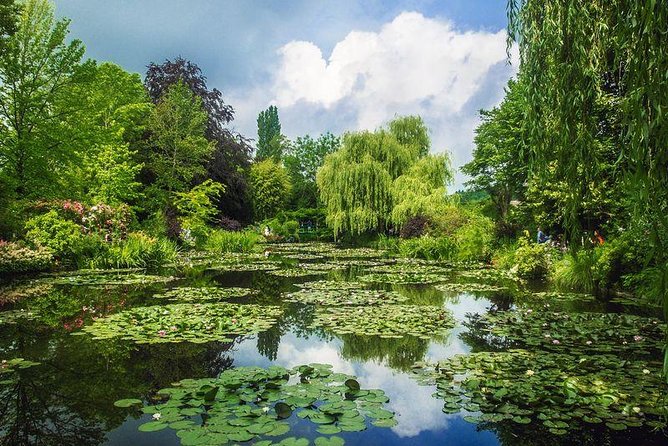
The water garden is the emotional center of the visit. The lily ponds, weeping willows, and Japanese bridge are instantly familiar from Monet’s work, but the real place is less tidy than a single canvas. You will see paths, reflections, changing light, and many other visitors sharing the view. That contrast is part of the experience: the paintings feel calm and private, while the popular site can be quite busy.
I would not come only for a quiet garden stroll. Come to connect the physical place with Monet’s working life. The guide helps explain how the gardens became more than decoration, and that context gives the flowers and ponds a sharper meaning.
More walking tours in France:
- Paris Top Sights Half Day Walking Tour with a Fun Guide
★ 5.0 · 2,893 reviews - Montmartre Hidden Gems and Scenic Highlights Walking Tour
★ 5.0 · 2,684 reviews - Montmartre Hill French Gourmet Food and Wine Tasting Walking Tour
★ 5.0 · 2,588 reviews
Starting with Giverny village at La Capucine
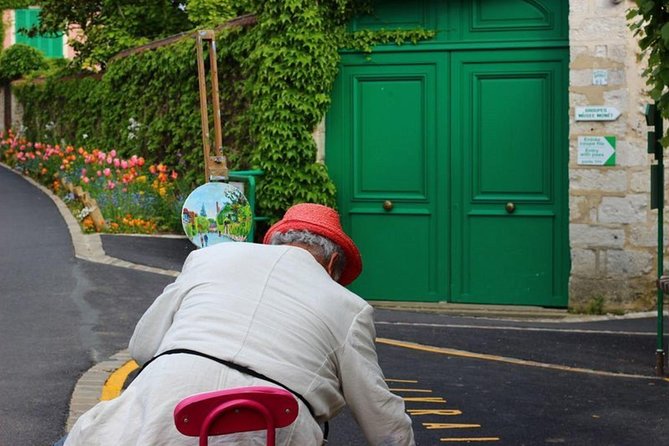
The meeting point is La Capucine Giverny, at 80 Rue Claude Monet, 27620 Giverny. You should arrive 15 minutes early. The tour starts promptly, and late arrival may mean missing the group.
The first part is a walking tour through Giverny. This is useful because the village gives you a sense of the quiet setting Monet chose in 1883, rather than dropping you straight at the ticket entrance. Your guide sets the scene for Monet’s years in Giverny from 1883 to 1926 and explains how the village became associated with artists.
By 1887, artists including Sargent, Cézanne, and Cassatt had connections to the area. That detail helps you picture Giverny as more than a famous address. It became a place where artists gathered around Monet’s ideas and reputation.
The village walk is not a separate long excursion. It is an introduction before the main visit, so the pace should suit most people who can walk for two hours. After the guided portion, the activity ends back at the meeting point. One useful detail from the experience is that you may have free time afterward to explore the village on your own, though the supplied schedule does not set out a separate length of time for it.
You can also visit Giverny’s church cemetery, where Monet is buried. The itinerary identifies this as an optional village point of interest rather than a separate included stop with a timed visit, so ask your guide if you want to pay your respects there.
Entering the Fondation Claude Monet through the special entrance
After the village walk, the guide takes the group to Monet’s house and gardens. Entrance fees are included, and tickets are provided by the UTG guide rather than directly by the Fondation Claude Monet.
The special entrance is the practical reason to choose this tour instead of arriving alone. Monet’s property draws large crowds, particularly during school holidays, Easter, and the main flowering months. Skipping the regular line does not make the grounds empty, but it can spare you a slow wait before the visit even begins.
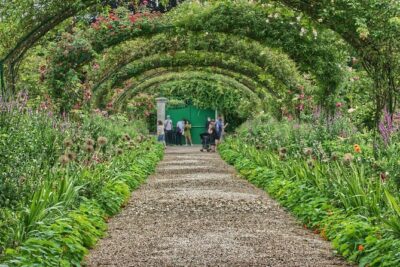
That benefit has limits. Skip-the-line entry does not mean private access, and you will still share the house and gardens with other groups. One account describes the site as extremely crowded, with a long group line and audio cutting out for people at the back. That problem involved a larger group than the advertised cap, so the 15-person limit is worth noting, but you should still keep close to your guide.
The tour is offered by an independent agency, not by the Monet house itself. That distinction matters if you expect staff from the foundation to lead the visit. Your guide handles the tour service and entrance tickets, while the foundation maintains the property.
Inside Monet’s pink house
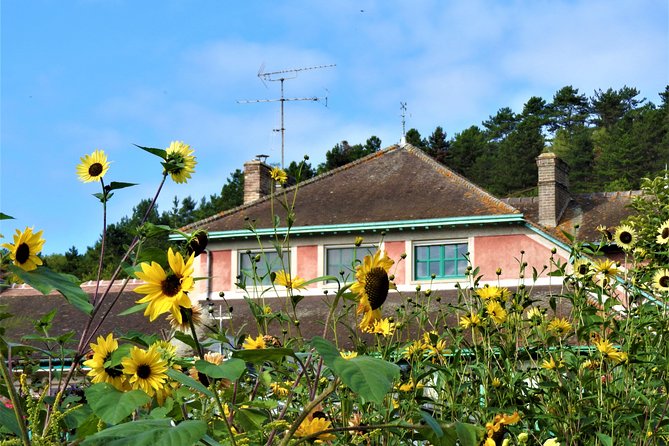
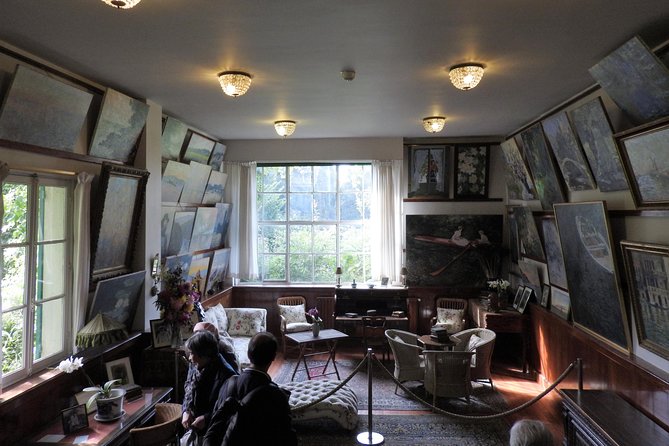
The house is not filled with original Monet paintings. The original works are held in museums, so you will see quality replicas and the rooms themselves rather than a gallery of authentic canvases.
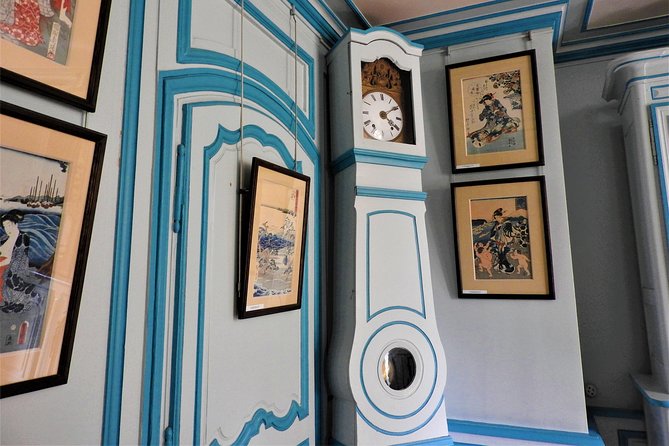
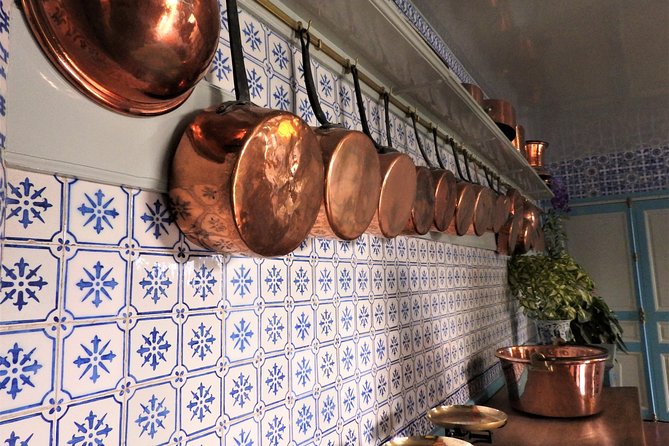
That is not a reason to skip the house. The interiors show the setting of Monet’s domestic life, including the lively kitchen and his collection of 18th and 19th century Japanese prints. The prints are especially important because Japanese art influenced the visual language Monet used in his garden and paintings.
The cheerful kitchen offers a welcome change from the solemn rooms found in many historic houses. It feels practical and lived-in, while the Japanese prints help connect the home to the bridge, ponds, and plant arrangements outside.
Your guide’s explanation is valuable here. A strong guide can turn furnishings and prints into part of Monet’s story rather than a quick walk through decorated rooms. Guides named Bertrand, Bernard, Marine, and Mwamiri received especially warm praise for clear stories, energy, patience, and group management. Guide quality is not guaranteed, but those examples show what makes the human part of this tour worthwhile.
There is a practical drawback inside the house: tight rooms and crowds can make it difficult to pause for long. If you want a slow look at every print or piece of furniture, a guided visit may feel brisk. The advantage is that you receive a clear framework for what you are seeing and do not have to work out Monet’s biography from labels alone.
More skip-the-line tickets in France:
- Versailles: Skip-the-Line Tour of Palace with Gardens Access
★ 4.7 · 9,778 reviews - Versailles: Skip-the-Line Guided Palace Tour and Full Access
★ 4.6 · 5,214 reviews - Louvre Museum: Skip-the-Line Small Group Guided Tour
★ 4.6 · 3,960 reviews - From Paris: Versailles Skip-the-Line Tour & Gardens Access
★ 4.7 · 3,011 reviews
Walking through the flower gardens
Outside, the flower gardens are arranged with color and movement rather than the clipped formality of a palace garden. From April to October, you might find roses, hollyhocks, poppies, honeysuckle, and many other seasonal plantings.
The garden is at its most visually generous during the flowering months, especially in spring. A May visit can bring strong color and full beds, making it easy to understand why the garden became central to Monet’s work. You will have plenty of photo opportunities, but remember that the paths can be crowded and that the best views may require patience.
I like this section because it makes Monet’s paintings feel more physical. You see how rows of flowers guide the eye, how color shifts across a bed, and how a familiar motif can look different under changing weather. The garden is not a museum display of paintings. It is a living place that keeps changing.
October requires more flexible expectations. Flowers may be past their best, and rain is possible, but the garden can still be attractive. Some late-season visits have found plenty in bloom and produced excellent photographs. Others found parts of the flower display looking tired. If flowers are your main reason for coming, aim for the stronger spring and summer period. If Monet’s home and the water garden matter just as much, autumn can still work.
The Japanese bridge and lily ponds
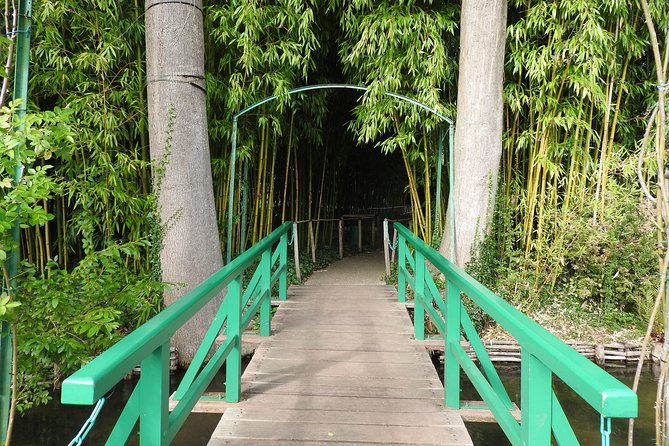
The water garden is reached as part of the visit to the property. Its Japanese bridge, lily ponds, and weeping willows are among the most recognizable sights in Giverny.
This is the place where you will most clearly recognize scenes from Monet’s paintings. The bridge is smaller and more ordinary than its artistic reputation suggests, which is part of the charm. Monet did not need a grand monument. He used a modest garden structure, water, plants, and light to create repeated subjects.
The ponds are also a good reminder that the paintings were not made from one fixed viewpoint. Walk slowly when the group allows it. Look at the reflections, then look back toward the bridge and willows. You may find that the view changes as people move, clouds pass, or the light shifts.
The main problem is crowding. The water garden can be peaceful in appearance but busy in practice. At peak times, several groups may gather around the same bridge and pond. A guide who keeps the party together and points out the right details helps, but you will not have the kind of private silence Monet had while working.
How much the guide adds
The tour rises or falls on the guide. The best guides do more than recite dates. They explain Monet’s long connection to Giverny, the role of gardening in his art, and the people who helped turn the village into an artists’ colony.
Specific guides praised for this style include Bertrand, Bernard, Marine, and Mwamiri. Their strengths included storytelling, kindness, humor, clear explanations, and the ability to keep a group moving through crowded paths. One guide used photographs to support the explanation, which can help when the garden is packed and a distant view is hard to see.
Still, the service can be uneven. A poorly organized group may include people who need translation, slowing the pace. One reported visit had French-speaking participants in an English tour, so the guide translated and the group expanded beyond the advertised small-group feel. Another guide spoke only at intervals and did not use a headset, making it hard for people at the back to follow.
This is why you should stay near the guide, even with a small group. If the guide provides an audio system, keep the receiver close and check that it works before the group moves on. If you cannot hear, say so early rather than waiting until you are separated by a garden path.
Price, timing, and what the $63.86 covers
At $63.86 per person, this is not the cheapest way to see Giverny. The price includes a local guide and admission to Monet’s house and gardens. It does not include pickup, drop-off, food, drinks, or tips.
The value depends on your priorities. If you want the simplest possible visit and are comfortable arranging your own transport, buying admission and walking through the property alone may cost less. You also set your own pace that way.
I see the tour’s value in three areas: the special entrance, the village introduction, and the guide’s interpretation. Those benefits matter most when the lines are long or when Monet’s life and artistic circle are as important to you as the flower beds.
The experience lasts about two hours. That is enough for a guided introduction to the village, house, and gardens, but it is not a full-day outing. You should not expect a long lunch stop or extended independent time inside the property.
The tour is often booked around 39 days ahead, which suggests that planning early is sensible during the main season. Confirmation arrives at booking. Free cancellation is available up to 24 hours before the scheduled start, with no refund for cancellations or changes inside that window.
Getting to the meeting point
Pickup and drop-off are not included, so you must reach Giverny independently. The meeting point is near public transportation, but the tour does not provide a full transport plan as part of the booking.
If you come from Paris by train, the route described by one participant was train travel to Vernon followed by a shuttle to Giverny. That can be straightforward, but you need to research the connection and leave enough time to reach La Capucine before the tour starts.
Driving brings a different issue. Parking can be difficult, especially when the property is crowded. One attempted visit spent a long time searching for a parking place and eventually gave up. If you drive, do not plan to arrive only a few minutes before departure. The 15-minute early arrival rule is a minimum, not a comfortable parking strategy.
Who should book this Giverny tour?
I would choose this experience if you are visiting Giverny for the first time and want someone to connect the village, home, and gardens. It suits art lovers, garden fans, families, and anyone who prefers a clear route through a crowded site.
It is also a good fit if waiting in a long entrance line would frustrate you. The small-group format should be easier to follow than a large coach excursion, and the included admission keeps the basic cost clear.
I would think twice if you want complete freedom to linger. The two-hour schedule and guided pace may move you along before you have finished every room or found a quiet view of the pond. Independent visitors who arrive early and plan carefully may prefer to explore alone.
The tour is generally suitable for most people, and service animals are allowed. The practical challenge is walking through a village, house, and gardens while keeping to the scheduled pace. Ask the operator directly about any specific mobility concern before booking.
My verdict on the Monet House and Gardens tour
You should book this tour if you want context, skip-the-line access, and a guided path through Giverny without arranging a full private visit. The gardens and water bridge are the stars, but the house, Japanese prints, village walk, and Monet’s connections with other artists make the outing more complete.
Go in spring or early summer if flowers are your main goal. October can still be beautiful, but the beds may be past their peak and rain can change the feel of the visit. Arrive early, stay close to the guide, and remember that the original Monet paintings are elsewhere.
At $63.86, the tour earns its price when the guide is strong and the entrance line is long. It is less compelling for an independent visitor who can handle transport, timing, and the property without help. For most first-time visitors who want the story as well as the scenery, it is a practical way to experience the place where Monet made Giverny famous.
FAQ
Where does the Giverny Monet House and Gardens tour begin?
It begins at La Capucine Giverny, 80 Rue Claude Monet, 27620 Giverny, France.
Where does the tour end?
The activity ends back at the meeting point.
How long does the tour last?
The tour lasts about two hours.
Is admission to Monet’s house and gardens included?
Yes. Entrance fees to Monet’s house and gardens are included, and tickets are provided by the UTG guide.
Does the tour include transportation from Paris?
No. Pickup and drop-off are not included. You must make your own way to Giverny and the meeting point.
How large is the group?
The activity has a maximum of 15 travelers.
What happens if I need to cancel?
You receive a full refund if you cancel at least 24 hours before the scheduled start time. Cancellations or changes made within 24 hours are not refunded or accepted.
Just listed in France
- Half-Day Walking Food Tour in Nice with Lunch★ 5.0 · 49 reviews
- Chartres Cathedral 5 Hours Tour from Paris with Private Transport★ 4.5 · 49 reviews
- Paris: Giverny & Versailles Small Group or Private Tour★ 4.5 · 49 reviews
- Marseille: Frioul Archipelago Catamaran Cruise with Lunch★ 4.4 · 49 reviews
- Paris: Louvre photoshoot or Seine bridges Eiffel Tower walk★ 5.0 · 49 reviews
- Bonifacio: sunset catamaran trip and aperitif★ 4.6 · 50 reviews
- Paris: Choux Pastry and Chocolate Éclair Making Class★ 4.9 · 50 reviews
- Private tour of the Champagne area, meet local producers and taste their Champagne, start from your hotel in Paris.★ 5.0 · 50 reviews
Giverny Tours, compared.
Monet’s Gardens & House-Private Giverny Tour From Paris
Read our review →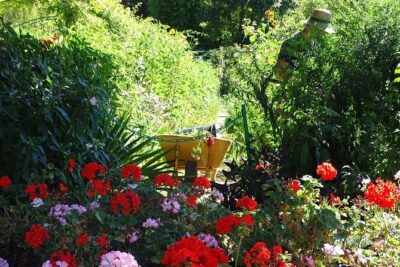
Guided tour Monet’s house and gardens/small group
Read our review →Browse the lists this tour appears in