
Reviewed · PARIS TOURS
Historic Paris Walking Tour in English
Paris reveals itself best on foot, and this tour links its biggest sights with the stories that explain why they matter. In 150 minutes, you move from medieval churches and royal palaces to revolutionary boulevards, bridges, gardens, and the Louvre. Guides such as Thomas, Harry, Yazid, Francesca, and Victoria have been praised for lively storytelling and an easy way with groups.
I especially like the strong first-day usefulness of this walk. It gives you a working map of central Paris while explaining the city’s long arc from Roman settlement to royal capital, revolutionary hotbed, and modern art center. I also like the mix of major sights and human stories, including Quasimodo, Napoleon, Hitler, the Mona Lisa theft, love, revenge, and Parisian rebellion.
The main consideration is simple: this is a 150-minute outdoor walk, not a museum tour. You see famous buildings and landmarks from the route, but the price does not include hotel pickup, and the guide’s focus is the city’s story rather than extended indoor visits.
Key points at a glance
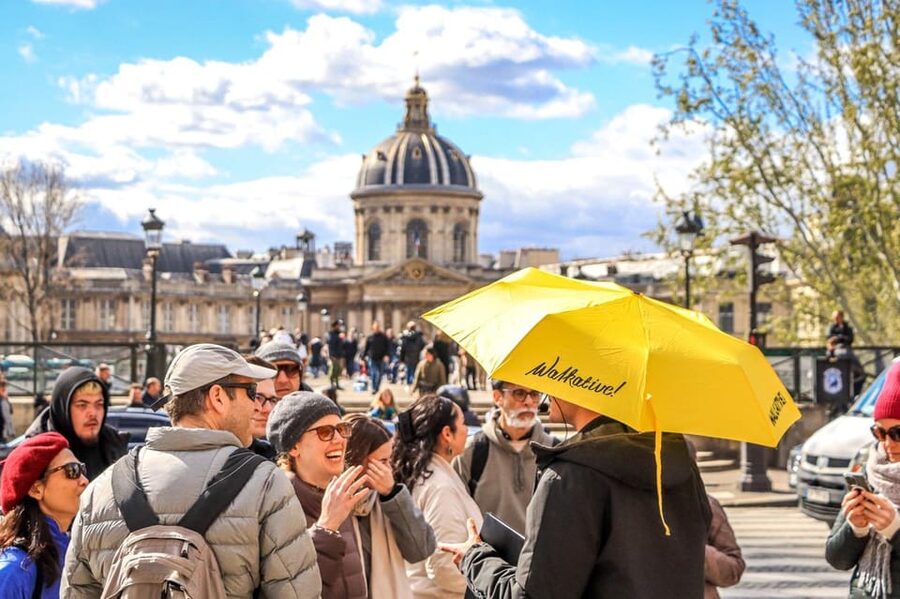
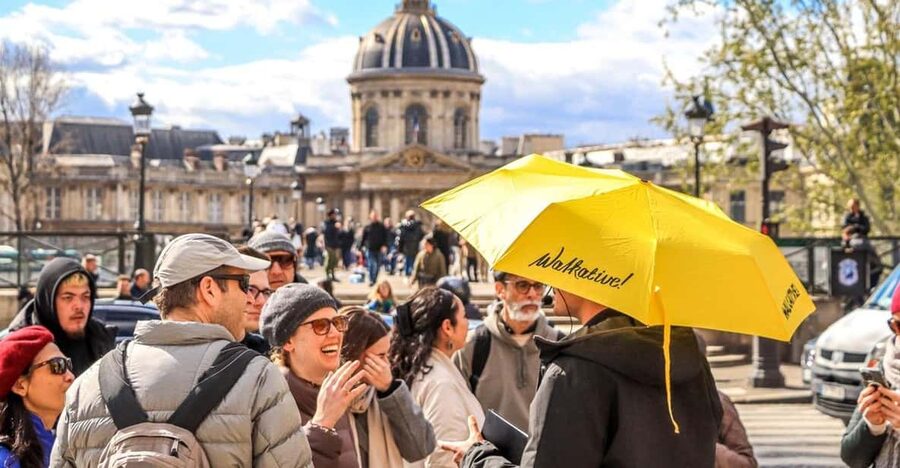
- Hôtel de Ville starting point: Meet outside the metro at exit 5, under a yellow umbrella, 10 minutes before the start.
- A full central-Paris route: Expect Notre-Dame, Sainte-Chapelle, Pont des Arts, the Louvre, Tuileries Gardens, elegant boulevards, bridges, and views connected with the Eiffel Tower.
- History with personality: The narrative covers Roman Paris, medieval power, the Revolution, Napoleon, Haussmann’s boulevards, art theft, and Parisian revolt.
- English-speaking local guide: Guides including Thomas, Harry, Yazid, Francesca, and Victoria have been praised for humor, clear explanations, and strong group engagement.
- Good value for a first visit: At $31, the tour combines orientation, exercise, history, and practical city context in one outing.
- Moderate physical effort: One-and-a-half hours of walking is not described as strenuous, but comfortable shoes remain a smart choice.
Starting at Hôtel de Ville, where Paris gets political
The meeting point outside Hôtel de Ville metro station gives the tour a fitting start. You are in the heart of central Paris, near the Seine and within reach of the city’s medieval, royal, and revolutionary storylines.
Look for the yellow umbrella at metro exit 5, and arrive 10 minutes early. That small buffer matters in Paris, where a wrong metro exit can put you on the other side of a broad square or a busy street. The tour does not provide hotel pickup, so you need to make your own way to the start.
From here, the guide begins building the larger picture. Paris grew around the Seine, first through the Gallic tribe known as the Parisii, then under Roman rule. It later became a capital of the Franks and developed into France’s political, religious, economic, and cultural center.
That big timeline is useful because Paris can otherwise feel like a collection of impressive facades. This walk connects them. You learn why royal power gathered around the river, why churches mattered so much, and why the city’s residents repeatedly challenged the people who ruled them.
More Historical Tours in Paris
- Paris: Louvre Museum Entry with History of Mona Lisa
★ 3.9 · 2,823 reviews - Paris: Dark History and Ghostly Guided Walking Tour
★ 4.7 · 1,000 reviews - Le Marais/Paris – The Historic, Trendy, Jewish, LGBT district
★ 5.0 · 341 reviews
Notre-Dame and the medieval heart of Paris
Notre-Dame Cathedral is one of the tour’s essential stops. The cathedral represents medieval Paris at its most ambitious, when religious buildings were also statements of civic wealth, technical skill, and political importance.
The tour places Notre-Dame within the story of the city rather than treating it as a pretty photograph. You hear about Paris when it was already one of Europe’s largest cities, with a population said to have reached 200,000 during the medieval period. That scale helps explain the cathedral’s role as more than a place of worship.
This is also where the story of Quasimodo connects with the city. The fictional bell ringer belongs to Victor Hugo’s world, but the tale opens a useful door into how literature shaped modern ideas about Notre-Dame and Paris itself.
The experience is strongest for you if you enjoy context. You will not simply hear dates and names. The guide ties architecture to religion, power, fiction, and daily life. An illustrated explanation can help, too. One guide was specifically praised for bringing visual material to support the story.
You should keep your expectations clear. This is not presented as a dedicated cathedral interior visit. The focus is on the building, its setting, and its place in Parisian history as you walk through the surrounding center.
Sainte-Chapelle and royal power in stone
Sainte-Chapelle adds another layer to the medieval story. Along with Notre-Dame, it shows how Paris served as both a religious center and the seat of royal authority.
The chapel is especially useful in a walking tour because it helps you see how close the city’s major institutions are to one another. The route does not leave you thinking of Notre-Dame, Sainte-Chapelle, and the Louvre as isolated stops. They become parts of a compact royal and religious district shaped by centuries of power.
The guide’s narrative is the key value here. A building can impress you in a minute, but a good explanation gives you a reason to remember it. The English narration is designed as a thoroughly constructed story, so art, architecture, military events, religion, and politics are treated as parts of one connected account.
If you prefer fast sightseeing with little commentary, the amount of history may feel heavy. If you want a first visit to make sense, this is one of the tour’s strongest features.
Crossing the Seine at Pont des Arts
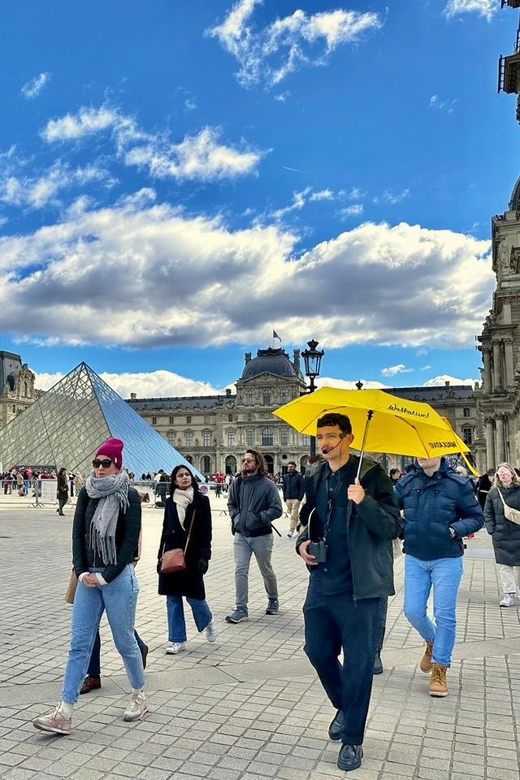
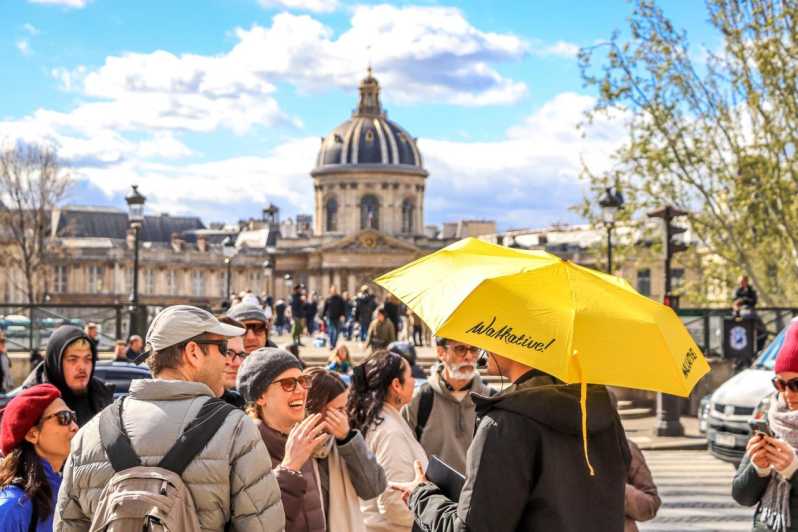
Pont des Arts offers a change of pace. After medieval churches and royal authority, you get an open view across the Seine and a chance to see how bridges shape the experience of Paris.
The bridge connects the Left Bank and the area around the Louvre. It is also a good place for the guide to shift from formal history to the emotional side of the city: art, love, desire, and the image of Paris as a place where people come to feel something special.
I like this part because it keeps the walk from becoming a string of indoor-sounding lectures. You are outside, moving through the city, with the river and architecture around you. The bridge also helps you understand the relationship between Paris’s neighborhoods and its major institutions.
The route includes beautiful and elegant bridges as part of the wider story, not merely as photo stops. That distinction matters. You gain a better sense of how the Seine organizes central Paris and why so many famous views are built around water, stone, and long sightlines.
More Walking Tours in Paris
- Paris Top Sights Half Day Walking Tour with a Fun Guide
★ 5.0 · 2,893 reviews - Montmartre Hidden Gems and Scenic Highlights Walking Tour
★ 5.0 · 2,684 reviews - Montmartre Hill French Gourmet Food and Wine Tasting Walking Tour
★ 5.0 · 2,588 reviews - Paris Île de la Cité and Notre-Dame Walking Tour With Crypt
★ 5.0 · 2,272 reviews
The Louvre, from royal palace to art capital
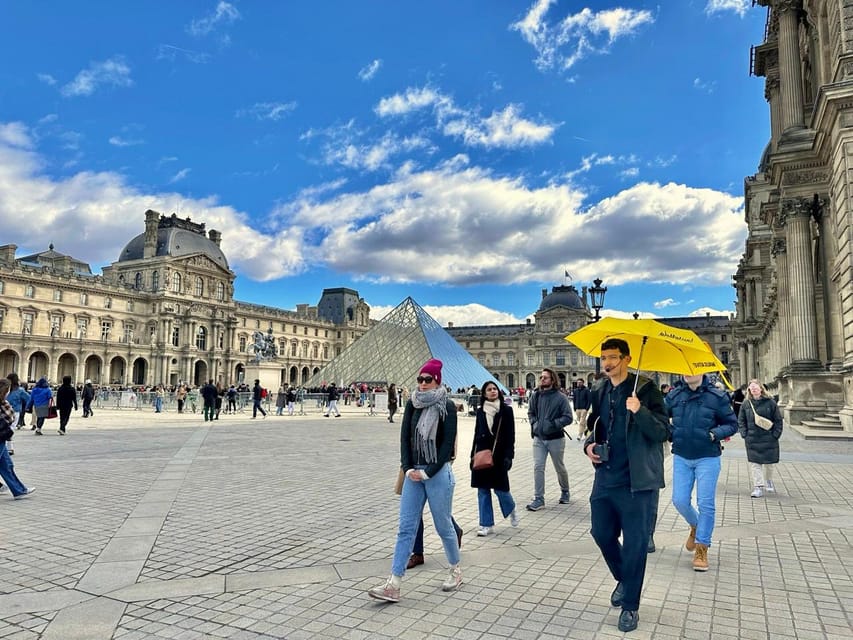
The Louvre is one of the main reasons to choose this tour. The guide explains the building’s earlier life as a palace, then shows how it became one of the world’s great museums.
That shift from royal residence to public art institution mirrors Paris’s political changes. The Louvre is not just a place where you see famous paintings. It reflects monarchy, empire, national identity, collecting, and the idea that art belongs at the center of public life.
The Mona Lisa story gives the stop a lighter hook. The tour covers one of the most daring art thefts in history, turning a familiar painting into a tale of risk, fame, and the strange power of celebrity.
You should not book this walk expecting admission and a full Louvre visit. The stated inclusions are an expert local guide and the prepared narrative. The value comes from understanding the palace and museum before, after, or instead of spending hours inside.
That can be particularly helpful on a short Paris visit. The Louvre is huge, and it is easy to lose half a day without a plan. This tour gives you historical bearings before you decide how much museum time you want later.
Tuileries Gardens and the making of modern Paris
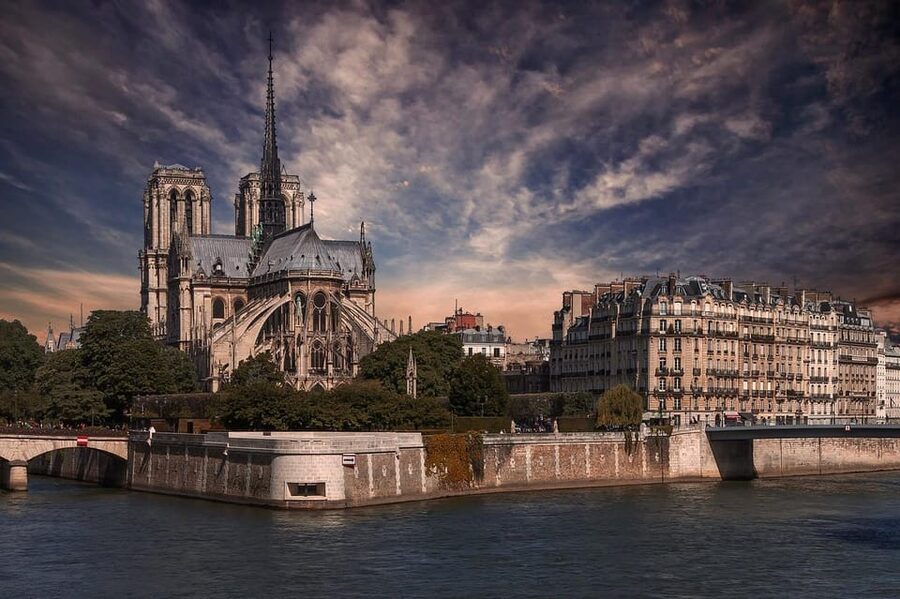
The Tuileries Gardens provide a calmer stretch of the route and a useful place to think about how Paris was designed for both beauty and control.
The gardens belong to the city’s royal and monumental tradition, but the tour also carries the story forward into the 19th century. Paris was repeatedly altered through broad boulevards, parks, aqueducts, and sewers. The changes improved movement and public health, but they also made it harder for residents to construct street barricades during uprisings.
That is a revealing detail. Paris’s grand boulevards are beautiful, but they were also political tools. The city’s look was shaped by rulers who wanted a cleaner, more orderly capital and fewer easy places for rebellion.
The guide also connects modernization with the Eiffel Tower and the 1889 Universal Exposition. Parisians initially disliked the tower and protested it for years before accepting it as a city symbol. You may not spend a long time at the tower itself, but its place in the story helps explain why Paris can be both proud of tradition and suspicious of new ideas.
The Tuileries are also a natural reminder to slow down. After the tour, you can use the garden as a pleasant place for a picnic with bread, cheese, and wine, all central to the Paris experience described throughout the walk.
Revolution, Napoleon, and Parisian resistance
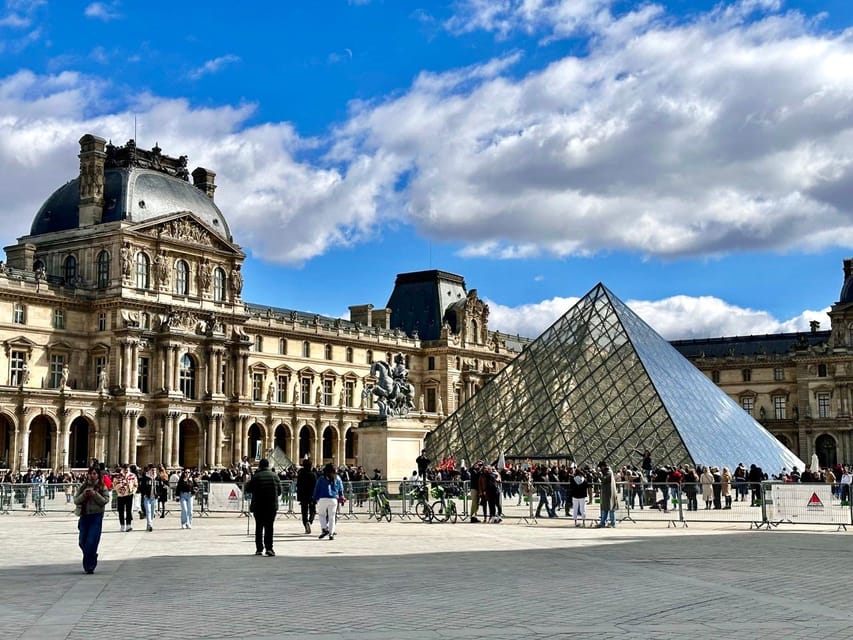
The most memorable thread running through the tour is Paris as a city that keeps challenging authority. Poverty and inequality helped fuel the French Revolution, which brought down the royal regime and led to the execution of the monarchs by guillotine.
The tour then follows the opening created by revolution to Napoleon’s seizure of power. This gives you a more useful view than the simple image of Napoleon as a military hero. He belongs to a period when Paris was remaking France and projecting power far beyond it.
Stories about Hitler add a darker 20th-century note. The inclusion of Hitler alongside Napoleon, Quasimodo, and the Revolution shows the broad range of the narrative. You get political history, war, literature, art, and city life rather than one narrow subject.
This variety suits mixed groups. A person who loves kings, queens, wars, and revolution can find plenty to enjoy, while someone with only a passing interest in history still gets humor, human drama, and memorable characters. Thomas was praised for making military and art history accessible, and other guides have been described as dramatic, warm, and entertaining.
The guide makes or breaks the experience
A walking tour lives or dies by its guide. Here, the strongest pattern is the quality of the storytelling.
Thomas has been praised for warmth, humor, and detailed historical perspective. Harry is described as an excellent storyteller who makes the past feel close. Yazid was noted for his enthusiasm for art, buildings, and culture. Francesca was praised for helping the group learn while also pointing out less obvious details.
Other named guides include Tom, Toto, Dawie, Gurvan, also known as Jay, and Tank. Their styles differ, but the recurring strengths are clear: clear English, energy, humor, passion, and an ability to keep different ages and interests involved.
That matters when a tour lasts two and a half hours. A dry lecture can make even the Louvre seem tiring. A guide who changes pace, uses illustrations, answers questions, and invites conversation can make the same distance pass quickly.
The group may not always be tiny. One account estimated fewer than 20 people and found that the walk never felt like a large, slow-moving crowd. Still, group size can vary, so you should be comfortable listening outdoors and staying near the guide.
Is $31 a good price for 150 minutes?
At $31 per person, I see this as fair value if you want orientation and interpretation in one package. You are paying for a local English-speaking guide, a planned historical narrative, and a route through several of Paris’s most important central sights.
The cost is especially sensible on a first visit. A good opening walk can help you decide where to return, which museums deserve your time, and how the Seine connects the major districts. It also gives you useful context before you tackle the Louvre or Notre-Dame on your own.
The payment structure needs attention. The activity notes that this is a general pay-as-you-wish tour format, but the listed amount covers the reservation fee and the guide’s payment in this case. You should not assume that another large payment is required at the end, though you may choose to reward your guide if you feel the experience deserves it.
For a solo visitor, the format can be reassuring. One solo participant found the experience welcoming and inclusive, with a relaxed social atmosphere. You do not need to arrange a private guide or build your own route from scratch.
Who should book this Paris walking tour?
I would choose this tour for a first visit, especially if you want to get your bearings quickly. It also suits solo visitors, couples, families with older children, and mixed groups where not everyone has the same interest in formal history.
You will get the most from it if you enjoy stories with a little drama. Quasimodo, Napoleon, the Revolution, Hitler, the Mona Lisa theft, love, desire, revenge, and Parisian revolt give the walk a broad emotional range.
It is less suitable if your main goal is extended time inside the Louvre, Sainte-Chapelle, or Notre-Dame. It is also not the best pick for someone who dislikes walking or wants a private, highly customized itinerary.
Wear comfortable shoes and prepare for outdoor conditions. A crisp February morning was considered ideal for seeing the sights, but the tour runs in the open air, so plan for the season.
Should you book it?
Book it if you want a lively introduction to central Paris with strong historical storytelling and a route that joins Notre-Dame, Sainte-Chapelle, Pont des Arts, the Louvre, and the Tuileries Gardens.
I would schedule it near the start of your stay, not the last day. You will finish with a better sense of where Paris’s major sights fit together, and you can use that knowledge to plan the rest of your visit. At $31, the combination of exercise, orientation, and memorable stories makes this a sound choice for most first-time visitors.
FAQ
How long is the Historic Paris Walking Tour?
The tour lasts 150 minutes, or two and a half hours.
What language is the tour conducted in?
The live tour guide conducts the experience in English.
Where does the tour meet?
Meet outside Hôtel de Ville metro station at exit 5. Look for a yellow umbrella.
How early should I arrive?
You should arrive at the meeting point 10 minutes before the activity begins.
What sights are included in the route?
The route includes Notre-Dame Cathedral, Sainte-Chapelle, Pont des Arts, the Louvre, the Tuileries Gardens, elegant boulevards, bridges, and views connected with the Eiffel Tower.
Does the tour include hotel pickup and drop-off?
No. Hotel pickup and drop-off are not included.
Is admission to the Louvre included?
The provided activity details list a local guide and a prepared narrative as inclusions, but they do not list Louvre admission. You should not book this as a full indoor Louvre visit.
How much does the tour cost?
The listed price is $31 per person.
Can I cancel the booking?
Yes. You can cancel up to 24 hours in advance for a full refund. You can also reserve now and pay later.
More Historic Sites in Paris
- Paris City of Fashion History Private Guided Walking Tour
★ 5.0 · 221 reviews - History of Paris City Center w/ Notre Dame Semi-Private 12ppl Max
★ 5.0 · 194 reviews - Paris: Le Marais & Montmartre Jewish History Walking Tour
★ 4.8 · 170 reviews - Paris Walking Tour , Historical Sites .
★ 5.0 · 150 reviews
Just listed in Paris
- Chartres Cathedral 5 Hours Tour from Paris with Private Transport★ 4.5 · 49 reviews
- Paris: Giverny & Versailles Small Group or Private Tour★ 4.5 · 49 reviews
- Paris: Louvre photoshoot or Seine bridges Eiffel Tower walk★ 5.0 · 49 reviews
- Paris: Choux Pastry and Chocolate Éclair Making Class★ 4.9 · 50 reviews
- Private tour of the Champagne area, meet local producers and taste their Champagne, start from your hotel in Paris.★ 5.0 · 50 reviews
- Paris Eternelle Notre-Dame Virtual Reality Tour★ 4.5 · 50 reviews
- Normandy D-Day Landing Beaches Private Day Trip from Paris★ 5.0 · 50 reviews
- Disneyland® Paris 1 Day with Round-Trip Train Tickets from Paris★ 4.0 · 50 reviews
Paris Tours, compared.



Versailles Palace and Gardens Full Access Ticket
Read our review →

Eiffel Tower Entry Ticket with Optional Summit Access
Read our review →

Louvre Guided Tour with Reserved Access & Boat Cruise
Read our review →
Moulin Rouge Cabaret Show Ticket with Champagne
Read our review →Browse the lists this tour appears in