
Reviewed · AIX EN PROVENCE TOURS
Time flies in this complete tour of Aix-en-Provence
Aix-en-Provence reveals itself best on foot, one fountain, shaded avenue, medieval lane, and market stall at a time. Benjamin Reilly’s tour connects the city’s Roman, religious, artistic, Jewish, and wartime past with practical food tips and personal family ties to Aix.
I like the small group of up to 12, which gives you room to ask questions, and I like the mix of major sights and less obvious places such as Passage Agard and Rue du Puits Juif. The calisson tasting, market stop, church entry, and souvenir photo add texture to what could otherwise be a standard city walk.
The main consideration is the price: at $127.03 per person, this is not a cheap orientation stroll. You also need decent walking fitness, and the full outing can cover close to 10,000 steps, so comfortable shoes matter.
Key points at a glance
- Benjamin Reilly’s personal connection: He ties Aix’s past to his own family story and presents the city with warmth and humor.
- Fifteen stops in 2 to 3 hours: You cover the center’s grand avenue, fountains, churches, markets, plazas, cathedral, and medieval quarter.
- A useful food introduction: You taste calisson and, depending on the time of day, sample market products or receive a gelato discount.
- A genuinely small group: With no more than 12 people, the walk feels more conversational than a large guided circuit.
- A strong first-day orientation: You finish near Saint-Sauveur Cathedral, with a better sense of where to eat and what to revisit.
- Free cancellation with weather protection: You can cancel up to 24 hours before the start for a full refund, and poor weather may bring a new date or refund.
Why Benjamin makes this more than a sightseeing loop
The route covers familiar Aix landmarks, but the guide is the real reason to consider booking it. Benjamin Reilly presents himself as a local with family connections reaching back through the city’s story. He also brings the energy of a teacher, using anecdotes, humor, questions, and a yellow binder to make dates and names easier to follow.
That approach matters in Aix. The city can look like a pleasant collection of fountains and handsome stone buildings if you only wander without context. With a guide, you begin to see how its religious institutions, courts, markets, artists, wealthy families, and wartime events shaped the streets around you.
Benjamin also appears comfortable with mixed ages. Families with teenagers and tweens have found the format engaging, and the tour has worked well in groups that wanted both facts and conversation. His fluency in three languages is another useful detail, though this experience is offered in English.
The personal touch does not mean the walk is only about family stories. You get geography, architecture, food, local customs, Paul Cezanne, Emile Zola, the Knights Templars, Provençal Jewish history, and the liberation of Aix during the Second World War.
A few other Aix en Provence half-days to compare
- Luberon Villages Half-Day Tour from Aix-en-Provence
★ 5.0 · 414 reviews - From Aix-en-Provence: Luberon Hilltop Villages Half-Day Tour
★ 4.8 · 369 reviews - Aix-en-Provence Food Tour – A Full French Meal by Do Eat Better
★ 5.0 · 264 reviews
Starting at the Tourist Information Center
You meet at the Tourist Information Center at 300 Av. Giuseppe Verdi. The opening 15 minutes are used for introductions, basic safety information, and a sense of how the walk will work.
This is a practical start. Public toilets are outside the building, and cafés nearby can help if you need coffee, water, or a quick snack before setting off. The tour does not supply bottled water, but you can refill your own bottle at local water sources, so bring one.
The meeting point is near public transport, and the walk ends at Saint-Sauveur Cathedral rather than returning to the starting point. That one-way design saves backtracking and puts you in a useful part of the old center for further exploring after the tour.
Rotonde Fountain and the shape of Aix
The first proper sight is Fontaine de La Rotonde, the large fountain at the end of Cours Mirabeau. Here, Benjamin gives you a geographic and historical orientation, helping you understand Aix’s position and the basic shape of its central districts.
This short stop is important because Aix can feel like two cities joined together. The broad, elegant Cours Mirabeau leads toward the older lanes, where the streets become narrower and the story becomes more medieval. A clear map early in the walk makes the later stops easier to place.
You then spend about 10 minutes along Cours Mirabeau. This is Aix’s grand public avenue, a place for walking, sitting, meeting friends, and admiring the city’s architecture. It is also where the tour begins to show how Aix balances ceremony with everyday life.
Cours Mirabeau and Hotel de Caumont
The next stop is Hotel de Caumont, an 18th-century mansion now used as an art center. The tour does not include admission, and the stop itself is brief, about five minutes, so you should not expect a full visit to the exhibitions or interior.
What you do get is an explanation of the building’s design and of the city’s layout. That is useful if you are deciding how to spend the rest of your day. If you have a strong interest in the art center, note it as a separate visit rather than treating this tour stop as an admission opportunity.
Same city, a completely different afternoon:
- Luberon Market & Villages Day Trip from Aix-en-Provence
★ 5.0 · 250 reviews - Provence Lavender Fields Tour from Aix-en-Provence
★ 5.0 · 241 reviews - Cotes de Provence Wine Tour from Aix-en-Provence
★ 5.0 · 239 reviews - From Aix-en-Provence: Valensole Lavender Full-Day Tour
★ 4.7 · 222 reviews
Cezanne, Zola, and Aix’s creative past
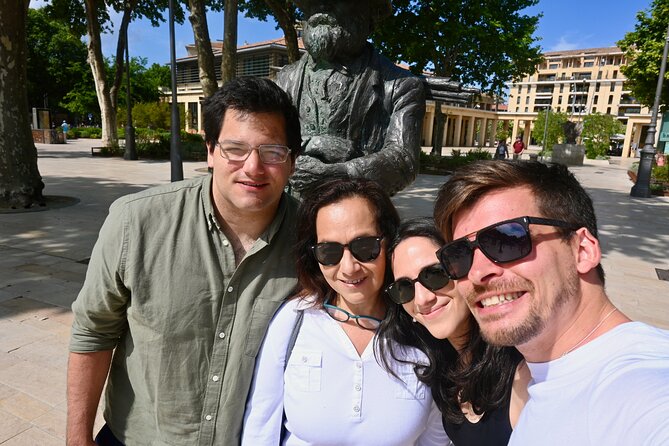
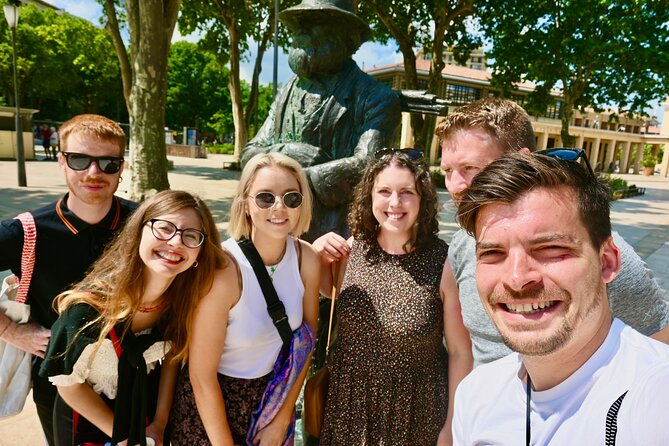
At Middle School Mignet, Benjamin introduces the stories of Paul Cezanne and Emile Zola, two major 19th-century figures linked to Aix. The stop lasts only about five minutes, but it gives you a human entry point into the city’s artistic life.
The value here is not a long artist biography. It is the sense that Aix was not just a pretty backdrop for painters and writers. It helped shape their early lives, friendships, ambitions, and view of the world.
The tour’s treatment of Cezanne also gives you a reason to look at the city differently after the walk. Instead of seeing only façades and fountains, you may start noticing the light, streets, and slopes that made Aix important to his work.
Italian Baroque style at Quatre-Dauphins
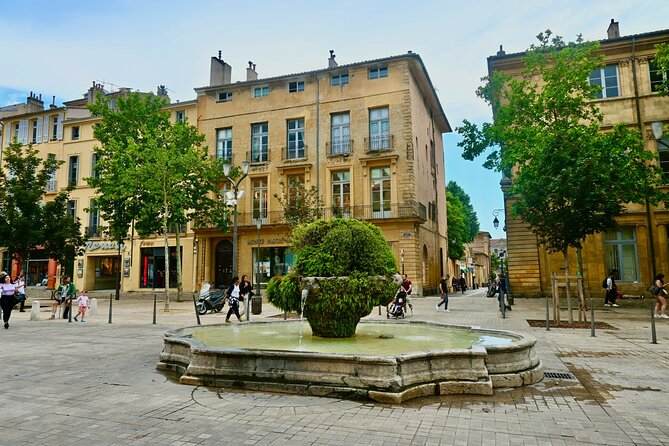
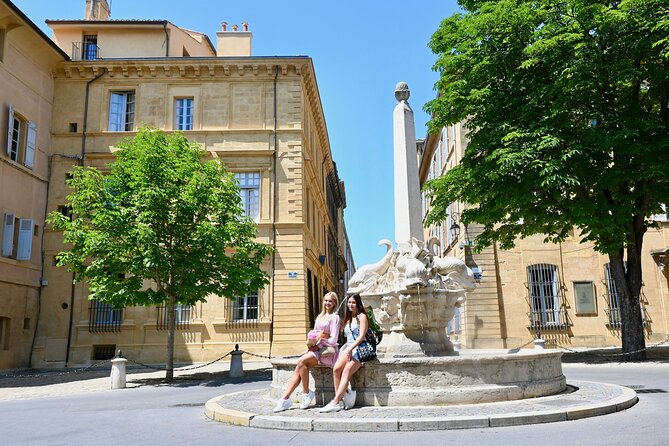
Fontaine des Quatre-Dauphins is one of the prettiest short stops on the route. This Baroque fountain has an Italian influence, and Benjamin pauses for about five minutes to explain it and take a souvenir photograph.
The photo is a small feature, but it helps mark the experience as something more personal than a lecture. Stickers and a Polaroid-style keepsake have also been part of the guide’s personal touches, giving you a physical reminder of the walk.
Do not expect a long photo session. The stop is quick, and the tour has many places to cover. Still, the fountain is an easy place to appreciate Aix’s fondness for public water features and decorative details.
Saint-Jean-de-Malte and the Knights Templars
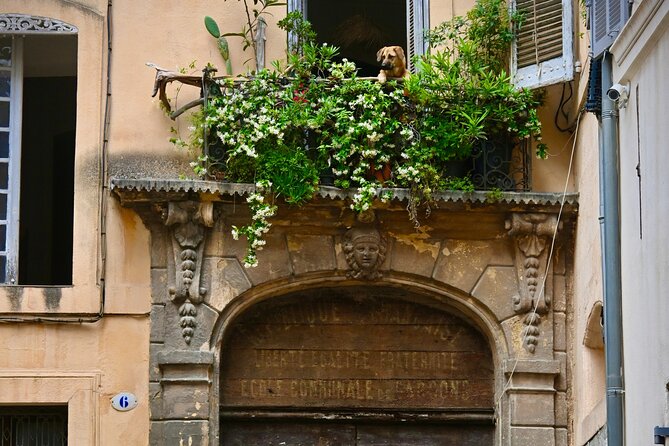
At Eglise Saint-Jean-de-Malte, you enter a church associated with the Knights Templars. The church also has the feel of a fortified religious building, making it a useful stop for understanding the power of military orders and the role of religion in Aix.
Entry to the church is included. The visit is scheduled for roughly 10 minutes, so you will get an introduction rather than a detailed examination of every artwork or architectural feature.
I like this part of the tour because it breaks up the street walking. You step indoors, change pace, and connect the city’s religious buildings to wider European institutions. Modest time inside also keeps the route moving.
Calisson on Rue d’Italie
Food is not an afterthought here. On Rue d’Italie, you taste a calisson, the almond and candied-fruit sweet closely associated with Provence.
This is one of the most useful inclusions because a local food sample gives you a quick sense of regional culture without asking you to commit to a full meal. Benjamin also offers practical recommendations for food and sightseeing, which can help you plan the hours after the walk.
The tasting lasts about 10 minutes. It is a sample, not a food tour, so book this experience for the city, stories, and orientation first. The sweet is an appealing bonus.
Passage Agard and the city behind the façades
Passage Agard is a hidden private passage that was once a convent. The stop lasts about five minutes, yet it may be one of the route’s most revealing moments.
Aix’s central streets can appear formal and public, with grand buildings facing broad avenues. A passage like this shows another side of the old city, where religious properties, private routes, and enclosed spaces once shaped movement through the center.
Access to passages can depend on local conditions, so the description presents it as part of the route but does not promise a long interior visit. Still, it is exactly the sort of detail that is hard to find by simply following a map.
Place des Prêcheurs and the medieval Jewish quarter
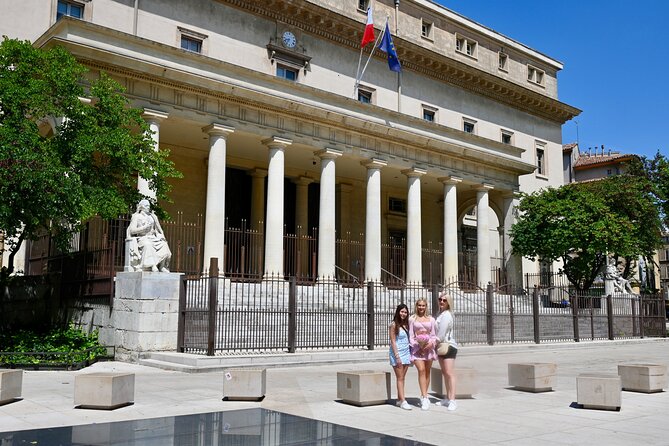
At Place des Prêcheurs, you look toward the courthouse, search for statues, and take in the open plaza. This is another short stop, but the square gives you a chance to see how civic power and public space meet in the old center.
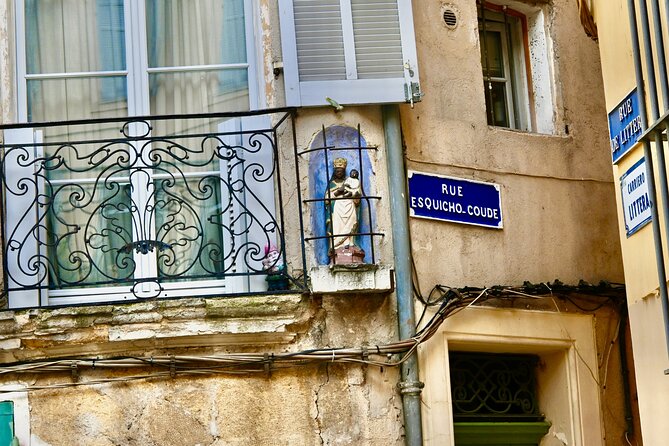
The route then moves to Rue du Puits Juif, in the medieval quarter associated with Provençal Jewish communities. Benjamin explains their influence on the region and the traces they left in Aix.
This part gives the tour needed range. It does not reduce Aix to fountains, artists, and pretty lanes. You also hear about communities whose work and presence helped shape Provence, along with the difficult changes that affected them.
The wording of the stop suggests a historical introduction rather than a museum visit. You will not be spending an hour on one subject, but you will gain a useful framework for noticing the old quarter.
Place Richelme and the daily market
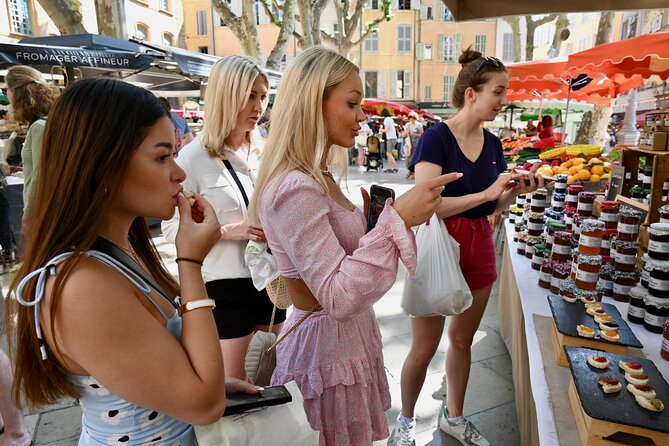
Place Richelme changes character depending on when you visit. In the morning, you can take in the farmers market, with its smells and local products. In the afternoon, the emphasis shifts to sitting, watching, and absorbing the rhythm of the square.
Morning and afternoon versions are therefore not identical. Morning participants receive tasters from the farmers market, while afternoon participants receive a discount at a local gelato shop. Check the tour time when booking if the food element matters to you.
This is also where the experience feels most connected to ordinary Aix life. The square is not only a historic stop to photograph. It is a place where people buy food, pause, and watch the city move around them.
Town Hall and wartime Aix
At the Town Hall, the route reaches the civic center of Aix. Benjamin explains the role of the mayor and the way the city is run, offering a short look at local government rather than another architectural photo stop.
You then visit Place des Martyrs de la Resistance. Here, the focus turns to survivors of the Second World War and the US army’s liberation of Aix from Nazi control.
The wartime stop adds weight near the end of the walk. It reminds you that the city’s story is not confined to centuries-old churches and grand families. Aix also carries memories of occupation, survival, and liberation in its public spaces.
Saint-Sauveur Cathedral, the final stop
The tour finishes at Cathédrale Saint-Sauveur, where Christian worship has shaped the center of Aix for around 1,500 years. Entry is included, and the visit introduces several features: the cathedral itself, a hidden statue of the Black Madonna, and the open-air concert setting used during the Opera Festival.
The cathedral stop is planned for about five minutes, which is enough for a focused introduction but not a full guided tour of every chapel, artwork, or architectural phase. If the building interests you, leave time to return on your own.
Ending here works well. You finish inside one of Aix’s key landmarks, near the old center, with the guide able to show you a map and help you find your next destination. That may mean a restaurant, another sight, or the route back to your accommodation.
Is $127.03 a fair price?
At $127.03 per person, this tour asks you to pay for more than a basic walk around the center. The price includes an English-speaking guide, church and cathedral entry, a calisson tasting, a souvenir photo, and a market or gelato-related food benefit depending on timing.
The strongest value is the guide’s interpretation. You are paying for a carefully connected story about Aix, not simply for directions between 15 landmarks. Benjamin’s teaching style, personal family links, humor, and willingness to answer questions are central to the experience.
Still, the price is high compared with a casual self-guided walk. If you already know Aix well, dislike group tours, or mainly want cathedral admission, you may not get enough extra value. For a first visit, especially when you want recommendations for the rest of your stay, the cost is easier to justify.
The group limit of 12 helps. It gives you a better chance to hear clearly, ask questions, and keep the pace flexible. The tour is recommended by all recorded participants and carries a five-star rating from 213 reviews, with one four-star review included in the supplied material. That is a strong record, but no walking tour can guarantee a perfect fit for every interest or pace.
Who will enjoy this Aix walking tour?
I would choose this for a first or second day in Aix. It gives you enough context to plan later visits, and one direct comment makes the practical point clearly: doing the tour earlier would have helped shape the rest of the stay.
It suits you if you enjoy:
- History told through places, people, and stories
- A guide who mixes facts with humor
- Food samples alongside architecture
- Family-friendly explanations for older children and teenagers
- A small group rather than a large crowd
- A one-way route through the historic center
You should think twice if you have limited walking ability, since the route requires moderate physical fitness and may reach around 10,000 steps. Rain and cold can also affect comfort. The tour requires good weather, and if conditions force cancellation, you are offered another date or a full refund.
Service animals are allowed. Confirmation arrives at booking, and free cancellation is available until 24 hours before the local start time. Cancellations or changes inside that window are not refunded or accepted.
Should you book it?
Book this tour if you want Aix to make sense quickly, not just look attractive. Benjamin Reilly’s route combines the city’s fountains and grand avenues with Cezanne, Zola, Jewish heritage, wartime memory, local sweets, the market, and Saint-Sauveur Cathedral.
I would especially recommend it for first-time visitors, families with older children, and anyone using Aix as a base in Provence. I would skip it if $127.03 feels too steep for a short city walk or if you prefer exploring alone at your own pace.
For most people who value a strong local guide, the small group and personal storytelling are the main reasons to book. Put on good shoes, bring a refillable bottle, and schedule it early in your stay so the advice can guide the rest of your time in Aix.
FAQ
How long does the Aix-en-Provence walking tour last?
The tour lasts approximately 2 to 3 hours.
Where does the tour begin?
It begins at the Tourist Information Center, 300 Av. Giuseppe Verdi, 13100 Aix-en-Provence, France.
Where does the tour end?
It ends at Paroisse Cathédrale Saint Sauveur Aix-en-Provence, 34 Pl. des Martyrs de la Resistance, 13100 Aix-en-Provence, France.
What language is the tour offered in?
The tour is offered in English.
How many people can join the tour?
The maximum group size is 12 travelers.
Is food included?
Yes. You receive a calisson tasting on Rue d’Italie. Morning tours include tasters at the farmers market, while afternoon tours include a discount at a local gelato shop.
Is cathedral entry included?
Yes. Entrance to Saint-Sauveur Cathedral is included.
Do I need good physical fitness?
Yes. A moderate level of physical fitness is recommended, and the walking may total close to 10,000 steps.
Can I cancel for a full refund?
Yes. You can cancel at least 24 hours before the experience start time for a full refund. Poor weather or failure to reach the minimum number of participants may also result in a new date, another experience, or a full refund.
Just listed in Aix en Provence
- Provencal Market Walking Tour with Tastings★ 4.6 · 50 reviews
- 2-Hour Foodie Tour with 10 Tastings in Aix-en-Provence★ 4.5 · 50 reviews
- Arles, Les Baux & Saint-Remy de Provence from Aix★ 4.5 · 55 reviews
- Picturesque Luberon – From AIX-EN-PROVENCE★ 5.0 · 55 reviews
- From Aix-en-Provence: Wine & Luberon Villages Full-day Tour★ 4.9 · 57 reviews
- Luberon villages Full-day tour from Aix-en-Provence★ 4.9 · 57 reviews
- Aix-en-Provence: Verdon & Moustiers-Sainte-Marie Full-day★ 4.6 · 57 reviews
- From Aix-en-Provence: 2-Hour Wine & Scenery Sidecar Tour★ 5.0 · 67 reviews
Aix en Provence Tours, compared.
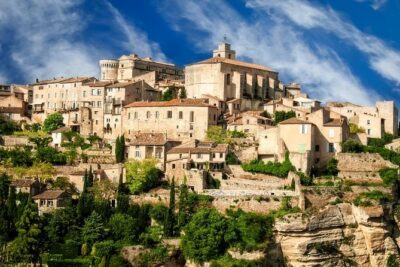
Luberon Villages Half-Day Tour from Aix-en-Provence
Read our review →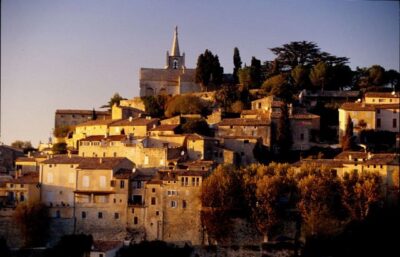
Aix-en-Provence Food Tour – A Full French Meal by Do Eat Better
Read our review →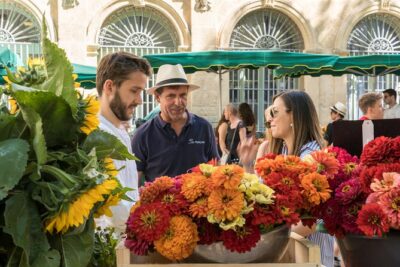
Luberon Market & Villages Day Trip from Aix-en-Provence
Read our review →
Provence Lavender Fields Tour from Aix-en-Provence
Read our review →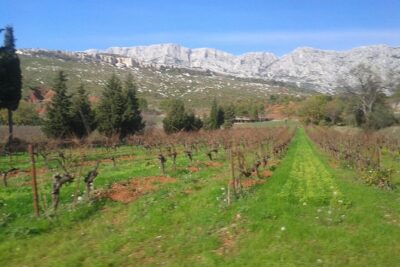
Cotes de Provence Wine Tour from Aix-en-Provence
Read our review →
Browse the lists this tour appears in