
Reviewed · BEAUNE TOURS
Skip the Line: Abbaye de Fontenay Admission Ticket
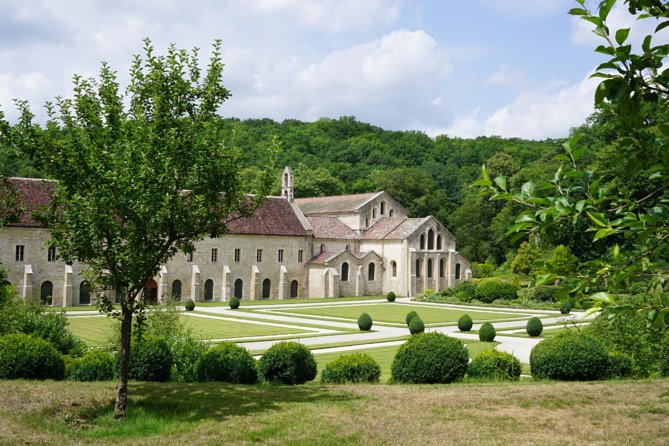
Fontenay Abbey is the sort of place where the silence does much of the explaining. Founded in 1118 by Saint Bernard of Clairvaux, it preserves a Romanesque church, cloister, dormitory, chapter room, common room, and forge in a setting shaped by nine centuries of religious life.
I like the intact medieval buildings and the way a pre-booked ticket lets you enter without fuss. I also like the quiet garden and valley setting, which make this more than a quick church stop. At about $13.91 per person, it is a fair price for a carefully preserved historic site.
The main consideration is that this is an admission ticket, not a full guided tour. You should be comfortable exploring at your own pace, and you need to plan around the midday closure from November through March.
Key points to know before visiting
- Founded in 1118: Saint Bernard of Clairvaux established Fontenay as a Cistercian abbey, and its Romanesque character remains remarkably clear.
- Six original spaces: The church, dormitory, cloister, chapter room, common room, and forge are all part of the visit.
- A UNESCO World Heritage site: Fontenay received this designation in 1981 after becoming a French historic monument in 1862.
- Allow 1 to 2 hours: That gives you time for the buildings, gardens, and lapidary museum without racing.
- Seasonal opening hours matter: From November 12 through March 31, the abbey closes from noon to 2 p.m.
- Free cancellation until 24 hours before: This gives you some breathing room if your Burgundy plans change.
Why Fontenay Abbey feels different from a standard monument visit
Many old religious sites have been altered, rebuilt, or absorbed into later towns. Fontenay offers something rarer: a group of major medieval buildings that still reads as one working abbey complex.
You can move from the church to the cloister, then on to the dormitory and practical rooms used by the monastic community. The result is a visit with a clear rhythm. You are not just looking at a handsome façade. You are seeing where prayer, sleep, work, meetings, and daily chores once fit together.
The Cistercians favored simplicity, discipline, and a restrained style. That makes Fontenay less ornate than some famous French churches, but no less powerful. Its appeal comes from proportion, stonework, light, and the sense that the buildings were designed for contemplation rather than display.
I especially like the fact that the site was not lost after the French Revolution. The monks left, and the abbey later took on an industrial role. That change helped preserve the Romanesque buildings, including the forge. It is an unusual twist in the story: an industrial chapter helped save a religious one.
A few other Beaune half-days to compare
- Paris: Louvre Museum Timed-Entrance Ticket
★ 4.6 · 71,977 reviews - Disneyland® Paris 1-Day Ticket
★ 4.6 · 49,412 reviews - Paris: Versailles Palace and Gardens Full Access Ticket
★ 4.6 · 41,579 reviews
The abbey church and the first sense of scale
Begin with the Abbey Church, one of the clearest expressions of Fontenay’s early Cistercian character. The church is not presented as a theatrical ruin. It remains a complete part of the complex, and its plain Romanesque form rewards a slow look.
Give yourself a few quiet minutes here before moving on. Notice how little the space needs in the way of decoration. The simplicity directs your attention to the architecture itself, and that is where Fontenay makes its strongest case.
The church works best when you resist the urge to treat it as a quick photo stop. Look upward, study the openings and stone surfaces, and consider how the lack of visual clutter would have shaped monastic worship.
The quiet is a major part of the experience. One visitor described being almost alone in the church and dormitory, able to appreciate both rooms in a deep silence. You cannot guarantee that kind of solitude, but visiting early or outside the busiest periods should give you a better chance.
The cloister, chapter room, and common room
The cloister is the natural center of the visit. It links the main buildings and helps you understand how the abbey operated as a self-contained community.
Walk it slowly rather than treating it as a passageway. The cloister offers the best view of how the buildings relate to one another, and the repeated forms create a calm visual order. This is a place for looking, not rushing.
From there, the Chapter Room gives you a sense of the abbey’s communal rules and decision-making. The Common Room shifts the focus toward practical daily life. Together, these spaces help turn an abstract story about monks into something easier to picture.
The rooms are valuable because they are not isolated objects. Their position within the complex matters. You see how worship, administration, rest, and work were tied together under one monastic plan.
If you are interested in architecture, Fontenay gives you plenty to study. If you prefer stories and explanations, you may want to check if a guided visit is available during your visit. The available information does not name a guide, but one recent visit included a passionate guide who focused on the abbey’s story. The admission ticket itself does not promise a guide, so do not buy it expecting a scheduled tour.
The dormitory and the power of plain design
The dormitory is one of the most memorable spaces because its size and simplicity make the monastic routine feel tangible. It is a large shared room rather than a series of private chambers, and its austerity fits the Cistercian ideal.
This is also one of the rooms where silence matters most. You may find the atmosphere more affecting than a room packed with displays. There is less to read and more to sense, so take your time with the scale, structure, and restraint.
For me, the dormitory helps explain why Fontenay can appeal even to people who are not especially interested in church history. The room is a direct piece of social history. It shows how the community lived, not just what it believed.
The building’s survival is important too. After the monks departed, the abbey’s industrial use did not erase the main Romanesque spaces. The preserved dormitory lets you see an original part of the complex rather than a modern reconstruction.
More skip-the-line tickets in Beaune:
- Versailles: Skip-the-Line Tour of Palace with Gardens Access
★ 4.7 · 9,778 reviews - Versailles: Skip-the-Line Guided Palace Tour and Full Access
★ 4.6 · 5,214 reviews - Louvre Museum: Skip-the-Line Small Group Guided Tour
★ 4.6 · 3,960 reviews - From Paris: Versailles Skip-the-Line Tour & Gardens Access
★ 4.7 · 3,011 reviews
The forge and the abbey’s working side
The forge keeps Fontenay from feeling like a purely spiritual monument. Monastic communities needed tools, equipment, and systems for daily work, and this building shows the practical side of the abbey.
Its survival also connects directly to the site’s later industrial period. That history adds texture to the visit. Fontenay was not frozen in one moment. It passed through religious, industrial, and preservation phases, and each period left the core buildings intact.
I appreciate this balance. A visit limited to the church and cloister could make the abbey seem remote from ordinary life. The forge brings you back to labor, production, and the physical work needed to maintain a large community.
You should not expect a hands-on industrial attraction from the ticket. The value is historical and architectural. The forge is one part of a larger story about how the abbey functioned and survived.
Gardens, valley views, and the lapidary museum
The visit includes the gardens and lapidary museum, so do not leave after seeing the main buildings. Fontenay’s grounds were recognized as a Remarkable Garden in 2004, and the setting gives the abbey room to breathe.
The garden is not just decoration around the monument. It helps explain the site’s appeal as a place set apart from ordinary town life. The preserved valley extends across 1,200 hectares, according to the site details, giving the complex a strong sense of space and quiet.
I would save time for an outdoor walk even if your main interest is architecture. The garden offers a change of pace after the stone interiors, and it lets you see the abbey in relation to its natural surroundings.
The lapidary museum adds another layer, though the supplied details do not specify its size or display arrangement. Think of it as a useful extra rather than the main reason to visit. The church, cloister, dormitory, and forge are the central experience.
How long to stay and how to plan the visit
The suggested visit takes about 1 to 2 hours. One hour is enough for a focused look at the major buildings, while two hours gives you time to move slowly, include the garden, and visit the lapidary museum.
I would choose the longer window if you care about atmosphere. Fontenay rewards pauses, and the best part of the visit may be sitting quietly in a room or walking the cloister without trying to check off every sight.
Opening hours change by season:
- From November 12 through March 31, the abbey is open daily from 10 a.m. to noon and 2 p.m. to 5 p.m.
- From April 1 through November 11, it is open daily from 10 a.m. to 6 p.m.
The winter midday closure is the detail most likely to catch you out. If you are visiting during the colder season, plan lunch and transport carefully so you do not arrive just before the gates close.
The ticket is a paper ticket, and confirmation is provided at booking. The experience is offered in English, but the admission itself is not described as an English-language guided tour. That distinction matters if you want a formal explanation throughout the visit.
Is $13.91 good value?
At $13.91 per person, I consider this good value for a major historic complex that includes the abbey buildings, gardens, and lapidary museum. You are paying for access to a site recognized both as a French historic monument and a UNESCO World Heritage site, not simply for entry to one chapel.
The value is strongest if you enjoy architecture, religious history, gardens, or quiet places with a strong sense of time. You can spend two hours here without needing extra paid activities, and the preserved buildings give the ticket real substance.
It is less compelling if you want a highly structured tour with live commentary included. There is no transportation, food, or drink in the price, and the ticket does not promise a guide. You will need to arrange your own way there and make your own visit plan.
Pre-booking is useful for convenience, especially since the ticket allows quick entry and the experience is often reserved well ahead of time. The average booking lead time is 17 days, so reserving in advance makes sense during popular travel periods. Still, the ticket does not turn the abbey into a timed, personalized tour. Its main advantage is smooth admission.
Who should book this Fontenay visit?
I would recommend it most strongly to:
- People who enjoy Romanesque architecture and intact historic buildings
- Visitors looking for a calm stop in Burgundy
- Garden lovers who want time outdoors as well as indoor sights
- Anyone interested in how religious sites changed after the French Revolution
- Independent explorers who prefer setting their own pace
- Couples, families, and small groups who can appreciate a quiet cultural visit
The activity has a maximum of 15 participants, although the ticket is primarily an admission product rather than a group tour. Most people can take part, and the site is near public transportation.
It may not suit you if your schedule is packed or if you need constant interpretation. Fontenay is a place where the architecture and silence carry much of the experience. You need to be willing to read the space for yourself.
Practical details that affect the experience
Transportation to and from the attraction is not included, so you should treat this as a self-arranged visit. Food and drinks are also not included. The available information confirms proximity to public transportation but does not specify routes, journey times, or parking details, so check those details before setting out.
The ticket is offered in English, and confirmation arrives when you book. Free cancellation is available until 24 hours before the experience start time. If you cancel later, or make changes within that 24-hour window, you should not expect a refund.
The property has been privately owned by the same family since 1820. That ownership is worth keeping in mind as you walk through the site. The family has continued to preserve the buildings and open them to the public throughout the year, giving Fontenay a different feel from a monument managed as part of a large urban complex.
The restoration work is especially important. The buildings have been cared for across several generations, and the result is a site that feels maintained without losing its age. You can appreciate the care while still seeing the plain, weathered character that makes the abbey special.
Should you book the Abbey of Fontenay ticket?
Book it if you want a quiet, substantial historic visit rather than a fast attraction with a packed schedule. The preserved church, cloister, dormitory, chapter room, common room, and forge give you a rare chance to understand a complete Cistercian complex, while the gardens and valley keep the visit from feeling confined indoors.
I would choose the ticket for a 1.5 to 2-hour slot, especially outside the busiest periods. If you want expert commentary, investigate guided options separately, because this admission does not include a named guide or a guaranteed tour.
At $13.91, the price is sensible for the amount of architecture and outdoor space included. Just watch the winter closing break, arrange your own transport, and come prepared to slow down. Fontenay’s best feature is not a single spectacular object. It is the calm, coherent experience of an abbey that has survived with its original character largely intact.
FAQ
What is included with the Abbey of Fontenay ticket?
Admission to the Abbey of Fontenay is included, along with access to its gardens and lapidary museum.
How long does a visit to Fontenay Abbey take?
The expected visit lasts about 1 to 2 hours.
Is transportation included?
No. Transportation to and from the attraction is not included.
Are food and drinks included?
No. Food and drinks are not included in the admission ticket.
What are the opening hours?
From November 12 through March 31, the abbey is open daily from 10 a.m. to noon and from 2 p.m. to 5 p.m. From April 1 through November 11, it is open daily from 10 a.m. to 6 p.m.
Is the visit guided?
The ticket provides admission, but the available details do not promise a guided tour. A separate visit may include a passionate history guide, but no guide name or guaranteed guide service is specified.
Can I cancel the booking?
Yes. You can cancel up to 24 hours before the experience start time for a full refund. Cancellations or changes made less than 24 hours before the start time are not accepted for a refund.
Just listed in Beaune
- Full-Day Private Tour, 6 Premiers & Grands Crus, The Best of Burgundy★ 5.0 · 50 reviews
- Visit of our 15th century cellars★ 5.0 · 57 reviews
- Private Tasting in Beaune : The Best of Burgundy Wines★ 5.0 · 66 reviews
- Private Tasting in Beaune : The Best of Burgundy Wines★ 4.9 · 66 reviews
- Discovery of the world of Truffles and tasting★ 4.5 · 66 reviews
- Luxury Luxury Wine Tour Experience★ 5.0 · 69 reviews
- Private Wine Tasting Tour – Burgundy Uncorked!!★ 5.0 · 74 reviews
- Meursault: Tour of the Vineyards on Motorbike with Sidecar★ 4.9 · 74 reviews
Beaune Tours, compared.
Burgundy Bike Tour with Wine Tasting from Beaune
Read our review →
Burgundy Grand Crus Route Day Tour – 14 Wines Tastings in Domains
Read our review →
Maison Champy Guided Cellar Tour with Wine Tasting
Read our review →
Private excursion to Côte de Beaune and Côte de Nuits (full day)
Read our review →
Browse the lists this tour appears in