
Reviewed · WALKING TOURS
[Walking Tour] Discover the Best of Brest in 2 hours
Brest is not a city that reveals itself through a long list of grand monuments. Its appeal comes from the stories tucked between modern buildings, wartime reconstruction, naval power, medieval corners, and bold new arts spaces. This walking tour gives you that bigger picture in about two hours, with local guide Caroline often leading the way with humor, old photographs, and obvious affection for her home city.
I like the small distance and leisurely pace, which make this a useful first look rather than a tiring march. I also like the way the route links Brest’s past with its future, from the 1,700-year-old castle site to the former military workshops at Les Ateliers des Capucins. The main consideration is timing: the tour can run beyond its advertised window, and the cable-car ticket costs extra.
Key points to know before you book
![[Walking Tour] Discover the Best of Brest in 2 hours - Key points to know before you book](https://photo.introducingfrance.com/wp-content/uploads/walking-tour-discover-the-best-of-brest-in-2-hours-1.jpg)
- Brest’s story comes first: Expect a city tour built around history, local anecdotes, and reconstruction rather than a parade of famous monuments.
- Caroline is a major part of the experience: Her lively style, humor, photographs, and pride in Brest receive repeated praise.
- The route covers less than 3 km: You walk at an easy pace for roughly 90 minutes to two hours, though one outing lasted about 2 hours and 15 minutes.
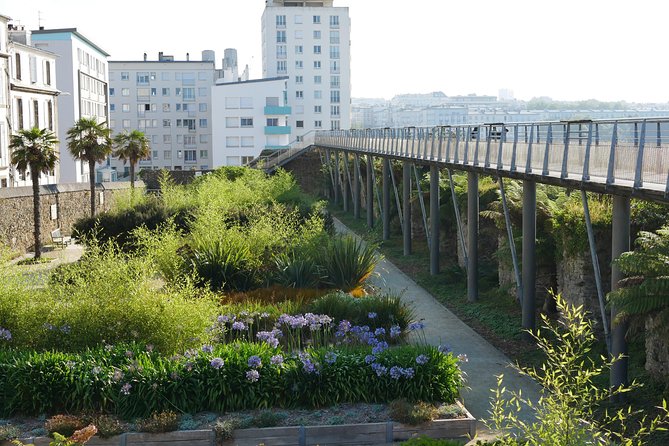
- The Jardin des Explorateurs offers the best early view: This small botanical garden looks across the castle and the bay.
- Les Ateliers des Capucins changes the mood: The tour ends in a huge former military building now used for culture and the arts.
- The cable car is optional and not included: You can pay for the ride back toward central Brest, or use the tram if the cable cars are not running.
Why Brest makes a good walking-tour surprise
![[Walking Tour] Discover the Best of Brest in 2 hours - Why Brest makes a good walking-tour surprise](https://photo.introducingfrance.com/wp-content/uploads/walking-tour-discover-the-best-of-brest-in-2-hours-2.jpg)
Brest was heavily damaged during World War II, so you should not arrive expecting an old town on the scale of Saint-Malo or Vannes. Much of the center was rebuilt, and parts of the city can look plain at first glance. That is exactly why a guide helps.
This route explains how to read Brest. You learn why the port mattered, how the navy shaped the city, what survived the war, and how modern Brest is using former military and industrial spaces. Instead of simply pointing out buildings, the guide connects them to the people and events that shaped the city.
The tone is a strong point. Caroline is described as lively, funny, and able to tell Brest’s story without pretending the city is something it is not. She talks about its good points and its less attractive sides, which makes the experience feel more honest. You get local pride, but not a sales pitch.
The tour is offered in English, and English and French guides are listed as available. If you want a polished overview with plenty of background, this is a better choice than wandering around with only a map.
A few other France half-days to compare
- The Père Lachaise Cemetery: Guided 2-Hour Small-Group Tour
★ 4.7 · 1,065 reviews - Paris: 2-Hour Perfume Creation Workshop
★ 4.8 · 731 reviews - La Rochelle: 2-Hour Sunset Sailing Cruise
★ 4.8 · 652 reviews
Starting at Multiplexe Liberté at 2 pm
The meeting point is Multiplexe Liberté, 10 Avenue Georges Clemenceau, in central Brest. The planned start is 2 pm, so build your afternoon around that time rather than assuming you can arrive late and catch up.
The group can include up to 25 people. That is not a private walk, but it is still small enough for a guide to speak to the group without the experience feeling like a large coach excursion. Caroline’s ability to respond to questions is one of the qualities that makes the walk work, so staying close to the guide matters.
The first part takes you through Brest’s shopping quarters. One local detail here is especially memorable: the area is named after a Siamese delegation, from present-day Thailand, that visited in 1686 and left local onlookers amazed. It is a small story, but it shows the style of the tour. Brest is presented through odd facts and human reactions, not just dates and architectural labels.
You may also begin to see how the city mixes old references with postwar buildings. That contrast can feel surprising if you expect a traditional Breton center. The guide gives you the context needed to make sense of it.
Brest Castle and the port that shaped the city
Brest Castle is one of the route’s most important stops. Its story reaches from a Roman castellum to Vauban’s citadel, covering more than 1,700 years of military use. The site remains a military fortress in a strategic position above the harbor.
You should not expect a full museum visit during this walk. The castle houses the National Museum of the Navy, but the tour is focused on the outside setting and the larger story of Brest’s role as a naval port. If you want to visit the museum, plan separate time and check its opening details independently.
The castle is valuable because it gives you the key to the city. Brest is not simply a seaside town with a fortress. Its location made it a place of defense, naval planning, exploration, and military industry. Once you understand that, later stops make more sense.
The route also shows you that Brest’s history is not confined to one preserved quarter. It is scattered across fortifications, viewpoints, surviving streets, and new public spaces. That makes the guide’s narration particularly useful.
The Jardin des Explorateurs and the bay view
![[Walking Tour] Discover the Best of Brest in 2 hours - The Jardin des Explorateurs and the bay view](https://photo.introducingfrance.com/wp-content/uploads/walking-tour-discover-the-best-of-brest-in-2-hours-4.jpg)
The Jardin des Explorateurs is a small botanical garden with a fine view of Brest Castle and the bay. The scheduled stop lasts about 10 minutes, and admission is free.
This is one of the quieter moments of the route. You can pause, look back toward the fortress, and hear about the explorers who left Brest during the 18th century. They returned from distant islands with plants and seeds, linking the port to the wider world in a practical and often overlooked way.
The garden also points to Brest’s later role in plant conservation. The Brest Botanical Conservatory opened in 1975 and became the first in the world devoted to protecting endangered species. That is an unusual piece of local history, and it adds another layer to the city’s identity.
Bring a camera, but do not think of this as a long garden visit. Ten minutes is enough for the view and the explanation, not for a detailed botanical tour. The garden’s real value is the combination of scenery and story.
More walking tours in France:
- Paris Top Sights Half Day Walking Tour with a Fun Guide
★ 5.0 · 2,893 reviews - Montmartre Hidden Gems and Scenic Highlights Walking Tour
★ 5.0 · 2,684 reviews - Montmartre Hill French Gourmet Food and Wine Tasting Walking Tour
★ 5.0 · 2,588 reviews - Paris Île de la Cité and Notre-Dame Walking Tour With Crypt
★ 5.0 · 2,272 reviews
The medieval tower and a glimpse of old Brest
![[Walking Tour] Discover the Best of Brest in 2 hours - The medieval tower and a glimpse of old Brest](https://photo.introducingfrance.com/wp-content/uploads/walking-tour-discover-the-best-of-brest-in-2-hours-5.jpg)
Another stop is a medieval tower dating back to the period of the Hundred Years’ War, around eight centuries ago. It now serves as the museum of Brest, where dioramas show what the city looked like before the war.
This is an important correction to the common first impression of Brest. Much of the city you see today is rebuilt, but the tower and its displays help you picture the older city that disappeared. The dioramas are especially useful because they turn an abstract explanation about wartime destruction into something you can visualize.
The supplied details do not specify how long you enter the museum, so you should think of this as a guided stop rather than a guaranteed extended museum visit. If the museum is a priority, ask the guide how much time the schedule allows on your date.
For me, this part of the route is one of the most useful. You are not only looking at what survived. You are also being shown what is gone.
A surviving street below the Capucins
![[Walking Tour] Discover the Best of Brest in 2 hours - A surviving street below the Capucins](https://photo.introducingfrance.com/wp-content/uploads/walking-tour-discover-the-best-of-brest-in-2-hours-6.jpg)
The walk continues toward one of Brest’s treasured prewar remnants. This street survived thanks to a local woman and the association Vivre la Rue, which worked to protect it.
The setting is described as a time capsule at the feet of the Capucins. That phrase captures the contrast well. Above and around it, you encounter the scale of Brest’s modern cultural redevelopment. Here, you get a more intimate sense of the older city.
This stop may appeal most to people who like ordinary urban history. It is not necessarily a grand sight. Its importance lies in the fact that it was saved, and in the reminder that local preservation often depends on determined residents rather than official monuments alone.
The guide’s storytelling matters here. Without context, a surviving street can look like an accidental fragment. With the story of Vivre la Rue, it becomes part of Brest’s modern identity.
Les Ateliers des Capucins: military workshops turned arts center
![[Walking Tour] Discover the Best of Brest in 2 hours - Les Ateliers des Capucins: military workshops turned arts center](https://photo.introducingfrance.com/wp-content/uploads/walking-tour-discover-the-best-of-brest-in-2-hours-7.jpg)
The tour spends about 20 minutes at Les Ateliers des Capucins, with free admission. This enormous former military building is now one of Brest’s main arts and cultural spaces.
The change in use is the point. The building shows how Brest is looking ahead without cutting itself off from its naval and industrial past. You move from fortresses and wartime remains into a large public venue devoted to culture, exhibitions, and city life.
Do not expect a small, precious gallery. The space is enormous, and its scale is part of the experience. The guide helps you understand what the building was and why its new role matters. It is also a practical place to linger after the tour if you have extra time.
One warning: the building may occasionally be closed to the public or affected by an event. The guide can adapt the route when this happens, but you should not treat indoor access as guaranteed in every circumstance. One past visit was adjusted because the Capucins were closed, with the guide continuing to explain the area along the way.
Finishing with the Brest cable car
![[Walking Tour] Discover the Best of Brest in 2 hours - Finishing with the Brest cable car](https://photo.introducingfrance.com/wp-content/uploads/walking-tour-discover-the-best-of-brest-in-2-hours-8.jpg)
The tour ends at the Médiathèque F. Mitterrand, inside or beside the Capucins district, at 25 Rue de Pontaniou. From here, you can stay in the area, enjoy the harbor views, or take Brest’s cable car back toward the city center.
The cable car links the two historic parts of Brest, Brest-même and Recouvrance. It is the tour’s flashiest modern feature and gives you a different way to understand the harbor and the city’s divided geography.
The ride is not included in the tour price. You pay separately, and the details describe the ride as an optional return to central Brest. If the cable cars are not operating, the guide says the tram can be used instead.
Allow a little flexibility after the official end time. Cable cars can have operating problems, and the walking tour itself may finish later than planned. If you have a cruise departure, train, or fixed dinner booking, do not schedule it too tightly.
What the $18.14 price really buys you
At $18.14 per person, this is priced as an accessible introduction rather than a major sightseeing investment. The cost covers the guide in English or French and the walking route, but not food, drinks, or the cable-car ride.
The value comes from interpretation. Brest does not give you a compact line of famous sights, so the guide’s stories are what turn the walk into an experience. You are paying for the explanation of the castle, the prewar city, the explorers, the military workshops, and the rebuilding process.
I would consider it good value if you have only one afternoon in Brest or if the city is a stop on a cruise. It can also help you decide where to spend more time afterward. The Capucins, the harbor views, and the castle area are easier to appreciate once you know how they fit together.
The price is less compelling if you want long interior visits or a museum-heavy outing. This is a moving history lesson with selected stops, not a series of full admissions. Still, free access to the Jardin des Explorateurs and Capucins keeps extra costs low.
Pace, footwear, and practical planning
The route covers less than 3 km and moves at a leisurely pace over roughly 90 minutes to two hours. One account describes a 2-hour-15-minute walk, so I would plan for the longer possibility, especially if the group asks questions or the guide spends extra time explaining a site.
You need to be comfortable standing and walking for a couple of hours. The tour is not recommended if that would be difficult, although one participant found the distance manageable in ordinary walking shoes. Wear comfortable sneakers, and prepare for Brest’s changeable weather. The city’s famous drizzle did not prevent one group from enjoying the walk, but a waterproof layer is still sensible.
The route is near public transportation, and the finish at Les Ateliers des Capucins gives you several options. You can ride the cable car back at your own cost, use the tram if needed, or remain in the cultural district.
Confirmation is provided when you book. Service animals are allowed, and most people who can manage the walking distance can take part. The maximum group size is 25.
Free cancellation is available up to 24 hours before the start time for a full refund. Changes or cancellations inside that 24-hour window are not accepted for a refund. The tour also requires a minimum number of participants, and if the provider cancels for that reason, you can receive a different option or a full refund.
The guide makes or breaks this walk
Caroline receives especially strong praise for her energy, humor, preparation, and ability to tell Brest’s story in a way that feels personal. She uses photographs to show how places looked before reconstruction, and she is willing to discuss both the city’s strengths and its weak spots.
That balance is important in Brest. A guide who insists that every street is beautiful would make the city harder to understand. Caroline’s approach seems more useful: she acknowledges the gray granite and lack of grand monuments, then shows you the character beneath the surface.
She also adapts to the group. Questions can shape the explanation, and changes such as a closed Capucins building can be handled without losing the main thread. If you enjoy local anecdotes and a guide with a strong personality, you are likely to get more from this than from a formal, scripted walk.
There is one serious organizational warning. A French-language departure was once left open by mistake while the guide was serving an English-language group. The guide did not appear at the advertised meeting point, communication failed during the day, and the booking error was only explained later. The issue was attributed to a booking-system problem, and the provider said the listing was removed to prevent a repeat. It appears to be an isolated failure, but if your schedule is tight, confirm the language and departure shortly before the day.
Who should book this Brest walk?
I would choose this tour if you are seeing Brest for the first time and want the city explained in a compact format. It suits cruise passengers, independent visitors with a free afternoon, and anyone who enjoys urban history more than checking off famous buildings.
It is also a good fit if you want a local perspective. The tour does not gloss over Brest’s postwar rebuilding, and it makes room for ordinary streets, military remains, botanical conservation, and cultural renewal.
You may want a different plan if your main goal is an extended visit inside the National Museum of the Navy, a long garden tour, or a private walk at your own pace. The route is active, and the cable-car ride adds a separate cost.
Should you book it?
Yes, if you want to understand why Brest looks the way it does. For $18.14, you get a compact route, strong local storytelling, harbor views, and a useful explanation of the city’s shift from naval stronghold to modern cultural center.
Book it with a little time in hand after the tour, and confirm the language and departure if you are visiting during a busy cruise day. Choose comfortable shoes, accept that the weather may be damp, and let the guide show you a city whose best stories are often found between the obvious sights.
FAQ
How long does the Brest walking tour last?
The experience lasts approximately 1 hour 30 minutes to 2 hours. You should allow extra time because one past outing lasted about 2 hours and 15 minutes.
Where does the tour start?
The meeting point is Multiplexe Liberté, 10 Avenue Georges Clemenceau, 29200 Brest, France. The scheduled start time is 2 pm.
Where does the tour finish?
The walk ends at Médiathèque F. Mitterrand at Les Capucins, 25 Rue de Pontaniou, Brest. You can remain in the Capucins district or return toward the city center by cable car or tram.
Is the cable-car ticket included?
No. The cable-car ride is not included in the tour price. You pay for it separately, and the tram may be used if the cable cars are not operating.
Is the tour available in English?
Yes. The experience is offered in English, and English and French guides are listed as available.
How much walking is involved?
The route covers less than 3 km over about two hours at a leisurely pace. You should be able to stand and walk comfortably for a couple of hours.
Can I cancel for a full refund?
Yes. You can cancel at least 24 hours before the local start time for a full refund. Cancellations and changes made less than 24 hours before the start are not refunded or accepted.
Just listed in France
- Paris: Giverny & Versailles Small Group or Private Tour★ 4.5 · 49 reviews
- Half-Day Walking Food Tour in Nice with Lunch★ 5.0 · 49 reviews
- Chartres Cathedral 5 Hours Tour from Paris with Private Transport★ 4.5 · 49 reviews
- Marseille: Frioul Archipelago Catamaran Cruise with Lunch★ 4.4 · 49 reviews
- Paris: Louvre photoshoot or Seine bridges Eiffel Tower walk★ 5.0 · 49 reviews
- Bonifacio: sunset catamaran trip and aperitif★ 4.6 · 50 reviews
- Paris: Choux Pastry and Chocolate Éclair Making Class★ 4.9 · 50 reviews
- Private tour of the Champagne area, meet local producers and taste their Champagne, start from your hotel in Paris.★ 5.0 · 50 reviews
Walking Tours, compared.

Paris Top Sights Half Day Walking Tour with a Fun Guide
Read our review →
Montmartre Hidden Gems and Scenic Highlights Walking Tour
Read our review →
Montmartre Hill French Gourmet Food and Wine Tasting Walking Tour
Read our review →
Paris Île de la Cité and Notre-Dame Walking Tour With Crypt
Read our review →
Montmartre Cheese, Wine & Pastry Guided Walking Tour
Read our review →
Paris in a Day: Louvre or Orsay, Eiffel Tower, City Walk & Cruise
Read our review →
Montmartre Highlights Walking Tour with a Local Guide
Read our review →
Browse the lists this tour appears in