
Reviewed · PARIS TOURS
Hands-on Eclair and Choux Making with a Pastry Chef
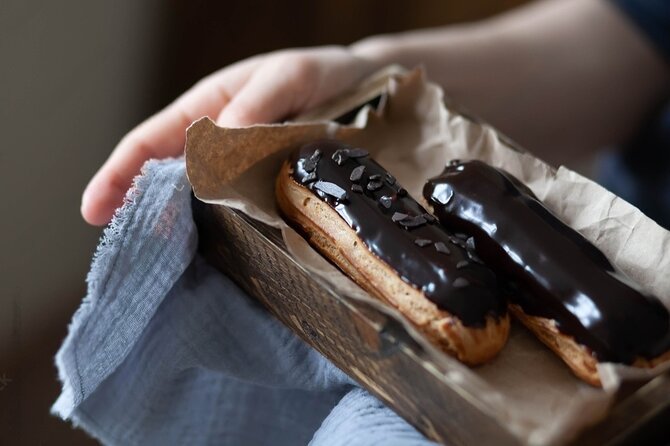
The best part of this Paris class is that you do not merely watch a chef make éclairs. You mix the dough, pipe it onto the tray, cook the pastry cream, fill the shells, and finish them with dark chocolate glaze. You leave with a real technique, not just a box of sweets.
I like the small class size, which allows the chef to correct shaky piping and answer questions. I also like the useful take-home result: each person gets three full-size éclairs, and the recipe is provided digitally. The main thing to know is that people often work in pairs, so this is hands-on, but not always one complete workstation per person.
Key points to know before booking
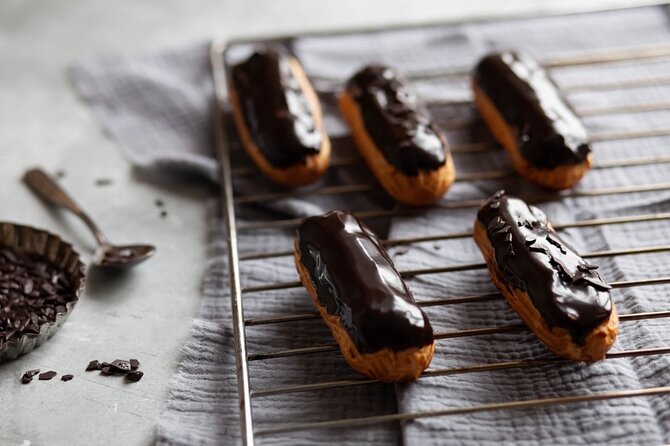
- Three éclairs to take home: You make enough pastry to leave with several full-size treats, not just a single sample.
- A true beginner class: The chef explains each stage, from cooking choux dough to thickening pastry cream.
- Small groups of up to eight: In a group of six or fewer, you can expect plenty of help with piping and filling.
- Dark chocolate glaze: The topping is made with dark chocolate and butter rather than a very sweet sugar icing.
- Convenient Paris setting: The meeting point is 7 Rue de Béarn in the 3rd arrondissement, a short walk from public transportation.
- Allow two and a half hours: The class is relaxed enough for instruction, baking, cooling, filling, and packing the éclairs.
A Paris pastry class with a useful payoff
At $132.75 per person, this is not a cheap snack stop. You are paying for instruction, ingredients, kitchen time, and a small-group activity in central Paris. The value improves if you want to learn a French pastry technique rather than simply eat one.
I see this as a good use of a morning or afternoon for families, couples, friends, and solo visitors who enjoy making things. It is also a fine choice for a birthday treat. One family used the class to mark a 16th birthday, and the format worked well for both adults and children.
The class is offered in English, and the chef changes by session. Past instructors have included Clara, Mathieu, Matthieu, Millie, Manel, Matteo, Alyssa, Amelia, and Julie. The names change, but the common pattern is clear: the chef demonstrates, you work through the stages, and the chef watches closely enough to help when the dough or piping goes wrong.
Do not expect a formal pastry-school course. You will not become a professional baker in 150 minutes. You will, however, learn the basic structure of pâte à choux and get a recipe you can try at home.
A few other Paris half-days to compare
- Fragonard Paris: Mini Perfume Workshop
★ 4.5 · 1,924 reviews - Paris Cooking Class and Lunch with Wine plus Market Visit Option
★ 5.0 · 1,024 reviews - Paris Croissant Small-Group Baking Class with a Chef
★ 5.0 · 910 reviews
Finding Maison Fleuret at 7 Rue de Béarn
The class begins and ends at 7 Rue de Béarn, 75003 Paris. This is in the Marais, a central neighborhood with plenty to do before or after class. The meeting point is near public transportation, so you can reach it without arranging a private car. Private transportation is not included, but you do not need it for this activity.
Give yourself a few extra minutes to find the address. A cooking class is not the place to arrive breathless and late, especially when the first step involves heating butter and water at the right moment.
The setting is practical rather than grand. One person found the room small and the building exterior less polished than expected. That is worth knowing if you picture an elegant Paris salon with marble counters. The room is used for teaching, not for putting on a show.
Still, the neighborhood adds a pleasant Paris touch. Plan a walk through the Marais afterward, or combine the class with lunch and nearby sights. Since the activity returns to the same meeting point, it is easy to fit into a day without crossing the city.
Mixing the choux pastry from scratch
The class begins with the foundation of the éclair: choux pastry. You heat water, butter, and salt in a saucepan until the butter melts. Flour goes in next, and you stir until the mixture pulls away from the sides of the pan.
This is a useful stage to watch closely. The dough needs to come together properly before the eggs are added. The chef can show you what the mixture should look like, which is much easier to understand in person than from a recipe alone.
The dough is transferred to a bowl, and eggs are mixed in one at a time. You need to blend each egg well before adding the next. This gives you a practical lesson in texture: the finished dough should be smooth enough to pipe but not so loose that it spreads across the baking sheet.
Ingredients are premeasured, so you can concentrate on the method. That makes the class less stressful for a first attempt and leaves more time for conversation. It also means you should pay attention to the technique, since the measuring work has already been done for you.
Learning to pipe straight éclair shells
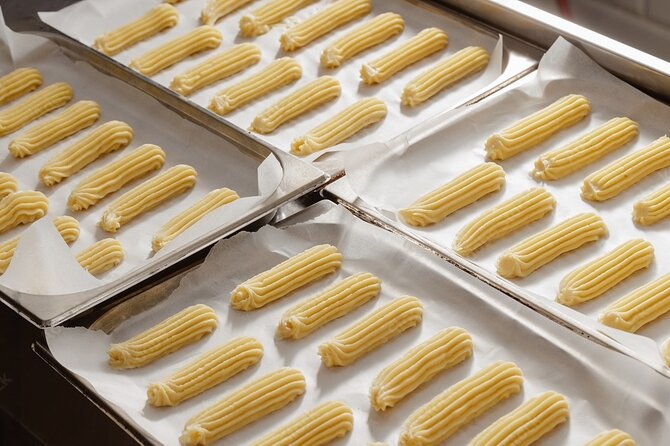
Once the dough is ready, it goes into a piping bag fitted with a plain tip. You pipe sticks of dough onto a parchment-lined baking sheet.
This is the moment when the class becomes more hands-on than a demonstration. Piping evenly takes practice. Your first éclair might be narrow, wide, crooked, or a little lumpy. That is normal. The instructor can help with pressure, speed, and spacing, and the small group makes it possible to get individual guidance.
One particularly useful detail is that imperfect piping does not ruin the activity. The finished éclairs can still be attractive and delicious even if your lines are not bakery-perfect. That makes this a comfortable introduction for children and adults who have never used a piping bag.
The class may pair you with another person, especially if the group has an odd number or the workstations are shared. Some people enjoy the social side of this arrangement. Others expect to make every stage alone and may find taking turns disappointing. If having your own full setup matters to you, ask about the arrangement before booking.
Same city, a completely different afternoon:
- Paris: Louvre Museum Timed-Entrance Ticket
★ 4.6 · 71,977 reviews - Disneyland® Paris 1-Day Ticket
★ 4.6 · 49,412 reviews - Paris: Versailles Palace and Gardens Full Access Ticket
★ 4.6 · 41,579 reviews - Paris: Evening River Cruise with Music
★ 4.4 · 22,721 reviews
Watching the pastry rise in the oven
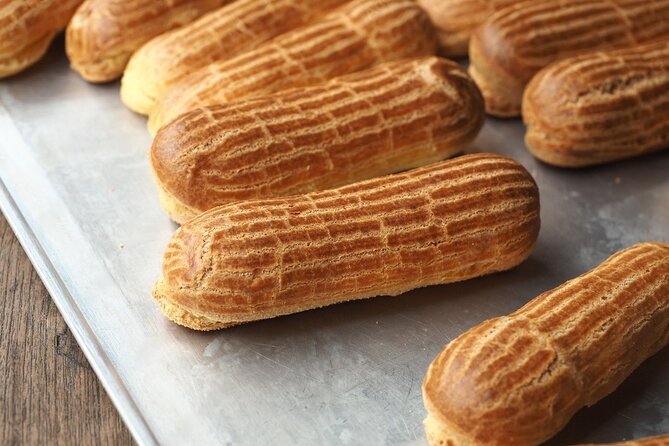
The piped dough bakes in a preheated oven at 200°C for about 20 to 25 minutes. The goal is a golden, crisp shell.
This waiting period gives the chef time to explain what happens inside the pastry. Choux dough rises from steam, creating the hollow center that later holds the cream. A properly baked shell needs enough time to become firm and dry, since a soft interior can collapse or make filling difficult.
You will not simply sit through the baking time. The next task is pastry cream, so the class keeps moving. Still, the oven stage is a good reminder that pastry rewards patience. Opening the oven too early or underbaking the shells can affect the final result.
The recipe uses metric measurements. You receive the recipe digitally, usually by scanning it, which is convenient for many people but less convenient if you prefer a printed page. If you want a paper copy, bring a way to note the amounts or ask the chef during class.
Cooking pastry cream with vanilla, coffee, or chocolate
While the shells bake, you make the filling. Milk is heated in a saucepan. In a separate bowl, you whisk egg yolks, sugar, flour, and cornstarch.
The hot milk is poured over the egg mixture while you stir constantly. The mixture then returns to the saucepan and cooks over low heat until thick. This is the part where steady stirring matters. The chef can show you how the cream changes from a thin custard to a smooth, spoon-coating filling.
Depending on the session, the filling can include chocolate, vanilla, coffee, or another listed flavor. Ask your chef which flavor is planned that day if you have a strong preference.
This step is valuable beyond the éclair itself. Once you understand the basic pastry cream method, you can use it for tarts, layered desserts, and other French pastries. The class gives you a practical base rather than a one-use trick.
Filling and glazing the cooled éclairs
The baked éclairs must cool before filling. You cut the shells in half, then use a piping bag to add the pastry cream.
Cooling is not a glamorous step, but it matters. Filling a hot shell can soften the pastry cream and make the éclair difficult to handle. The class gives you time to see how the crisp shell and smooth cream work together.
The final stage is the glaze. Dark chocolate is melted with butter and stirred until smooth. You dip the top of each éclair into the chocolate mixture.
I like this choice of topping because it keeps the finished pastry from becoming overly sweet. One participant specifically preferred the dark chocolate glaze to the usual sugar icing. It gives the éclair a more pronounced chocolate flavor and a clean finish.
The class produces enough for three full-size éclairs per person. They are packed to take away rather than served as a sit-down dessert course. Coffee or tea is listed as included, but one person expected to eat the pastries over coffee and did not find that portion of the experience clearly provided. Treat the drinks as a possible inclusion, not the main reason to book.
How personal is a group of eight?
The maximum group size is eight, which is small by cooking-class standards. In practice, some sessions are much smaller. A class with six participants gives the chef room to watch each person and correct small mistakes before they become large ones.
The teaching style can depend on the chef. Clara was described as friendly and enthusiastic, while Mathieu and Matthieu were praised for explaining each stage slowly and helping each person. Millie’s clear English and energy suited beginners, and Matteo was especially encouraging during the chocolate éclair class.
The tone is generally relaxed and social. You can chat while working, and solo participants have found it easy to take part. Families with older children can also fit in well. A nine-year-old enjoyed the process, and the instructions were considered clear enough for different ages.
There is one fair caution. A good instructor does not always mean a lively performance. One person found the chef helpful but somewhat distracted and the atmosphere plain. If you want a polished entertainment show, this may feel basic. If you want close instruction and tasty results, the simple setup is less important.
Is $132.75 good value?
The price is $132.75 per person for about two and a half hours. That puts this class in the category of special-occasion activities rather than casual food stops.
I would judge the value in three parts. First, you get direct instruction in several connected techniques: choux dough, piping, pastry cream, filling, and glazing. Second, you produce three éclairs to take with you. Third, you receive a recipe that lets you repeat the experience at home.
The value is weaker if you only want to eat a pastry or if you dislike shared workstations. A Paris bakery can give you an éclair for a small fraction of the cost. This class earns its price through participation, guidance, and the chance to recreate the dessert later.
The recipe is in metric measurements, but converting it to US measurements is manageable. If you are not comfortable with digital files, make sure you save the recipe before leaving. One person had trouble because the recipe was scanned rather than handed out on paper.
Who should book this class?
I would choose this for anyone who wants a food activity with a clear beginning and end. It suits first-time bakers because the chef handles the structure and you practice the key movements under supervision.
Families should consider the age and patience of their children. The class has worked well for a nine-year-old and for older children, but young bakers will be sharing tasks and waiting during baking. A teenager who likes desserts may enjoy it as a birthday activity.
It is also a good option for a group of friends or a parent and adult child. The social side is part of the appeal. Solo participants can fit in, too, since the small group makes it easy to work alongside others.
I would hesitate if you need a guaranteed schedule. Several sessions have been canceled because a pastry chef became ill, with replacement times offered on short notice. Those cancellations were not the usual outcome, but they caused real problems for people with hotel checkouts, river cruises, and fixed plans. Keep your confirmation details and avoid placing this class immediately before an important departure.
You can cancel for a full refund up to 24 hours before the start time. Changes or cancellations inside that window are not accepted for a refund, and the cut-off uses Paris local time.
My take on the hands-on éclair class
This is a practical pastry lesson with a sweet reward at the end. I like that you work through the complete process instead of piping a single decoration onto a ready-made dessert. The class also makes room for mistakes, which is exactly what beginners need.
The strongest reasons to book are the small group, the patient teaching style found in many sessions, and the three éclairs you take home. The main drawbacks are the shared setup, the plain room, the digital recipe, and the occasional risk of schedule changes.
Book it if you want to bring a bit of French baking home with you and are happy to spend more than you would on pastries at a shop. Skip it if your priority is a polished setting, a guaranteed private workstation, or a quick tasting. For hands-on learners, this is one of the more useful ways to spend two and a half hours in the Marais.
FAQ
Where does the éclair class begin?
The class begins at 7 Rue de Béarn, 75003 Paris, France, and ends at the same meeting point.
How long does the activity last?
The activity lasts approximately two hours and 30 minutes.
Is the class suitable for beginners?
Yes. Previous pastry experience is not required, and the chef explains the choux pastry, piping, pastry cream, filling, and glazing steps.
How many people can join the class?
The maximum group size is eight people.
Do I get to take éclairs home?
Yes. The class produces three regular-size éclairs per person to take away.
Is cancellation free?
You can cancel for a full refund up to 24 hours before the experience start time. Cancellations and changes made less than 24 hours before the start time are not accepted for a refund.
Just listed in Paris
- Paris: Giverny & Versailles Small Group or Private Tour★ 4.5 · 49 reviews
- Chartres Cathedral 5 Hours Tour from Paris with Private Transport★ 4.5 · 49 reviews
- Paris: Louvre photoshoot or Seine bridges Eiffel Tower walk★ 5.0 · 49 reviews
- Private tour of the Champagne area, meet local producers and taste their Champagne, start from your hotel in Paris.★ 5.0 · 50 reviews
- Paris: Choux Pastry and Chocolate Éclair Making Class★ 4.9 · 50 reviews
- Paris Eternelle Notre-Dame Virtual Reality Tour★ 4.5 · 50 reviews
- Normandy D-Day Landing Beaches Private Day Trip from Paris★ 5.0 · 50 reviews
- Disneyland® Paris 1 Day with Round-Trip Train Tickets from Paris★ 4.0 · 50 reviews
Paris Tours, compared.



Versailles Palace and Gardens Full Access Ticket
Read our review →

Eiffel Tower Entry Ticket with Optional Summit Access
Read our review →

Louvre Guided Tour with Reserved Access & Boat Cruise
Read our review →
Moulin Rouge Cabaret Show Ticket with Champagne
Read our review →Browse the lists this tour appears in