
Reviewed · LOUVRE MUSEUM TOURS
Louvre Museum Access Private Guided Visit
The Louvre is too large for casual wandering, especially if you have only two hours. This private visit gives you a clear route through the museum, from the Nike of Samothrace and Mona Lisa to Greek, Roman, medieval, Renaissance, Romantic, and Neoclassical art.
I like the personal format and the guide’s ability to adjust the visit to your interests. I also like the practical orientation: several guides, including Boris, Tina, Mila, Anne, and Anya, have helped visitors find major works quickly and understand where to continue after the formal tour.
The main drawback is the price, listed at $301.71 per person. That is a serious sum for two hours, particularly for a solo visitor. You are paying for private attention, museum know-how, and saved time, not simply for admission.
Key points at a glance
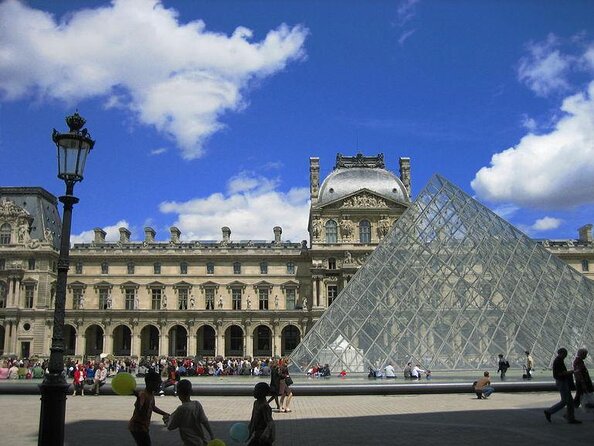
- Two focused hours inside the Louvre: A short route covers major art periods without trying to see the entire museum.
- Private guide for your group: The visit is not shared with strangers, so the route can respond to your interests.
- Major works plus lesser-known pieces: Expect the Mona Lisa and Nike of Samothrace, along with artworks you might miss alone.
- Art history told in sequence: Greek and Roman art lead into medieval, Renaissance, Neoclassical, and Romantic developments.
- Useful museum orientation: Your guide can help you continue independently after the scheduled visit.
- English-language service: The experience is offered in English, with admission included for adults.
Why a guide helps at the Louvre

The Louvre is not a museum you simply stroll through from one end to the other. Its galleries cover centuries of art and several building wings, and the most famous rooms can pull you far from other works you hoped to see.
I like the way this visit treats the Louvre as a story rather than a checklist. Greek sculpture, Roman art, medieval objects, Renaissance painting, Neoclassicism, and Romanticism are not isolated subjects. They show how artists borrowed, argued, and changed direction over time.
A private guide also gives you someone to make decisions. If you care most about painting, sculpture, ancient cultures, or the museum itself, you can signal that early. Guides have adjusted visits for families, solo visitors, couples, and groups with teenagers.
Boris is frequently singled out for his ability to move efficiently through the museum while explaining what matters. Tina has been praised for a warm, flexible approach, while Mila is noted for making the visit memorable and accessible. Other guides named in past bookings include Amy, Anne, Steph, Adi, and Anya.
Guide assignments can vary, so you should not book expecting one particular person unless the provider confirms that guide in advance. The important point is the format: an art historian leads only your group and can respond to your questions as you go.
A few other Paris half-days to compare
- Paris: Louvre Museum Timed-Entrance Ticket
★ 4.6 · 71,977 reviews - Paris: Louvre Guided Tour with Reserved Access & Boat Cruise
★ 4.3 · 16,353 reviews - Louvre Museum Masterpieces Guided Tour with Access
★ 4.5 · 12,023 reviews
Meeting at the Arc de Triomphe du Carrousel
The meeting point is the Arc de Triomphe du Carrousel, at Place du Carrousel, 75001 Paris. This is a practical location near the Louvre and public transportation, but you should allow enough time to find the exact meeting spot.
Your guide meets you there before the museum visit begins. Some past guides have arrived early and been easy to identify, which matters at a large site with crowds, several entrances, and plenty of people waiting for tours.
The experience ends back at the meeting point. That makes the visit simple to fit into a day of sightseeing, though you should not plan a tight appointment immediately afterward. Two hours is approximate, and the Louvre can require extra time for moving between galleries and managing entry.
The tour includes a mobile ticket and the €22 adult museum admission. Visitors under 18 and residents of the European Economic Area under 26 may qualify for free admission with valid identification and proof of residency. If that applies to you, bring the required documents.
The Louvre’s famous highlights
The first major goal is usually the Mona Lisa. You will see the celebrated Leonardo painting, but the room can be crowded and the viewing time may be brief. A guide helps you place the painting in the wider story of Renaissance art instead of treating it as the only reason to enter the museum.
The Nike of Samothrace offers a different experience. This winged Greek sculpture sits dramatically at the top of the Daru staircase, where its pose, missing head, and flowing stone clothing create a strong sense of movement. It is one of the Louvre’s essential stops, and its setting makes it easy to remember.
A good guide does not spend the entire two hours at these two famous works. That would leave you with a photograph and little understanding of the museum. The value comes from linking the famous objects to the less celebrated paintings, sculptures, and historical material nearby.
You might also see part of the original moat from the medieval fortress beneath the modern museum. This is the kind of detail you could miss while hurrying between famous rooms, yet it helps explain how the Louvre changed from a defensive structure into a royal residence and then a public museum.
Greek art and the roots of European taste
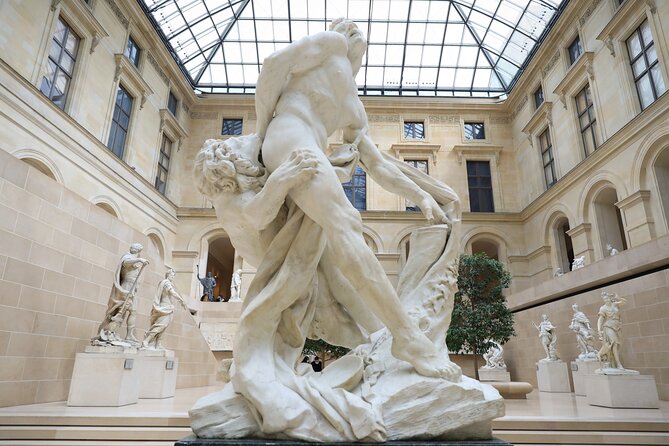
The Greek section is important because later European artists repeatedly looked back to Greek sculpture for ideas about the human body, proportion, balance, and ideal beauty. Your guide can show you how these ideas influenced later artists, even when later periods changed the mood or purpose of the work.
The emphasis here is not simply on identifying statues. You are given a framework for understanding why Greek art became so important to European education and collecting. The visit can also help you notice the difference between a calm, idealized figure and the more emotional or dramatic styles that appear later.
This section is especially useful if you normally find ancient art difficult to approach. Without context, white marble can look distant. With explanation, posture, clothing, damage, and the original purpose of a work become clues.
The limitation is time. Fifteen minutes is listed for this stop, and the Louvre has far more Greek material than any short visit can cover. You will get a sharp introduction, not a full study of the collection.
More museums in Paris:
- Paris: Louvre Museum Entry Ticket With Host and River Cruise
★ 4.6 · 9,926 reviews - Les Invalides: Napoleon’s Tomb & Army Museum Entry
★ 4.6 · 9,185 reviews - Louvre Museum – Exclusive Guided Tour (Entry Included)
★ 5.0 · 6,296 reviews - Paris: Louvre Museum Hosted Entry and Mona Lisa Audioguide
★ 4.6 · 5,235 reviews
Roman art and its lasting influence

The Roman gallery follows naturally. Roman artists adopted and adapted Greek forms, but Roman art also served political, social, and personal purposes. Portraits, monuments, and decorative objects can tell you how Roman power presented itself and how later Europe borrowed Roman visual language.
This part of the route gives the rest of the visit a useful foundation. As you move toward later European art, you can watch older classical ideas return in new forms. The guide may connect Roman models to later painting, sculpture, architecture, and public culture.
The Roman section can appeal to people who prefer objects with a strong link to daily life or government. It broadens the visit beyond the best-known paintings and shows that the Louvre is also a major museum of ancient civilizations.
Again, the short time limit requires choices. You will not examine every gallery or period. The guide’s role is to choose representative works and explain why they matter.
Medieval art before the Renaissance

Medieval art can be overlooked by visitors racing toward the Italian paintings. That is a mistake. The medieval section helps you see the changes that made the Renaissance possible, including shifts in religious imagery, artistic technique, patronage, and the treatment of the human figure.
This stop also links the Louvre’s building to its past. The museum contains evidence of the medieval fortress that once occupied this ground, so the visit is not only about framed paintings and famous statues. The building itself carries layers of Parisian history.
You should expect the guide to explain medieval art as a bridge rather than a dead end. Later artists did not simply reject the Middle Ages. They studied earlier traditions, revived classical models, and developed new ways to show space, emotion, and the body.
For visitors with little art background, this section can be one of the most useful. It gives you a timeline, which makes the famous Renaissance rooms easier to understand.
The Great Gallery and Italian Renaissance painting
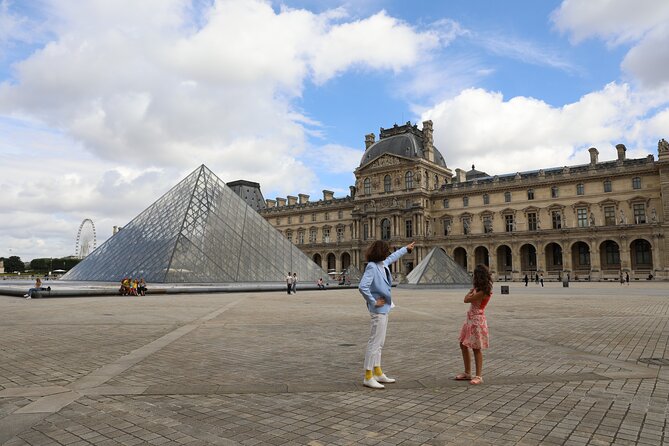
The Great Gallery is the centerpiece of the route. Its long succession of Italian paintings can feel overwhelming without direction, so a guide’s selection matters.
The Italian Renaissance is often treated as the high point of European painting, and this gallery explains why. You can look for changes in perspective, anatomy, light, composition, and emotional expression. Instead of seeing a wall of old paintings, you begin to recognize different artistic problems and solutions.
The Mona Lisa belongs to this larger story. Placing it alongside other Renaissance works helps you see more than its fame. You can consider how the figure is presented, how the background works, and why Leonardo’s approach continues to attract attention.
This is also where a private format earns its keep. A guide can pause at a work that interests you, move past a painting that does not, or point out an excellent piece that lacks the fame of the Mona Lisa. Several guides have been praised for showing important works that independent visitors might pass without noticing.
The Great Gallery can be crowded, and two hours goes quickly. If Renaissance painting is your main reason for coming, tell the guide at the start so the route gives this section enough attention.
Neoclassicism and Romanticism side by side
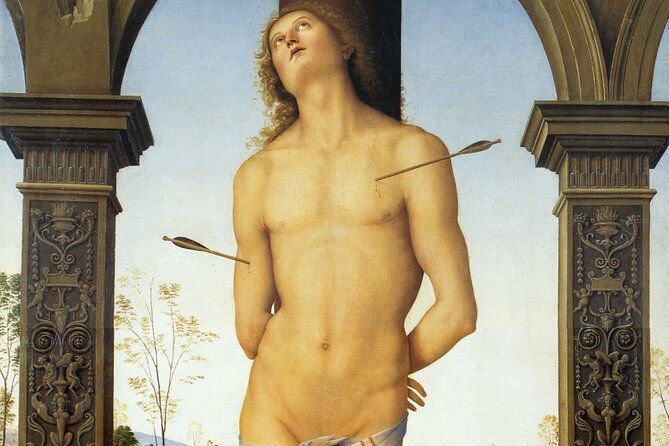
The Neoclassicism gallery offers a change in tone. Its paintings are elegant, controlled, and shaped by renewed interest in the classical world. After the emotional and spiritual changes of earlier periods, Neoclassical artists often favored order, clean lines, and carefully arranged compositions.
This is a good place to connect the earlier Greek and Roman galleries with later European painting. The classical past did not disappear. It returned as a deliberate artistic and political language.
Romanticism provides a sharp contrast. Its paintings are more fiery and dramatic, with stronger emotion, movement, and tension. The route lets you compare controlled Neoclassical design with the forceful mood of Romantic painting.
These final galleries make the tour feel like a course in visual change. You move from ancient models to medieval traditions, Renaissance innovation, Neoclassical restraint, and Romantic drama.
The drawback is that the supplied route describes about fifteen minutes for each stop. That is enough to understand the main idea, but not enough for a slow, detailed look at every major artist. If you want a specialist visit devoted only to one period, ask about that before booking.
What the two-hour format really gives you
Two hours is the right length for a first orientation, not a complete Louvre visit. The museum is far too large to cover thoroughly in one short appointment. A guide can give you a strong framework, but you will still need to make choices.
I see the tour’s greatest practical value in what happens after the formal visit. A guide can show you how the galleries connect and help you decide where to return. Several past bookings have used the remaining time to continue independently after receiving this orientation.
That makes this a useful first visit for someone with limited time in Paris. You are not left wandering through corridors, checking a map every few minutes, or spending half your appointment searching for the Mona Lisa.
The route is also efficient for families and mixed-interest groups. Teenagers may respond to the building, the fortress remains, or dramatic sculpture, while adults may want Renaissance painting or ancient art. A private guide can balance those interests better than a fixed large-group route.
Still, efficiency is not the same as calm. You will walk through large galleries and may encounter crowded rooms. A moderate level of physical fitness is recommended, and you should wear practical shoes.
Is $301.71 per person good value?
At $301.71 per person, this is expensive. The adult museum admission is €22, so most of the cost pays for the private guide and the convenience of a focused route.
For one person, the price is difficult to justify unless saving time and receiving individual attention matter greatly. A solo visitor who wants a serious introduction to the Louvre may still find it worthwhile, particularly on a short Paris trip, but the cost deserves an honest look.
For a couple or family, the value depends on the listed group discount and the size of your party. Because this is a private experience, you are paying for the group rather than joining a large shared tour. A larger party can spread the guide cost across several people, subject to the booking terms.
I would not choose this tour if you want to browse slowly, read every label, or spend an entire morning with one collection. I would consider it if you have two hours, a crowded sightseeing schedule, and no desire to lose time figuring out the museum’s layout.
The strongest reason to pay is not simply skipping a queue. Entry conditions can vary, and the information provided does not promise a guaranteed skip-the-line service. The reliable value is the guide’s ability to meet you, organize the visit, select major works, and help you continue on your own.
Who should book this private Louvre visit?
This suits a first-time visitor who wants the famous works but also wants to understand how they fit together. It is especially useful if you feel uneasy in huge museums or have only a short window in Paris.
It also works well for:
- Solo visitors who want personal conversation instead of a large group
- Families with teenagers who need a flexible pace
- Couples with different interests in painting, sculpture, and ancient art
- Visitors who want an art-history framework before exploring alone
- People who value time more than a low admission cost
Art specialists may find the route too broad unless they arrange a more focused approach. The same is true for repeat Louvre visitors who already know the major galleries.
English is the offered language, so you should be comfortable discussing art and asking questions in English. Food and drinks are not included, but a two-hour museum visit does not require a meal component.
Booking and cancellation details to weigh
Confirmation is provided when you book, and the activity is near public transportation. The meeting point and return point are the Arc de Triomphe du Carrousel, which keeps the plan straightforward.
The booking is non-refundable and cannot be changed for any reason. I would only reserve once your Paris schedule is firm, since illness, altered plans, or a missed appointment will not qualify for a refund under the stated policy.
Bring identification and proof of residency if you are claiming free admission as someone under 18 or an EEA resident under 26. Adults receive the €22 entrance ticket as part of the experience.
My verdict: pay for focus, not just entry
I would book this if the Louvre is important to you but you do not want to spend a day working out its layout. The private format, art-history structure, and ability to tailor the route offer much more than a ticket alone.
I would skip it if you are happy to wander slowly, already know the museum well, or are traveling on a tight budget. At this price, you should treat the visit as a private lesson and orientation, not as a complete tour of the Louvre.
The best use of the two hours is to tell your guide what you care about before entering. Ask for the major highlights, but leave room for less famous works, the medieval foundations, and the connections between art periods. If you do that, this can turn an intimidating museum into a manageable and rewarding first look.
FAQ
How long does the private Louvre visit last?
The visit lasts approximately two hours.
Where does the tour begin?
It begins at the Arc de Triomphe du Carrousel, Place du Carrousel, 75001 Paris, France.
Where does the activity end?
The activity ends back at the meeting point.
Is museum admission included?
Yes. The €22 adult museum entrance ticket is included.
Is the tour private?
Yes. Only your group participates in the activity.
What language is offered?
The tour is offered in English.
Can visitors under 18 enter for free?
Free admission applies to visitors under 18 and EEA residents under 26, provided they show valid identification and proof of residency.
Just listed in Paris
- Chartres Cathedral 5 Hours Tour from Paris with Private Transport★ 4.5 · 49 reviews
- Paris: Giverny & Versailles Small Group or Private Tour★ 4.5 · 49 reviews
- Paris: Louvre photoshoot or Seine bridges Eiffel Tower walk★ 5.0 · 49 reviews
- Private tour of the Champagne area, meet local producers and taste their Champagne, start from your hotel in Paris.★ 5.0 · 50 reviews
- Paris: Choux Pastry and Chocolate Éclair Making Class★ 4.9 · 50 reviews
- Paris Eternelle Notre-Dame Virtual Reality Tour★ 4.5 · 50 reviews
- Normandy D-Day Landing Beaches Private Day Trip from Paris★ 5.0 · 50 reviews
- Disneyland® Paris 1 Day with Round-Trip Train Tickets from Paris★ 4.0 · 50 reviews
Louvre Museum Tours, compared.


Louvre Guided Tour with Reserved Access & Boat Cruise
Read our review →
Louvre Museum Entry Ticket With Host and River Cruise
Read our review →
Mona Lisa & Louvre Masterpieces Tour with Reserved Access
Read our review →
Louvre Museum – Exclusive Guided Tour (Entry Included)
Read our review →
Louvre Museum Hosted Entry and Mona Lisa Audioguide
Read our review →
Louvre Priority Access with Mona Lisa Escort or Guided Option
Read our review →
Browse the lists this tour appears in