
Reviewed · PARIS TOURS
Paris Small-Group Macaron Making Class with a French Chef
Making macarons is less about stirring sugar and more about precision. In this small Paris class, you learn the tricky Italian meringue method, how to fold the batter until it has the right texture, and how to judge doneness by touch. The class takes you from measured ingredients to filled, finished cookies.
I like the maximum group size of six, which gives you real time with the chef instead of watching from the back of a crowded room. I also like the practical focus: you learn why each step matters, receive an English recipe, and leave with macarons you can attempt at home. The main consideration is that this is a focused pastry lesson, not a casual drop-in tasting. It takes about two and a half hours, and the pace can feel intense if you want a loose, social activity.
Key points to know before booking
- Italian meringue method: You learn the more technical technique used for consistent macaron shells.
- Smallest practical group size: Up to six people means the chef can help with mixing, piping, and judging texture.
- Hands-on from start to finish: You make the macaron mixture, prepare ganache, pipe the shells, and add fillings.
- Take-home results: Bags are provided, and many participants leave with roughly 15 macarons to enjoy later.
- English instruction: Recipes are supplied in English, and the chefs teach in English.
- Good for older children: The minimum age is 12, with one registered adult required for each child.
Why this Paris macaron class is worth your morning
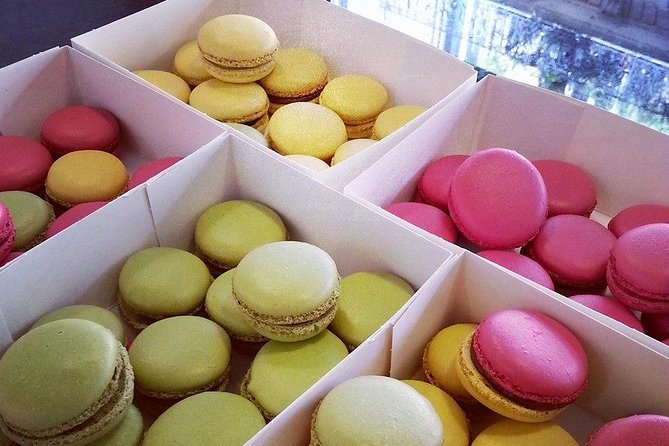
Macarons look simple in a pastry case, but they are famously fussy to make. The shells need the right consistency, the meringue must hold its shape, and the finished cookies should be crisp outside with a softer center. A small error in mixing or piping can change the result.
That is why this class offers more than a sweet snack. You get a working lesson in French pastry technique, with a chef explaining not just what to do but why you are doing it. That extra explanation matters once you return home and try the recipe without someone standing beside you.
The session costs about $114.65 per person. That is not cheap for a Paris activity, but it includes the professional chef, all ingredients and equipment, apron, English recipes, tea and coffee, take-home bags, and the macarons you make. It also includes an Everyday Gourmet French Tarts eBook as part of the provider’s 10th anniversary offer.
I see the price as fair if you value instruction and a souvenir you can eat. It is less compelling if you only want to taste macarons, since Paris pâtisseries offer that for far less. Here, you are paying for the skill, the small class, and the chance to repeat the experience in your own kitchen.
A few other Paris half-days to compare
- Fragonard Paris: Mini Perfume Workshop
★ 4.5 · 1,924 reviews - Paris Cooking Class and Lunch with Wine plus Market Visit Option
★ 5.0 · 1,024 reviews - Paris Croissant Small-Group Baking Class with a Chef
★ 5.0 · 910 reviews
Arriving at Patisserie a la Carte on Rue Thimonnier
The class begins at 9 Rue Thimonnier, 75009 Paris, and finishes at the same location. The address is near public transportation, and you should give yourself extra time to find the building and navigate the surrounding streets.
One useful detail is the late-arrival rule. After five minutes, the class begins without anyone who has not arrived. After 15 minutes with no one present, the class can be cancelled and treated as a last-minute non-refundable cancellation. In practical terms, do not cut this one close. Paris transport can be easy to use, but a short walk, an unfamiliar street, or a wrong turn can cost you those five minutes.
The setting is a working pastry classroom rather than a sightseeing stop. That is part of the appeal. You are stepping away from the usual museum and monument route and spending a few hours doing something with your hands. It is a good choice for a morning or afternoon when you want a quieter break from walking.
The first lesson: Italian meringue and careful measuring
The class uses the Italian meringue method. This approach is more technical than simpler macaron methods, but the aim is reliable results. You learn how the ingredients work together and how exact measurements affect the finished shells.
Ingredients are prepared with precision, but this does not mean you simply watch the chef work. You still mix the components, handle the batter, and take part in the steps that determine the final texture. The chef watches your technique and offers corrections when needed.
The central skill is often called macaronage, the process of folding the mixture until it is smooth enough to pipe without becoming runny. You learn to look at the batter and feel its movement rather than relying only on a timer or a written recipe.
This is where the class can feel more advanced than a basic cooking demonstration. One participant described it as intense and suited to someone who has already taken baking classes. That is useful context. You do not need to be an experienced baker, but you should be ready to concentrate and follow precise directions.
Piping shells and learning when they are done
After the batter is ready, you pipe the macaron shells. This is a small step with a large effect. Even shapes help the shells bake evenly and make it easier to pair them later.
The chef guides you through the process and points out the little habits that prevent common mistakes. You learn how the batter should settle after piping and how to recognize when the shells have baked enough. Rather than depending only on cooking time, the class teaches you to judge the result by touch.
That hands-on correction is one of the best reasons to choose a group capped at six. You can ask for help while you are working, not only after the whole class has moved on. Several instructors have been praised for patient, clear teaching, including Gaëlle, Hiba, Marie, Julie, and Gail. The exact chef may vary, but the class is designed around individual guidance.
The pace is still real. You may work in pairs for certain preparations, so not every task is performed alone from beginning to end. That is normal in a small cooking class, but it is worth knowing if you expect six completely separate pastry stations.
Same city, a completely different afternoon:
- Paris: Louvre Museum Timed-Entrance Ticket
★ 4.6 · 71,977 reviews - Disneyland® Paris 1-Day Ticket
★ 4.6 · 49,412 reviews - Paris: Versailles Palace and Gardens Full Access Ticket
★ 4.6 · 41,579 reviews - Paris: Evening River Cruise with Music
★ 4.4 · 22,721 reviews
Preparing the ganache filling
While the shells are being prepared, you learn to make the ganache. The lesson includes the proper way to hold the whisk for a smooth mixture, along with small techniques that help keep the filling glossy and well blended.
The filling is what turns two shells into a finished macaron, so this part deserves attention. A shell can look perfect, but a grainy or poorly mixed ganache will spoil the texture. The chef shows you how to work the mixture and how to tell when it is ready for piping.
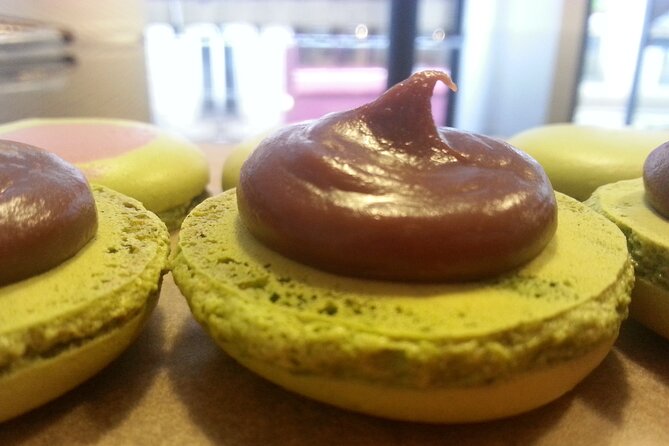
The class also introduces different flavor and garnish options. Possibilities include chocolate ganache, pistachio, vanilla, raspberry, chocolate shavings, and passionfruit. The exact flavors made during your session are not specified, so think of these as examples of the range you may learn about rather than a guaranteed tasting menu.
This section is useful for home bakers because it encourages you to think beyond one fixed recipe. Once you understand the shell and filling methods, you can begin adapting the finished macarons with different flavors and decorations.
Finishing, filling, and tasting the macarons
The final stage brings the pieces together. You pair the shells, pipe in the ganache, and add garnishes. It is satisfying because the process is visible: a bowl of ingredients has become a tray of French pastries.
You can eat the finished macarons during the class, or place them in take-home bags. The number varies with the batch, but one family reported taking home about 15 macarons. That makes the class feel like both a lesson and a useful edible souvenir.
Tea and coffee are included, giving you a simple pause during the work. This is not presented as a full meal, so plan other food around it if you need lunch or breakfast. The focus remains pastry, with the drinks serving as a pleasant extra.
The macarons are gluten-free, which is important for anyone avoiding gluten. Still, you should report all allergies or special dietary needs when booking. Gluten-free does not automatically mean free from every other allergen, and the available information does not promise a fully allergen-free environment.
How the teaching style may shape your experience
The strongest pattern in the class is clear instruction. Participants describe chefs who explain the process step by step, offer useful tips, and make a difficult recipe feel manageable. Several parents found the lesson worked well with teenagers, including children aged 13, 14, and 16.
Gaëlle receives especially strong praise for checking each stage and knowing when ingredients were ready. Hiba is described as patient with a younger baker and good at giving direction. Marie is praised for taking the class through the complete process, while Julie helped make the recipe easy to repeat at home.
Teaching style can vary from one session to another. One participant found the chef too businesslike and wished for more energy. That is a fair caution. This is a technical class, and some instructors may emphasize accuracy over theatrical entertainment. If you want a lively cooking show, this may feel restrained. If you want to learn the method properly, that calm focus can work in your favor.
The small format also makes the social side pleasant without taking over the activity. You meet the other people in the group, but you still have enough structure to stay focused on the pastry.
Who should book this experience?
I would recommend this class to first-time bakers who want a clear introduction to macarons, as well as experienced home bakers who have struggled with failed batches. One participant took the class after several unsuccessful attempts and finally produced macarons successfully. That is a strong sign that the guidance addresses the usual trouble spots.
It also suits families with older children. The minimum age is 12, and each child must attend with a registered adult. A parent and teenager can share the work and come away with a skill they can repeat together. Younger children cannot join under the stated rules.
The class is a good fit for couples, friends, and solo visitors who enjoy food activities. A solo participant may receive especially close attention if the group is small, though the exact class size can change. The maximum is six, not a promise that every session will have six people.
You may want to skip it if your Paris schedule is packed tightly. The class lasts about two and a half hours, and you need to allow time to reach Rue Thimonnier. It is also not ideal if you dislike precise instructions, standing at a work surface, or sharing some preparation tasks with a partner.
Planning the class into your Paris itinerary
Because the activity begins and ends at the same address, it is easy to pair with other plans in the same general part of the city. Still, avoid booking a timed museum entry or train immediately afterward. The stated duration is approximate, and the class may take about two and a half hours even with only four people.
Booking well ahead is sensible. This experience is often reserved about 31 days in advance, and confirmation arrives within 48 hours, subject to availability. The small capacity means popular dates can fill earlier than larger food tours.
The cancellation policy is flexible if your plans change: you can cancel for a full refund up to 24 hours before the start time. Changes or cancellations made inside that window are not accepted for a refund. Cutoff times follow local Paris time.
Final decision: should you book it?
Book this class if you want to learn a real French pastry technique, not simply eat a macaron. The six-person limit, English recipe, patient instruction, equipment, and take-home pastries give the $114.65 price a reasonable purpose.
I would especially choose it for a parent and teenager, a serious home baker, or anyone who has tried macarons at home and failed. Skip it if you need a fast activity, a full meal, or a highly theatrical chef-led show. For the right baker, this is a sweet Paris memory with a practical afterlife in your own kitchen.
FAQ
Where does the macaron class begin and end?
The class begins at 9 Rue Thimonnier, 75009 Paris, France, and ends back at the same meeting point.
How long does the class last?
The experience lasts approximately two hours and 30 minutes.
Is the class taught in English?
Yes. English instruction is offered, and an English copy of the recipes is included.
What is included in the price?
The experience includes a professional French pastry chef, all cooking equipment, ingredients for the class, an apron, English recipes, take-home bags, tea, coffee, and the Everyday Gourmet French Tarts eBook offered for the provider’s 10th anniversary.
What is the minimum age?
The minimum age is 12. Children must attend with a registered adult, with one adult required for each child.
Can I cancel for a full refund?
Yes. You can cancel at least 24 hours before the experience start time for a full refund. Cancellations or changes made less than 24 hours before the start time are not accepted for a refund.
Just listed in Paris
- Chartres Cathedral 5 Hours Tour from Paris with Private Transport★ 4.5 · 49 reviews
- Paris: Giverny & Versailles Small Group or Private Tour★ 4.5 · 49 reviews
- Paris: Louvre photoshoot or Seine bridges Eiffel Tower walk★ 5.0 · 49 reviews
- Private tour of the Champagne area, meet local producers and taste their Champagne, start from your hotel in Paris.★ 5.0 · 50 reviews
- Paris: Choux Pastry and Chocolate Éclair Making Class★ 4.9 · 50 reviews
- Paris Eternelle Notre-Dame Virtual Reality Tour★ 4.5 · 50 reviews
- Normandy D-Day Landing Beaches Private Day Trip from Paris★ 5.0 · 50 reviews
- Disneyland® Paris 1 Day with Round-Trip Train Tickets from Paris★ 4.0 · 50 reviews
Paris Tours, compared.



Versailles Palace and Gardens Full Access Ticket
Read our review →

Eiffel Tower Entry Ticket with Optional Summit Access
Read our review →

Louvre Guided Tour with Reserved Access & Boat Cruise
Read our review →
Moulin Rouge Cabaret Show Ticket with Champagne
Read our review →Browse the lists this tour appears in