
Reviewed · LOUVRE MUSEUM TOURS
Louvre Museum Guided Family Treasure Hunt
The clever trick here is simple: your children become art detectives. Instead of dragging them through endless galleries, a private guide leads your family to the Venus of Milo, Winged Victory of Samothrace, and Mona Lisa while the kids solve clues in their own activity booklets. I like the age-matched material for children 3 to 6 or 7 to 12, and I like that the guide does the museum navigation for you.
I also like the manageable two-hour length. It gives your family a real taste of the Louvre without turning the morning into an endurance test. The main caution is the price, $760.28 for up to four people, which is a serious splurge for a short visit. It makes the most sense when you value a private guide and need help keeping young children interested.
Key points at a glance
- Your children lead the mystery: Each child receives an activity booklet designed for a specific age group.
- Three Louvre icons are guaranteed targets: The route includes the Venus of Milo, Mona Lisa, and Winged Victory of Samothrace.
- A private English-speaking guide keeps the pace personal: Only your group takes part, so the guide can respond to your children.
- The visit lasts about two hours: That is long enough for major highlights, but short enough for most younger children.
- Adult timed-entry tickets are included: The package includes €32 Louvre tickets for adults, while eligible children may enter free with proper identification.
- The focus is firmly family-oriented: Adults receive art and building history too, but this is not designed as a full Louvre survey.
Why this Louvre visit works for families
The Louvre can overwhelm adults, let alone children. It is huge, crowded, and packed with famous objects competing for your attention. A family treasure hunt gives the visit a clear purpose: find the next masterpiece, answer a question, and move on before interest fades.
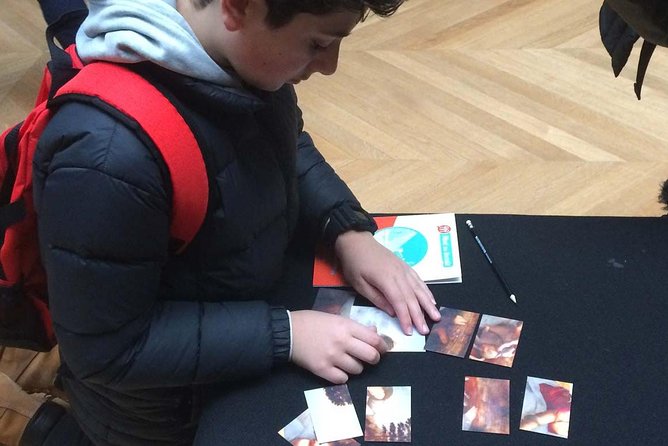
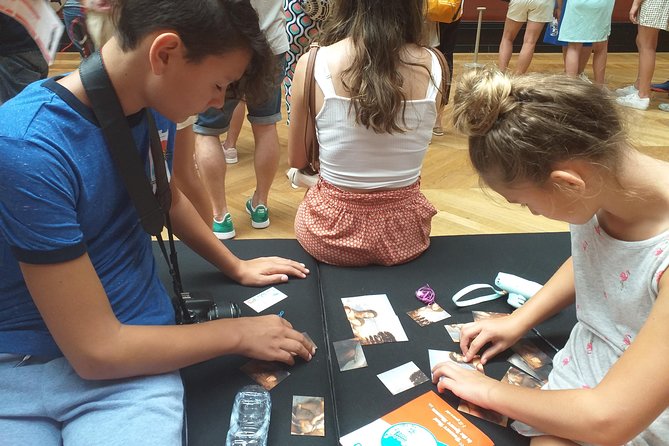
That structure matters. Your children are not simply standing beside you while an adult listens to a lecture. They look closely at the art, hunt for visual clues, and answer questions about what they see. The booklet gives them something to hold and complete, then take home as a reminder of the visit.
I especially like the way the questions connect looking with storytelling. Your child may consider why the Mona Lisa smiles or search for clues in Napoleon’s coronation. These are simple questions, but they encourage the habit that museums hope to teach: look first, then ask why.
The private format helps too. You are not joining a large group with a fixed script and a single pace. Your guide can pause for a child who is curious, simplify an explanation, or move along when energy drops. That flexibility appears especially useful for families with mixed ages.
The experience is offered in English. Guides named in family feedback include Cindy, Marcela, Philippe, Justine, Yaelle, Marine, Laura, Sean, Tetiana, Jessica, Laurine, and Quintin. Your guide will vary, but the strongest pattern is clear: the role calls for patience, playfulness, and a firm grasp of art history.
A few other Paris half-days to compare
- Paris: Louvre Museum Timed-Entrance Ticket
★ 4.6 · 71,977 reviews - Paris: Louvre Guided Tour with Reserved Access & Boat Cruise
★ 4.3 · 16,353 reviews - Louvre Museum Masterpieces Guided Tour with Access
★ 4.5 · 12,023 reviews
Meeting your guide at Place du Carrousel
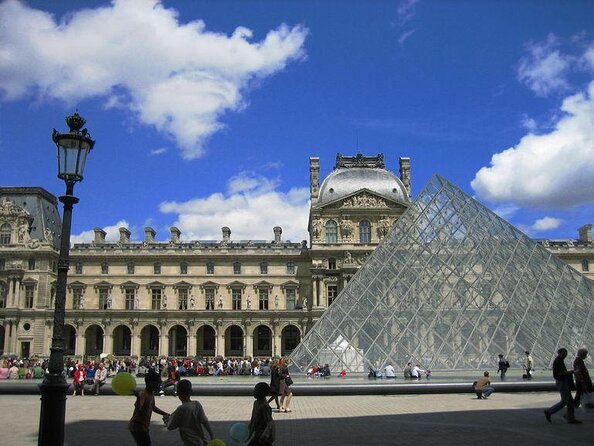
You begin at 8 Place du Carrousel, near the Louvre. Your guide waits there for your private group, and the tour ends back at the same meeting point after the museum visit.
This location is practical because it places you beside the Louvre rather than asking you to find your way through the museum’s vast interior. Still, allow enough time to reach the meeting point. The experience includes a mobile ticket, but you are responsible for getting to the attraction.
Once everyone is together, the children receive their activity books. The materials are prepared for two broad age levels, 3 to 6 and 7 to 12. That distinction is useful. A preschool child needs picture-based prompts and simple tasks, while an older child can handle questions about symbols, characters, and artistic choices.
The booking information lists the price for four people as a family of two adults and two children. All participants must be included in the reservation, even children who qualify for free admission. You must provide children’s names and birthdates in advance.
The Louvre Palace becomes part of the game
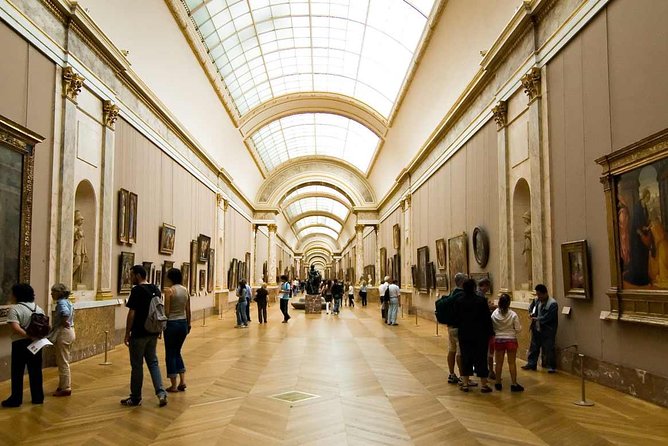
The museum is not only a place filled with paintings and sculptures. The building itself was once a palace, and the treasure hunt uses that setting to give the visit a sense of discovery.
Your guide leads you through the museum rather than leaving you to find the major works on your own. That saves precious time. At the Louvre, a wrong turn can cost more than a few minutes, especially when everyone is trying to keep a child moving.
The building’s grand scale can be exciting for children, but it can also be tiring. Expect a fair amount of walking through large rooms and corridors. A moderate level of physical fitness is recommended, and one family ran into difficulty when a stroller and a broken elevator created an access problem with security.
That stroller experience is worth taking seriously. The tour may work well for younger children, but the museum’s entrances, elevators, and security procedures can affect how easily a family moves through the building. If you plan to bring a stroller, confirm current access arrangements before you go. The supplied information does not promise special stroller handling.
Venus of Milo: a strong first art lesson
The Venus of Milo is one of the Louvre’s most recognizable sculptures. Children usually respond well to it because the missing arms create an immediate question. What happened to them? What might the statue have been holding? Why was the figure made this way?
Your guide can use the sculpture to introduce Greek mythology, ancient art, and the way museums preserve incomplete works. One family specifically enjoyed learning about Greek mythology during the tour, and that kind of story-based explanation is exactly what helps a young mind stay with the subject.
For adults, the Venus provides a quick reminder that the Louvre’s famous objects are not famous by accident. You see the work, hear the basic context, and watch your children form their own theories. The booklet turns that moment into a task instead of a passive stop.
Do not expect a long scholarly talk here. The goal is to make the sculpture understandable and memorable. If you want detailed discussion of Greek sculpture, this family format may feel light. For a first museum visit with children, the lighter touch is likely the better choice.
More museums in Paris:
- Paris: Louvre Museum Entry Ticket With Host and River Cruise
★ 4.6 · 9,926 reviews - Les Invalides: Napoleon’s Tomb & Army Museum Entry
★ 4.6 · 9,185 reviews - Louvre Museum – Exclusive Guided Tour (Entry Included)
★ 5.0 · 6,296 reviews - Paris: Louvre Museum Hosted Entry and Mona Lisa Audioguide
★ 4.6 · 5,235 reviews
Winged Victory of Samothrace and the power of movement

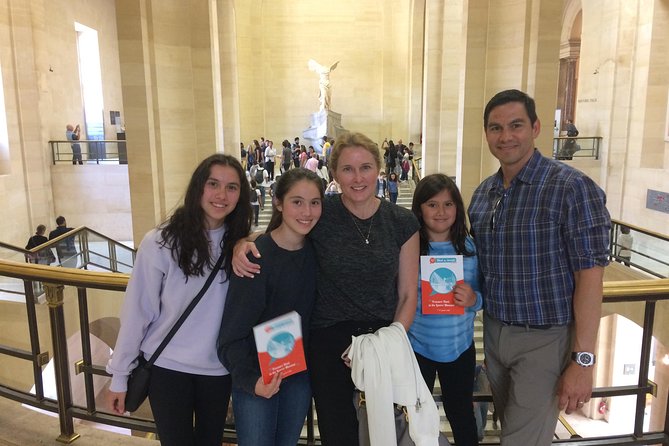
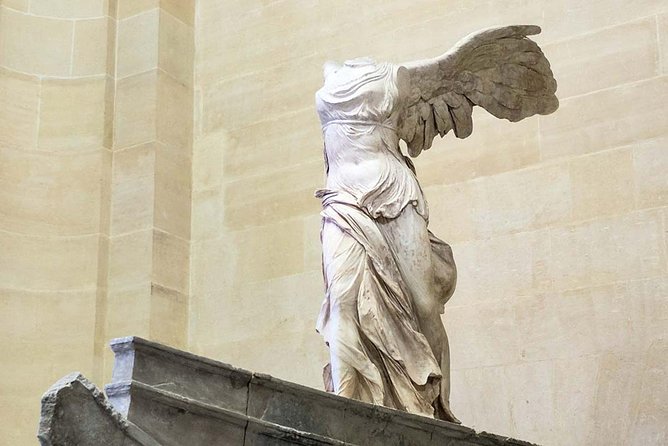
Winged Victory is an excellent choice for a family route because it is dramatic even before anyone explains it. The sculpture sits high on a monumental staircase, and its sweeping wings and windblown clothing suggest motion.
Children can look for signs of movement. What makes the figure seem to be advancing? How does the pose affect the way you feel when you approach it? These questions help children understand that sculpture can suggest action without actually moving.
The staircase and the scale of the work also give the route variety. After paintings and smaller objects, this is a large, theatrical stop. Your guide can explain the subject and setting in accessible terms, while the children use their booklet to spot details.
The tradeoff is that popular Louvre highlights can be busy. You may not get a quiet, private view of every masterpiece. The value of your guide is not solitude. It is knowing where to go, what to look for, and how to keep the visit moving.
Mona Lisa: the payoff for many children
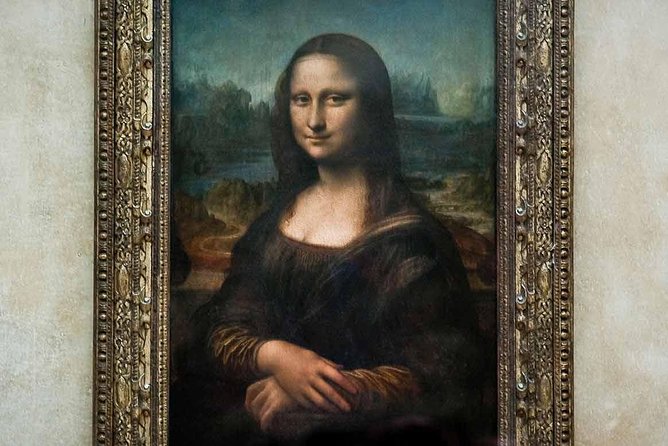
For many families, seeing the Mona Lisa is the moment the children have been waiting for. The painting is small compared with the grand rooms around it, and the crowd can make the viewing feel brief. A guide helps you approach the stop with realistic expectations.
The booklet gives children a job while they look. Instead of simply trying to get close for a photograph, they can study the face, pose, and famous smile. The question about why she smiles invites several answers, which is more useful than presenting one official explanation.
The Mona Lisa is also a good lesson in how fame shapes a museum visit. Your guide can explain why a relatively small portrait attracts such attention, then help your children compare public excitement with what they actually notice in the painting.
This is not a long, relaxed viewing. The exact time at the painting can depend on crowd conditions and the group’s pace. If the Mona Lisa is your main reason for booking, remember that the tour also includes the Venus of Milo, Winged Victory, palace spaces, and other works along the way.
What the activity booklet adds
The booklet is the heart of the experience. Each child gets one, and the material is adjusted for the two stated age groups. It gives your family a shared project and gives children a record to keep after the visit.
The tasks encourage careful observation. Your child may need to find a detail, answer a question, or solve part of the mystery. That approach works particularly well for children who enjoy puzzles, clues, and collecting small achievements as they move from one stop to the next.
Several families found that children stayed interested for the full visit because they were looking for clues. One family with children ages 6, 9, and 11 found the two-hour route manageable, while another family with children ages 5, 8, and 11 appreciated the guide’s patience when everyone was tired and jet-lagged.
A booklet cannot solve every problem. A tired child may still be tired, and an older teenager may find the activities aimed too young. The strongest fit is probably families with children in the 3 to 12 range, especially those who enjoy games and questions.
How adults fit into this family tour
This is not a children-only performance. Adults can learn about the artworks, the palace, and the stories behind the objects. Guides such as Marcela and Philippe were praised for giving the whole family useful historical and art context, not just entertaining the children.
Still, you should book with the right expectation. The tour is built around keeping children engaged, so the explanations are designed to be clear, lively, and age-appropriate. If you want an extended discussion of French painting, the Louvre’s complete collection, or every major gallery, you will need more time and perhaps a different tour.
I see the best use of this experience as a first Louvre visit. You get your bearings, see the essential icons, and leave before the museum becomes too much. You can always return later for a longer adult-focused visit.
The private setting is particularly useful for families with different ages. An 8-year-old can work on the booklet while a 13-year-old listens to a more detailed explanation. One family included a senior, parents, an 8-year-old, and a 13-year-old, and the guide managed to keep the group involved. That is a good sign for multigenerational families, though each child’s patience will differ.
Is $760.28 a fair price?
At $760.28 per group of up to four, this is expensive. If you divide the cost among two adults and two children, the price is easier to understand, but it remains a premium for about two hours.
The package includes private guiding, children’s activity booklets, and €32 timed-entry tickets for each adult. Children under 18 and eligible European Economic Area residents under 26 may enter free with valid identification and proof of residency. Even then, everyone must be named on the booking.
The real purchase is not simply admission. You are paying for a guide who knows the route, frames the famous works for children, and manages the pace for your particular family. That can be good value if the alternative is a frustrating visit where your children lose interest after the first gallery.
For a family of four that wants help making the Louvre work, the cost may be justified. For two adults who mainly want art history, it is harder to defend. You would be paying for a family method you may not need.
The experience is often booked around 60 days ahead, so popular dates may require planning. The booking includes free cancellation up to 24 hours before the start time. Changes or cancellations inside that window are not accepted for a refund.
Timing, walking, and practical limits
The visit lasts about two hours, though one family experienced a shorter visit of roughly 80 minutes and felt rushed. That is a useful reminder to confirm the timing with your guide at the start and to speak up if your group needs a slower pace.
Two hours is a sensible target for younger children. It is long enough to reach the main works and short enough to avoid the afternoon slump. If your child is jet-lagged, hungry, or prone to museum fatigue, schedule food before or after the tour rather than expecting the visit to carry the whole day.
Food, snacks, and alcoholic drinks are not included. Transportation to and from the attraction is also not included, aside from bus tickets during the tour. The meeting point is near public transportation, so you can plan your route separately.
The tour is offered in English and is private. Only your group participates, which makes it easier to ask questions and adjust the pace. You should still expect walking through the museum and should plan for a moderate physical effort.
Who should book the Louvre treasure hunt?
I would choose this for parents of children ages 3 to 12 who want the Louvre’s greatest hits without managing the route alone. It is also a good match for families who find that games, clues, and short challenges work better than long explanations.
It suits first-time Louvre visitors, mixed-age groups, and parents who want to enjoy the art themselves while a guide gives the children a reason to pay attention. The many strong guide experiences, especially those involving Cindy, Marcela, Laura, Marine, Laurine, and Sean, point to the importance of a warm, patient guide.
I would hesitate if your children are older teenagers seeking serious art analysis, or if you want to spend hours in one department. I would also think twice if the price is a major concern or if you need guaranteed stroller access without checking current conditions.
Should you book it?
Book it if your goal is a focused, cheerful introduction to the Louvre. The private format, age-based booklets, and clear route take much of the stress out of bringing children to one of Europe’s largest museums.
Skip it if you want a long, adult-focused art tour or a low-cost museum visit. For the right family, the price buys more than entry: it buys a plan, a pace, and a guide who can turn the Mona Lisa, Venus of Milo, and Winged Victory into a shared family adventure.
FAQ
Where does the Louvre family treasure hunt start?
It starts at 8 Place du Carrousel, 75001 Paris, France, near the Louvre Museum.
Where does the activity end?
The activity ends back at the meeting point after the Louvre visit.
How long does the Louvre treasure hunt last?
The tour lasts approximately two hours.
Is the tour private?
Yes. This is a private activity, so only your group participates.
Is the tour offered in English?
Yes. The experience is offered in English.
What ages are the activity booklets designed for?
The booklets are designed for two age ranges: children ages 3 to 6 and children ages 7 to 12.
Which Louvre artworks are included?
The route includes the Venus of Milo, the Mona Lisa, and the Winged Victory of Samothrace, along with other museum highlights.
Are Louvre admission tickets included?
Timed-entry tickets for adults, listed as €32 per adult, are included. Children under 18 and eligible EEA residents under 26 may enter free with valid identification and proof of residency.
Do children need to be included in the booking?
Yes. Every participant must be included, even children who qualify for free admission. Children’s names and birthdates must be supplied in advance.
Is food included?
No. Food, snacks, and alcoholic beverages are not included.
How far in advance can I cancel?
You can cancel up to 24 hours before the experience for a full refund. Cancellations or changes made less than 24 hours before the start time are not accepted for a refund.
Just listed in Paris
- Chartres Cathedral 5 Hours Tour from Paris with Private Transport★ 4.5 · 49 reviews
- Paris: Giverny & Versailles Small Group or Private Tour★ 4.5 · 49 reviews
- Paris: Louvre photoshoot or Seine bridges Eiffel Tower walk★ 5.0 · 49 reviews
- Private tour of the Champagne area, meet local producers and taste their Champagne, start from your hotel in Paris.★ 5.0 · 50 reviews
- Paris: Choux Pastry and Chocolate Éclair Making Class★ 4.9 · 50 reviews
- Paris Eternelle Notre-Dame Virtual Reality Tour★ 4.5 · 50 reviews
- Normandy D-Day Landing Beaches Private Day Trip from Paris★ 5.0 · 50 reviews
- Disneyland® Paris 1 Day with Round-Trip Train Tickets from Paris★ 4.0 · 50 reviews
Louvre Museum Tours, compared.


Louvre Guided Tour with Reserved Access & Boat Cruise
Read our review →
Louvre Museum Entry Ticket With Host and River Cruise
Read our review →
Mona Lisa & Louvre Masterpieces Tour with Reserved Access
Read our review →
Louvre Museum – Exclusive Guided Tour (Entry Included)
Read our review →
Louvre Museum Hosted Entry and Mona Lisa Audioguide
Read our review →
Louvre Priority Access with Mona Lisa Escort or Guided Option
Read our review →
Browse the lists this tour appears in