
Reviewed · LOUVRE MUSEUM TOURS
Louvre Museum – Highlights Tour with Mona Lisa
The Mona Lisa is only one piece of the puzzle here. This tour leads you through the Louvre’s vast palace and its best-known art, from Winged Victory of Samothrace to Michelangelo’s Slaves, so you spend less time staring at a map and more time looking at masterpieces.
I like two things right away: the guide gives the art a human story, and the skip-the-line entry saves precious Paris time. Guides such as Avi, Omar, Claire, Laurence, and Felix have been singled out for clear explanations, humor, and strong storytelling.
The tradeoff is pace. In two hours, you can see the museum’s famous highlights, but you cannot linger over every painting. If you want quiet, sustained time with the art, choose the three-hour closing-time option or plan a separate Louvre visit.
Quick takeaways for this Louvre tour
- Mona Lisa and major masterpieces: See Leonardo’s famous portrait, Michelangelo’s Slaves, and Winged Victory in one organized route.
- A palace as well as a museum: Your guide explains the Louvre’s royal past, grand stonework, frescoes, and political dramas.
- Skip-the-line admission: Your guide handles the group’s museum entry, which can be valuable when regular tickets are sold out.
- English-speaking guidance: Stories and art-history context make the collection easier to understand, even if you know little about art.
- Several start times: You can fit the visit around other Paris plans, including a closing-time option lasting about three hours.
- Groups capped at 20: The group is not private, but the maximum is more manageable than a large bus-style outing.
Why a guide helps inside the Louvre
The Louvre is not simply a large museum. It is an enormous former palace with several wings, levels, and collections. On a first visit, the challenge is not finding something interesting. It is deciding what deserves your limited time.
That is where this tour earns its keep. You follow a planned route instead of wandering into a gallery, losing your bearings, and discovering an hour later that you are nowhere near the Mona Lisa. The headset also matters. In a crowded room, you can hear the guide without needing to stand shoulder to shoulder.
The goal is an introduction, not a complete survey. You will see a short list of major works and hear why they matter. A good guide can turn a name such as Delacroix or Géricault into a story about artistic choices, politics, and people.
The strongest guide feedback centers on this storytelling. Avi is praised for being funny and well informed. Omar is noted for keeping the group involved while adding facts about the art and building. Claire is described as especially good at covering the main works without losing the group. Laurence brings detailed painting and sculpture explanations, while Felix reportedly makes the Louvre’s past feel immediate and lively.
Guide quality can vary from day to day, as it does on any shared tour. Still, the repeated pattern is clear: this experience works best when you want interpretation, not just admission.
A few other Paris half-days to compare
- Paris: Louvre Museum Timed-Entrance Ticket
★ 4.6 · 71,977 reviews - Paris: Louvre Guided Tour with Reserved Access & Boat Cruise
★ 4.3 · 16,353 reviews - Louvre Museum Masterpieces Guided Tour with Access
★ 4.5 · 12,023 reviews
Meeting at the Arc de Triomphe du Carrousel
The tour begins at the Arc de Triomphe du Carrousel, at Place du Carrousel near the Louvre. This is a useful starting point because it places you directly in the monumental setting of the former royal complex.
Do not confuse it with the larger Arc de Triomphe at the end of the Champs-Élysées. The Carrousel arch is the smaller triumphal monument beside the Louvre and Tuileries area. The stated meeting address is Pl. du Carrousel, 75001 Paris.
Arrive early. The tour company’s directions emphasize meeting the guide before entry, and the Louvre area can be confusing when several groups gather around the same landmarks. Bring your booking reference and identification, and check the latest time shown in your current confirmation.
This point is worth taking seriously. Some missed visits have involved confusion over changed times, unclear messages, or failure to find the guide. The group ticket is held for entry with the guide, so you cannot count on simply arriving late and using the ticket alone. If a flight delay threatens your arrival, contact the operator through the channel given in your confirmation, and do not assume ordinary text messages will reach the guide.
The Carrousel and Louvre Pyramid orientation
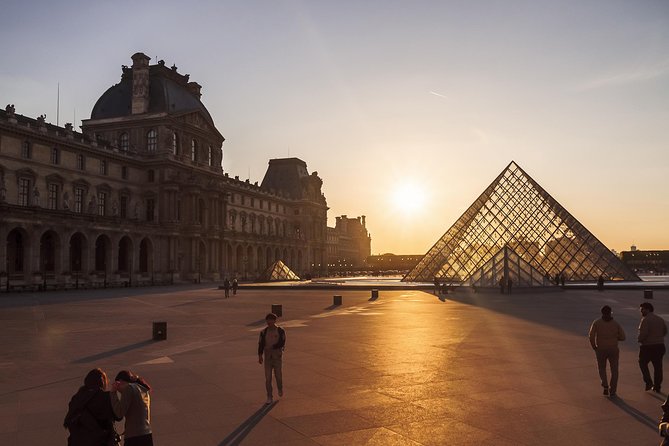
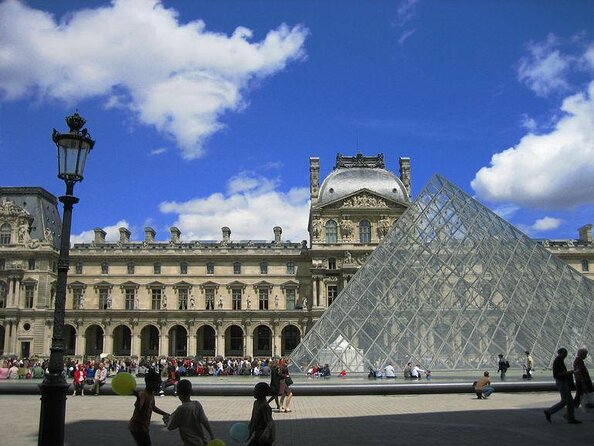
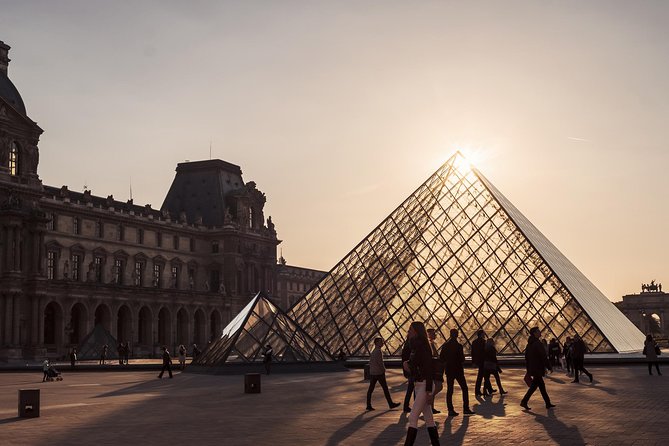
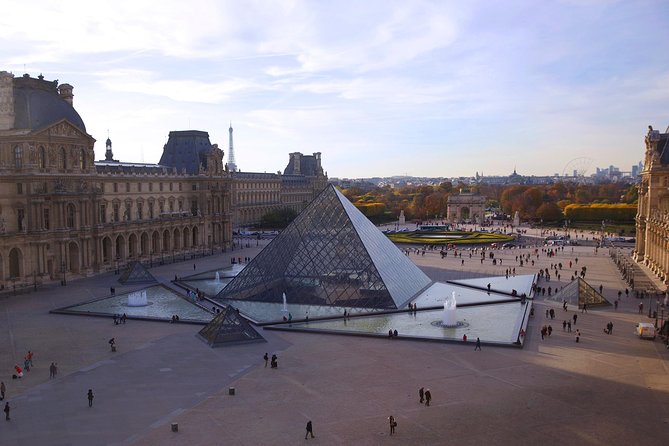
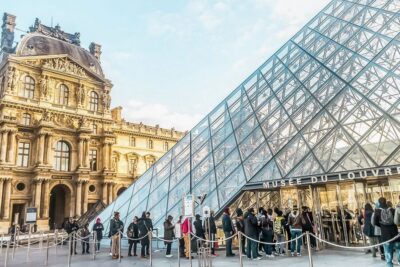
Before the galleries, the route includes the Place du Carrousel and the Louvre Pyramid area. These spaces help you understand the museum’s scale and its layered past.
The pyramid is the modern glass entrance symbol most people associate with the Louvre. Around it, the older palace wings make the contrast plain: the museum is both a historic royal residence and a modern public institution.
This outside portion is brief, but it gives the visit a useful frame. You are not entering an isolated art box. You are walking into a palace complex that developed over centuries. The guide may also point out nearby features around the Place des Pyramides, another stop listed for the experience.
The practical benefit is simple: you begin with orientation. You know where you are meeting, where the museum sits, and why the building itself deserves attention.
Entering the galleries with skip-the-line admission
The included museum ticket is one of the main reasons to consider this tour, especially if regular Louvre admission is sold out. It does not mean every security or crowd delay disappears, and it does not give you unlimited control over the route. It means you have an organized entry arrangement rather than trying to solve admission on your own.
Once inside, stay close to the guide and listen for directions through the headset. The group size can reach 20 people, so this is not the intimate feel of a private guide. On the other hand, a cap of 20 keeps it more workable than a huge group, especially when moving through busy corridors.
The tour lasts about two to three hours. The standard visit is described as about two hours, while the closing-time choice extends to roughly three hours. Your route may change if a gallery or room is closed, since the museum can alter access during the day.
That flexibility is important. You are buying a guided overview, not a promise that every named room will be open at every visit.
More museums in Paris:
- Paris: Louvre Museum Entry Ticket With Host and River Cruise
★ 4.6 · 9,926 reviews - Les Invalides: Napoleon’s Tomb & Army Museum Entry
★ 4.6 · 9,185 reviews - Louvre Museum – Exclusive Guided Tour (Entry Included)
★ 5.0 · 6,296 reviews - Paris: Louvre Museum Hosted Entry and Mona Lisa Audioguide
★ 4.6 · 5,235 reviews
Mona Lisa: famous, crowded, and easy to misunderstand
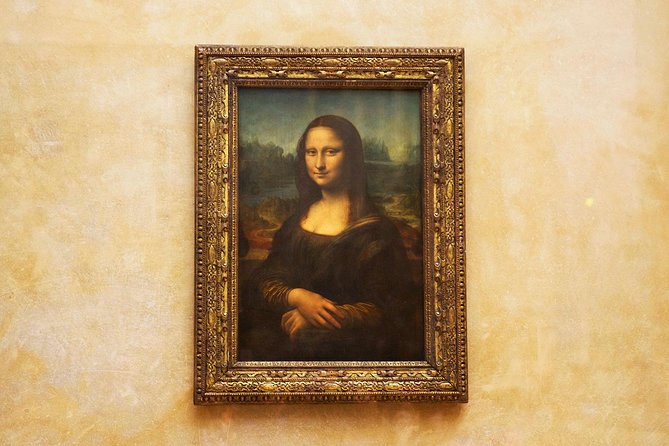
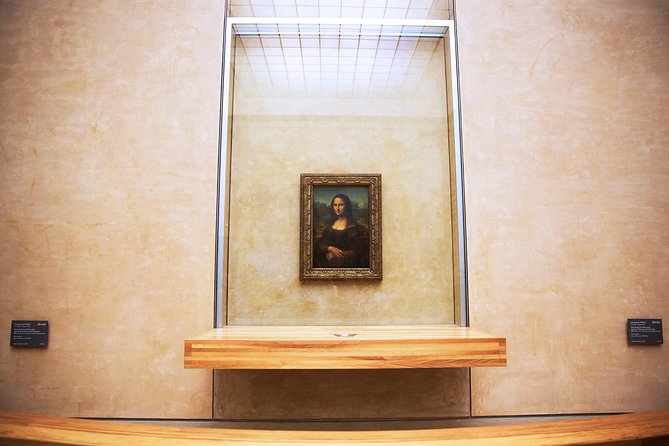
The Mona Lisa is the headline work, and the tour makes sure it is part of the route. You will likely encounter a crowd gathered around the painting, with people trying to get a clear view and take a photograph.
A guide helps by giving the portrait context rather than treating it as a simple photo stop. Leonardo da Vinci’s painting is famous for many reasons, but the experience of seeing it in person can be surprisingly quick. The room may be noisy, and your viewing angle may be limited.
This is also where the tour’s brisk pace can be most noticeable. You may get the explanation, a chance to see the painting, and then move on. Families should think about height and crowd conditions. One family reported that a young child could not see over the people in front, with no alternate arrangement offered.
For that reason, do not sell the Mona Lisa visit to a small child as a guaranteed long look. If the painting is your sole reason for entering the Louvre, understand that the crowd is part of the experience.
Winged Victory and the power of a staircase
The Winged Victory of Samothrace is one of the museum’s great visual moments. The ancient sculpture is placed at the top of a dramatic staircase, where its forward motion and spread wings make sense from a distance.
Your guide can help you notice details that are easy to miss while people stream past. The missing head and arms are not a flaw to be ignored. They are part of the sculpture’s story, and the surviving body still creates a strong sense of wind, movement, and arrival.
This stop also shows why a planned route helps. You are not merely checking off a famous object. You are seeing how the Louvre uses architecture, stairs, and gallery placement to give certain works extra force.
Michelangelo’s Slaves and the human side of sculpture
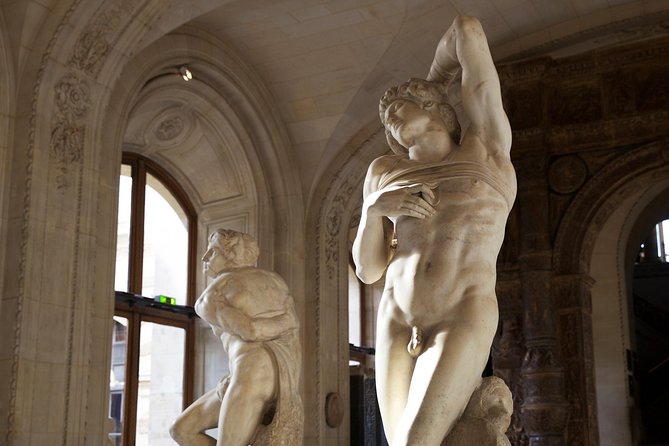
Michelangelo’s Slaves offer a different kind of encounter. These unfinished figures show bodies emerging from stone, and the incomplete surfaces invite questions about process, intention, and the boundary between finished and unfinished art.
The guide’s role here is to slow your eye down. You can look at the strain in the figures, the marks left by carving, and the way the stone seems to resist the bodies. A short explanation adds much more than a label can provide.
This is a good example of the tour’s value for people who do not consider themselves art experts. You do not need a background in Renaissance sculpture to respond to the figures. The guide gives you a few handles for looking, then keeps the route moving.
French painting and stories beyond the headline works
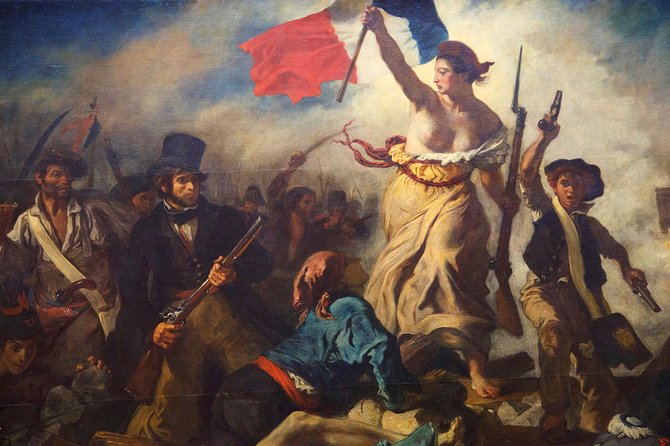
The tour also brings in artists such as Canova, Géricault, Delacroix, and David. These names represent different periods and styles, so the route is not limited to Italian Renaissance icons.
Canova connects the visit to elegant neoclassical sculpture. Géricault and Delacroix open a window onto the drama and emotional force of French Romantic painting. David brings in the political side of art, where paintings can serve public power, national identity, and changing ideas about leadership.
You should not expect a full lesson on each artist. The purpose is to show how the Louvre’s collection moves across time and place. A guide can point out what changes in pose, color, subject, and mood, giving you a basic map for further exploration.
This is where the best guides make a real difference. The most praised performances combine facts with side stories and humor, rather than reciting dates in a flat voice. Felicia, for example, is noted for mixing art information with playful details. That approach can help a long museum visit feel less like a school assignment.
The Louvre building as part of the tour
One unusual feature of this experience is the attention given to the building itself. You will hear about the Louvre’s palace origins, royal dramas, ornate stonework, and painted interiors.
Some people will love this. The building is not background decoration. Its corridors, grand rooms, and layered construction explain why the Louvre feels different from a purpose-built modern museum.
Others may find that the building history takes time away from the art. That is the clearest criticism to keep in mind. If you are visiting with a child or you already know the palace story, you may wish the tour would pause longer in front of the paintings and sculptures.
I see this as a question of priorities. A first-time visitor often benefits from learning both stories: what the Louvre contains and what the Louvre was. Someone returning to study a particular collection may prefer a more focused art tour.
Choosing the closing-time option
The closing-time option offers an extended visit of about three hours, beginning shortly before the museum closes. It is designed for a calmer experience after some crowds have cleared.
That does not guarantee empty galleries. The Mona Lisa and the major sculptures remain popular, and the Louvre is still a major public museum. But the timing may make the route feel less pressured than a busy daytime visit.
The extra hour matters because the standard two-hour format is necessarily brisk. You have more time to listen, move between rooms, and take in the building without feeling that every stop is a sprint.
Choose this option if you can arrange your day around the late start and want the fullest version of the tour. Choose a regular start time if you need flexibility afterward or want to keep your evening open.
Is $95.53 a fair price?
At $95.53 per person, this is not the cheapest way to enter the Louvre. You are paying for more than admission: a skip-the-line group arrangement, an English-speaking guide, a headset, and a fixed route through a difficult museum.
The price makes the most sense when regular tickets are unavailable, you have only a few hours, or you want someone else to handle the route and explain the art. It also protects you from spending your first hour inside the Louvre simply trying to find the famous works.
The value is weaker if you enjoy wandering alone, already know exactly which galleries you want, or want to spend 20 minutes with one painting. In that case, direct admission and a self-guided plan may suit you better.
Because the group can reach 20 people, do not mistake this price for a private museum experience. You are buying structure and interpretation, not personal attention at every stop.
Who should book this Louvre experience?
I would recommend it for a first Louvre visit, a short Paris stay, families who need a clear route, and anyone uneasy about navigating a giant museum. It is also useful if you want a basic art-history introduction without committing to a full-day visit.
It suits you especially well if names such as Leonardo, Michelangelo, Delacroix, and David are familiar but their work is not. The guide connects the objects and gives you a starting point for a later solo visit.
I would hesitate if you want a slow art study, if you dislike group pacing, or if your main goal is a quiet encounter with the Mona Lisa. Young children may also struggle with the crowds and the need to keep moving.
The museum requires a moderate walking pace, and most people can take part. Hotel pickup and drop-off are not included, so you make your own way to the Carrousel meeting point and finish at the Louvre.
Should you book it?
Book this tour if you want the Louvre’s essential works, a clear route, and lively context in two to three hours. The guides are often praised for humor, art knowledge, patience, and the ability to steer a group through crowds.
Skip it if you want to set your own pace or spend serious time in one department. The smartest choice for many first-time visitors is the closing-time option, especially if you can spare three hours and want a little more breathing room.
The cancellation terms are straightforward: cancel at least 24 hours before the start for a full refund. Changes or cancellations inside that window are not accepted, so check your meeting time carefully before setting out.
FAQ
How long does the Louvre highlights tour last?
The standard tour lasts about two hours. The closing-time option lasts about three hours and begins shortly before the museum closes.
Is the Mona Lisa included?
Yes. The route includes Leonardo da Vinci’s Mona Lisa, along with Michelangelo’s Slaves and Winged Victory of Samothrace.
What language is the tour offered in?
The tour is offered in English with a local English-speaking guide.
Does the price include Louvre admission?
Yes. A skip-the-line ticket for the Louvre Museum is included.
Where does the tour meet?
The meeting point is the Arc de Triomphe du Carrousel at Place du Carrousel, 75001 Paris.
Where does the tour end?
The stated end point is the Musée du Louvre in Paris.
How large can the group be?
The group can include a maximum of 20 travelers.
What happens if part of the Louvre is closed?
The museum may close certain areas, and the guide may modify the route on the day of the tour. Strikes can also cause Louvre closures, with cancellations sometimes communicated at the meeting point.
Just listed in Paris
- Chartres Cathedral 5 Hours Tour from Paris with Private Transport★ 4.5 · 49 reviews
- Paris: Giverny & Versailles Small Group or Private Tour★ 4.5 · 49 reviews
- Paris: Louvre photoshoot or Seine bridges Eiffel Tower walk★ 5.0 · 49 reviews
- Paris: Choux Pastry and Chocolate Éclair Making Class★ 4.9 · 50 reviews
- Private tour of the Champagne area, meet local producers and taste their Champagne, start from your hotel in Paris.★ 5.0 · 50 reviews
- Paris Eternelle Notre-Dame Virtual Reality Tour★ 4.5 · 50 reviews
- Normandy D-Day Landing Beaches Private Day Trip from Paris★ 5.0 · 50 reviews
- Disneyland® Paris 1 Day with Round-Trip Train Tickets from Paris★ 4.0 · 50 reviews
Louvre Museum Tours, compared.

Louvre Guided Tour with Reserved Access & Boat Cruise
Read our review →
Louvre Museum Entry Ticket With Host and River Cruise
Read our review →
Mona Lisa & Louvre Masterpieces Tour with Reserved Access
Read our review →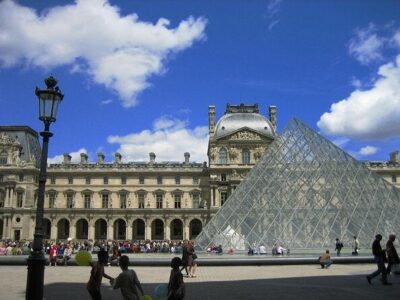
Louvre Museum – Exclusive Guided Tour (Entry Included)
Read our review →
Louvre Museum Hosted Entry and Mona Lisa Audioguide
Read our review →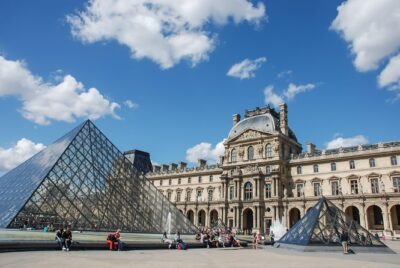
Louvre Priority Access with Mona Lisa Escort or Guided Option
Read our review →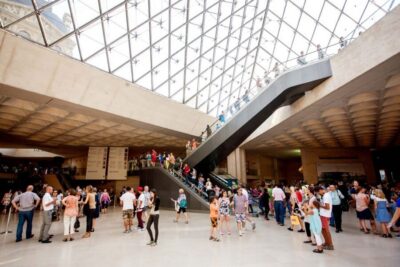
Browse the lists this tour appears in