
Reviewed · LOUVRE MUSEUM TOURS
Paris: Skip-the-Line Louvre Highlights Guided Tour
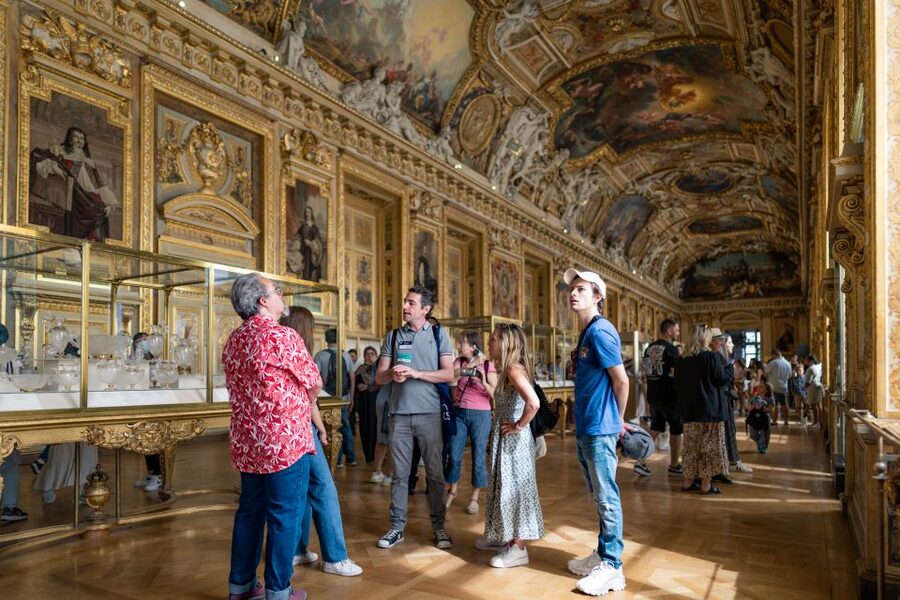
The Louvre is less a museum than a city under one roof, with nearly 10 miles of galleries and an awkward layout shaped by its earlier life as a royal palace. This small-group Louvre tour gives you a clear route through the grandest rooms and famous works without leaving you to wander in circles.
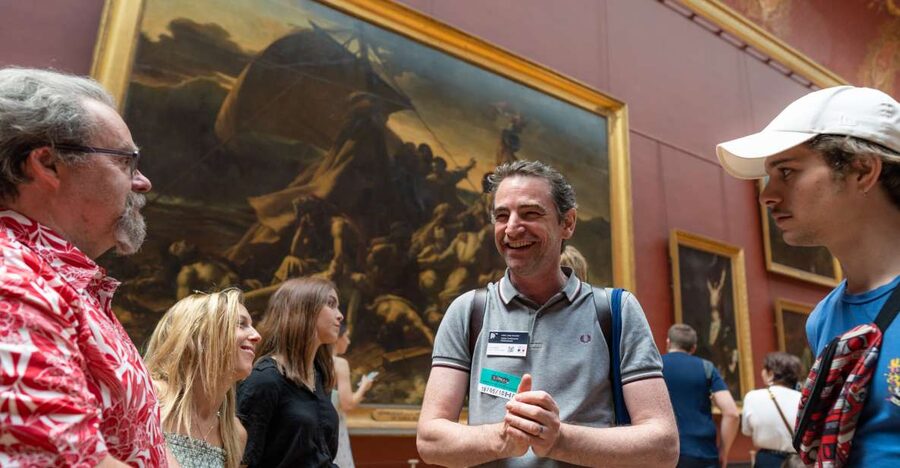
I like the six-person limit, which makes it easier to hear the guide and ask questions. I also like that the guides bring art history to life with stories, comparisons, and practical crowd navigation. The possible catch is that skip-the-line entry does not mean an empty museum. Security checks and the Mona Lisa crowd can still slow you down.
Key points at a glance
- See the Louvre’s essential masterpieces: The route includes the Mona Lisa, Venus de Milo, Winged Victory, Liberty Leading the People, and the Coronation of Napoleon.
- Follow a tiny group: Groups are limited to six participants, giving the tour a more personal feel than a large museum procession.
- Hear from an art specialist: Guides such as Megan, John Edward, Claire, Caroline, Will, Christina, Astrid, Hervé, and Humberto have led tours, with the assigned guide varying by departure.
- Enter with a pre-reserved ticket: You skip the ticket line, though security screening and crowded galleries still apply.
- Choose 1.5 or 3 hours: The shorter option covers the major sights quickly, while three hours allows more room for context and lesser-known works.
- Stay after the tour: Once the guided portion ends, you may continue exploring the Louvre until closing time.
Why a guided Louvre visit helps
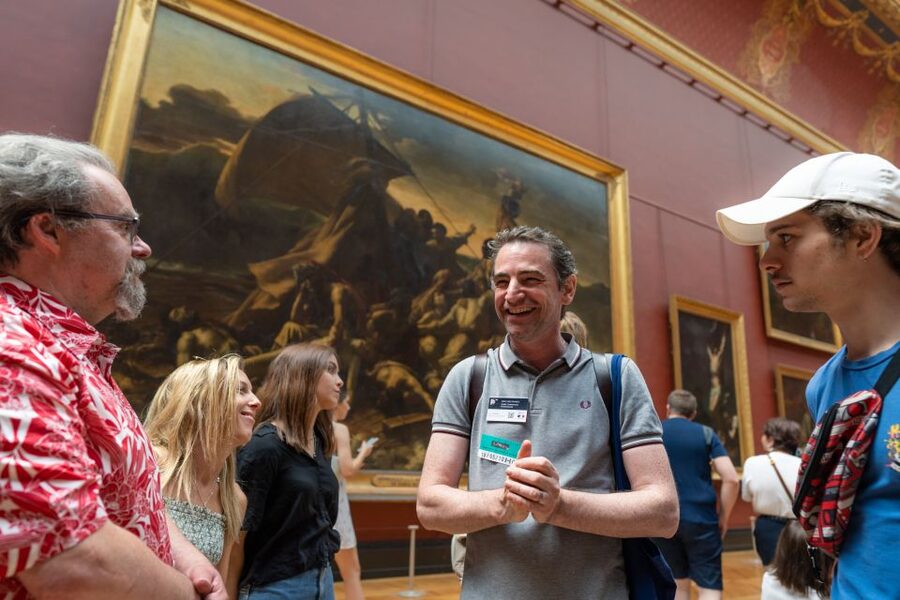
The Louvre can punish a casual plan. You arrive wanting the Mona Lisa, then find yourself trying to decode a maze of wings, staircases, room numbers, and signs. The building was not designed as a museum, so even a strong sense of direction does not solve the whole problem.
A guide gives your visit a shape. Instead of spending your first half-hour figuring out where to go, you move directly toward the important rooms and learn why the works matter. That is especially useful if this is your first time in Paris or if you have only a short museum window.
The tour focuses on major works, but it is not limited to a checklist. Along the way, your guide may point out smaller paintings, architectural details, royal objects, and pieces that are easy to miss when you are focused only on the famous names.
The English-speaking guides are accredited local professionals. Previous guides have included art-history specialists and people with advanced degrees in the subject. Names associated with recent departures include John Edward, Megan, Claire, Caroline, Will, Christina, Astrid, Hervé, and Humberto. You cannot choose a particular guide from the information provided, but the guide roster has included people praised for clear explanations, strong art knowledge, warmth, and a lively style.
A few other Paris half-days to compare
- Paris: Louvre Museum Timed-Entrance Ticket
★ 4.6 · 71,977 reviews - Paris: Louvre Guided Tour with Reserved Access & Boat Cruise
★ 4.3 · 16,353 reviews - Louvre Museum Masterpieces Guided Tour with Access
★ 4.5 · 12,023 reviews
Meeting at the Arc de Triomphe du Carrousel
The tour begins at the Arc de Triomphe du Carrousel, at 75001 Paris. This is the triumphal arch in the open area near the Louvre, not the much larger Arc de Triomphe at the top of the Champs-Élysées.
Give yourself enough time to identify the correct arch and meeting spot. The Louvre area is large, and arriving at the wrong monument would be a frustrating way to start a timed museum visit. Your confirmation should be checked carefully for the exact meeting instructions and starting time.
There is no hotel pickup or drop-off. You make your own way to the meeting point, then the activity ends back there after the guided service. Since you may remain in the museum afterward, the stated ending point is useful, but your own Louvre visit continues inside rather than being escorted to another Paris sight.
Bring a passport or ID card. The museum also restricts luggage and large bags. Anything larger than 55 by 35 by 20 centimeters is not permitted, so do not arrive with a suitcase or oversize day bag.
Entering the Louvre with a pre-reserved ticket
The pre-reserved admission is one of the tour’s practical advantages. You skip the ticket line and join the entry process with your guide, saving the uncertainty of buying a ticket at the museum.
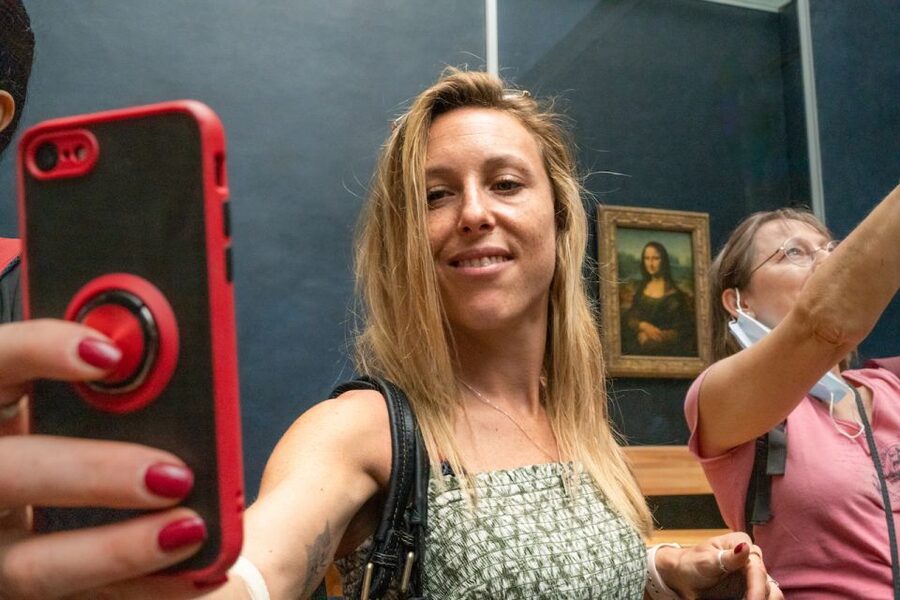
Skip-the-line does not mean skip every queue. Increased security measures can affect waiting times, and everyone still has to pass through the museum’s security procedures. The Mona Lisa area can also be crowded once you are inside. One useful thing a good guide can do is turn unavoidable waiting into lesson time, explaining the painting and its setting instead of letting you stand there without context.
That distinction matters when you compare this tour with a simple timed admission ticket. You are paying for more than entry. You are paying for a route, interpretation, and help with the Louvre’s crowds. A prepaid ticket might get you through the entrance just as efficiently at certain times, but it will not explain the art or solve the building’s confusing layout.
The Louvre’s royal setting and grand rooms
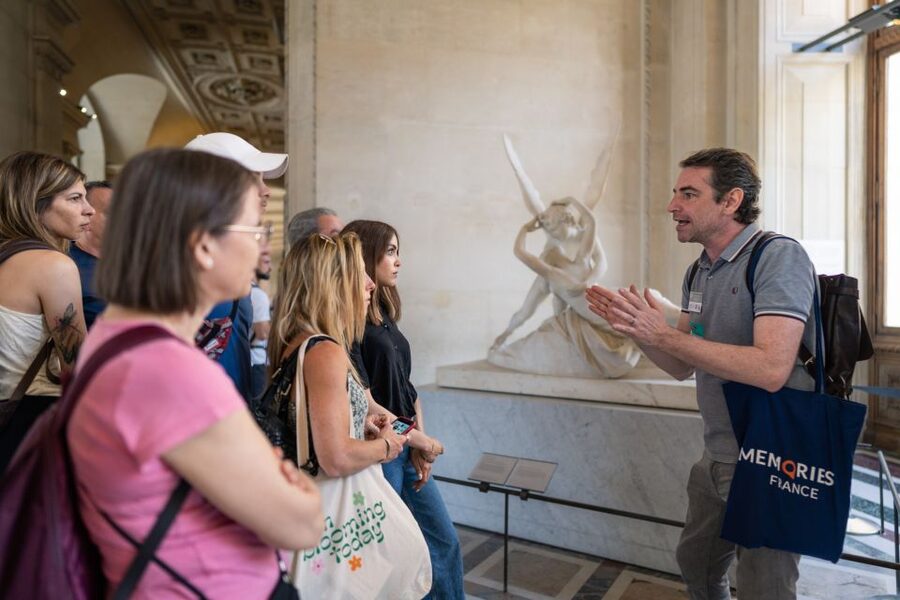
Before the works themselves, the building deserves attention. The Louvre began as a fortress and later grew into a royal palace. Its long history as a home for French rulers explains the odd arrangement of wings and galleries, as well as the scale of the interiors.
Your guide uses the building as part of the story. You may pass through spaces connected to French monarchy, see the French Crown Jewels, and examine the ornate salons preserved from the Second Empire. The Napoleon III apartments are especially memorable for their lavish decoration and furnishings.
These rooms offer a change of pace from paintings and statues. Gilded details, elaborate furniture, and formal interiors show how power was displayed in the last period when the Louvre housed a sovereign. They also help you understand that the museum is not simply a neutral container for art. The palace itself is one of the major sights.
The main drawback is time. A 1.5-hour tour cannot give equal attention to every department. You will see selected rooms and works, not the complete museum. That is not a flaw in the route, since the Louvre is far too large for one sitting, but you should set realistic expectations.
More skip-the-line tickets in Paris:
- Versailles: Skip-the-Line Tour of Palace with Gardens Access
★ 4.7 · 9,778 reviews - Versailles: Skip-the-Line Guided Palace Tour and Full Access
★ 4.6 · 5,214 reviews - Louvre Museum: Skip-the-Line Small Group Guided Tour
★ 4.6 · 3,960 reviews - From Paris: Versailles Skip-the-Line Tour & Gardens Access
★ 4.7 · 3,011 reviews
Winged Victory and the sweep of ancient sculpture
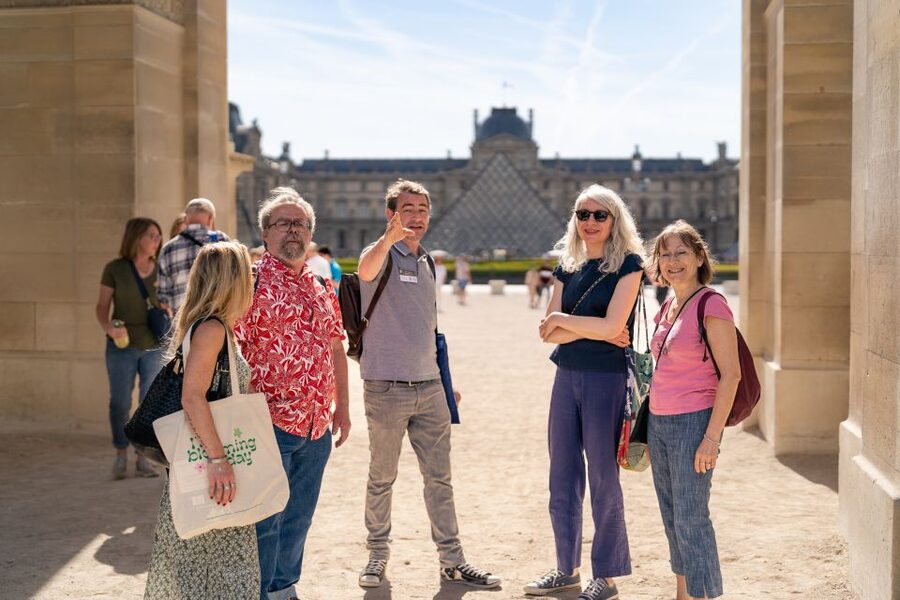
Winged Victory of Samothrace is one of the Louvre’s most dramatic sculptures. Its placement at the top of a grand staircase gives it a strong sense of movement and arrival. The figure appears to lean into the wind, with carved fabric suggesting motion even though the statue is made of stone.
A guide can help you look past the missing head and arms. Rather than treating the sculpture as an incomplete object, you begin to notice the force of the pose, the folds of the clothing, and the way the work interacts with its surroundings.
The route also includes the Venus de Milo, another ancient sculpture known across the world. Here, the guide can supply context about the work and explain why its pose, proportions, and missing arms have kept it at the center of public attention.
These statues are valuable stops for first-time visitors because they are easy to appreciate even if you do not have a background in art. You get a direct visual experience, then enough explanation to understand why each work has become so important.
The paintings that shaped the French story
Large-format French paintings give the tour a different mood. Liberty Leading the People is not just a grand canvas with a memorable figure at its center. It is also a work tied to revolution, national identity, and the way history gets turned into an image.
The Coronation of Napoleon brings another kind of spectacle. Its scale and ceremony show how a ruler wished to be seen, while the details reward a slower look. A guide can point out the people, costumes, gestures, and symbols that are easy to miss when you are standing among other museumgoers.
This is where the tour’s interpretation matters most. A label can tell you a title and date. A strong guide adds the human choices behind the image and explains how a painting reflects the politics and values of its time.
The exact order of the stops can vary with crowd movement, room access, and the guide’s judgment. That flexibility is useful inside a museum as large as the Louvre, though it means your tour should be viewed as a highlights route rather than a fixed theatrical performance.
Meeting Leonardo at the Mona Lisa
The Mona Lisa is usually the stop everyone has in mind. The painting is smaller than many people expect, and the viewing area can be packed. You should not expect a quiet, private encounter or unlimited time directly in front of the work.
You can expect your guide to explain the painting’s fame, Leonardo da Vinci’s approach, and the features that make the image so compelling. The famous expression is only part of the story. The sitter’s pose, the treatment of the background, and Leonardo’s handling of atmosphere all help explain why this modestly sized portrait has had such a large cultural impact.
A guide also helps you manage expectations. You may get a quick look, a photograph, and a short explanation before the crowd carries you onward. That is normal. The value comes from understanding what you are seeing, not from pretending the room will be calm.
Several guides have been praised for using waiting time well around the Mona Lisa. That is a small but important sign of a well-run museum tour. The queue becomes part of the lesson rather than dead time.
Beyond the famous four
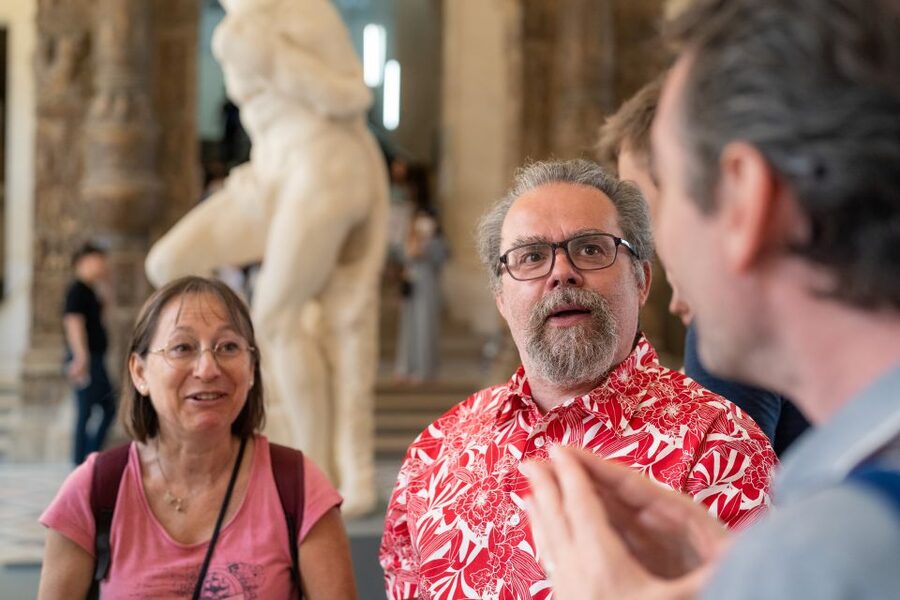
The appeal of this tour is not limited to four postcard works. The route can include Egyptian antiquities thousands of years old, French royal objects, Michelangelo sculptures, and lesser-known paintings that you might pass without noticing.
The Egyptian collection adds great age and a different visual language to the visit. The Crown Jewels connect art with monarchy and ceremony. Michelangelo’s sculptures show how the human body can carry emotion through posture and tension, even when the figure is not one of the museum’s headline attractions.
Your guide’s choices matter here. A good route gives you famous works for recognition, then adds a few quieter pieces that broaden your idea of what the Louvre contains. Past guides have been praised for showing personal favorites and for staying a little beyond the planned time on occasion, but extra time should never be assumed. The advertised duration remains 1.5 or 3 hours.
If you have already been to the Louvre, the three-hour option makes more sense. You may know where the famous works are, but a guide can connect them to rooms and periods you overlooked on an earlier visit. One repeat visitor found the guided format opened up much more of the museum than a self-guided walk.
Choosing between 1.5 and 3 hours
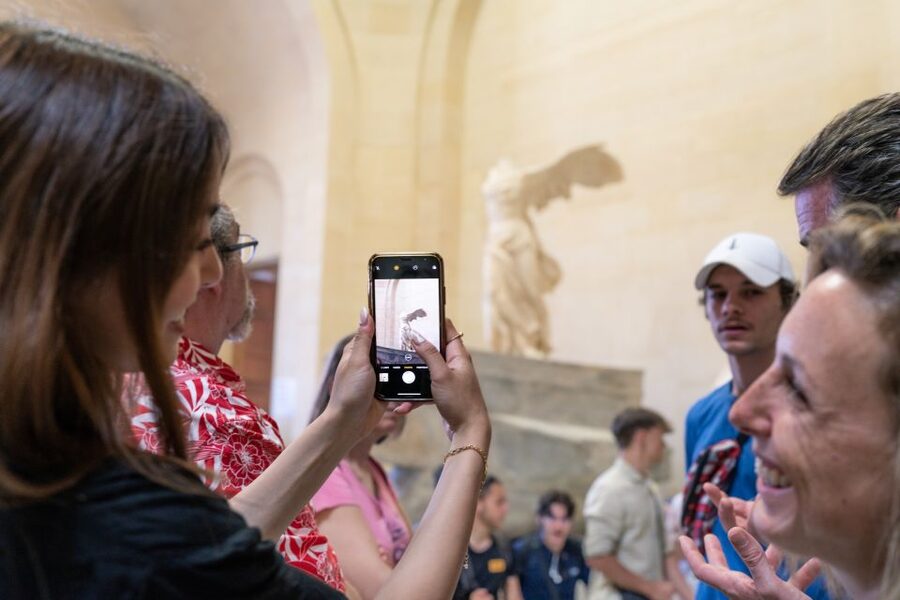
The 1.5-hour version is a focused introduction. It suits you if you want the main works, a basic understanding of the museum, and time afterward for your own plans. It also works well for families who may not want a long art-history session.
The three-hour version gives the guide more time to explain the Louvre’s history, compare different works, and show additional rooms. It is the better choice if you have a serious interest in art, are visiting for the first time and want a fuller route, or hope to leave with a sense of how the museum fits together.
Three hours inside a large museum can be tiring. You may prefer the shorter tour if your Paris schedule is crowded, your children have limited patience for galleries, or you want to save energy for another sight.
Either way, you can continue exploring at your own pace after the guided tour. This makes the tour more useful than a simple escorted loop. Once you understand the layout, you can return to a favorite painting or visit a department that was not part of the highlights route.
Group size, pace, and guide style
The group is limited to six participants. That is small enough for questions and personal attention, while still keeping the price below that of a private tour. The small size also helps the guide move through crowded rooms without losing half the group at every doorway.
The guides associated with this experience have varied personalities. Megan has been described as warm and patient, John Edward as especially engaging, and Will as able to keep children interested while guiding a family through the museum. Christina has been praised for combining background stories with an easy manner, while Astrid led a well-paced three-hour visit.
Those details point to the main strength of the format: you are not simply following a recorded audio track. You can ask why a work matters, request more explanation, or tell the guide what interests you. The experience will still depend on the individual assigned to your departure, but the small group gives that person room to adapt.
The pace is designed for highlights, not long periods seated in front of every painting. Wear comfortable shoes and keep your belongings light. Large bags are not allowed, and museum crowds can make movement slow even when the guide is efficient.
Is $137 a fair price?
At $137 per person, this is not a budget Louvre entry. The value depends on how much you want from the visit.
For the price, you receive pre-reserved admission, an accredited English-speaking guide, and a small group capped at six. You are also paying for the time saved in planning and for the ability to move straight toward the important works. If the Louvre feels intimidating to you, that help can be worth more than a cheaper ticket that leaves you to manage the museum alone.
The price is harder to justify if you are confident navigating museums, already know the Louvre well, or mainly want a quick look at the Mona Lisa. In that case, a standard museum ticket may suit you better, though it will not provide the same explanations or route planning.
The three-hour format offers stronger value for anyone who wants art context rather than a quick checklist. The 1.5-hour tour is easier to fit into a tight Paris schedule, but the cost per hour is effectively higher because the admission and guide service are the same kind of package.
Free cancellation up to 24 hours before the activity and the option to reserve now and pay later reduce some booking risk. You still need to check the available starting times before planning the rest of your day.
Who should book this Louvre tour?
I would point this tour toward a first-time Louvre visitor who wants the major sights without spending hours studying a map. It also suits families, couples, and solo visitors who value a small group and a live guide.
The tour is a good fit if you want:
- A clear introduction to the Louvre
- Direct access to the major masterpieces
- Historical and artistic context
- A compact visit in English
- The freedom to stay inside after the guided portion
- Help managing the museum’s confusing layout
I would think twice if you want a slow, independent study of one department. The guide has a set amount of time and a highlights focus, so you may move on from a work just as you are getting interested.
The accessibility information needs checking before you book. The activity details describe it as wheelchair accessible in one place, but also say it is not suitable for wheelchair users elsewhere. That conflict is important. Contact the provider and confirm the current route, entrance arrangements, and suitability for your needs.
Final call: book it for direction and context
Book this tour if the Louvre’s size worries you, if you have limited time in Paris, or if you want more than a quick photograph of famous art. The six-person group, pre-reserved ticket, and strong guide focus make it a practical way to get oriented.
Choose the three-hour option if you want room for the palace interiors, French paintings, ancient sculpture, and lesser-known works. Choose 1.5 hours if you want the essential masterpieces and plan to continue alone.
The skip-the-line benefit is useful, but it is not a magic pass through every delay. You will still face security and crowded rooms. For most first visits, though, the combination of a clear route and an art-focused guide makes $137 easier to defend than an admission ticket that leaves the Louvre’s maze entirely to you.
FAQ
Where does the Louvre tour begin?
The tour begins at the Arc de Triomphe du Carrousel, 75001 Paris, France.
Where does the activity end?
The guided activity ends back at the meeting point. You may remain inside the Louvre and continue exploring at your own pace after the tour.
How long is the tour?
The experience is offered as either a 1.5-hour or 3-hour guided tour. Available starting times depend on the date you choose.
What language is the tour in?
The live tour guide speaks English.
How large is the group?
The tour is limited to six participants.
Which Louvre artworks are included?
The highlights include the Mona Lisa, Winged Victory, Venus de Milo, French Crown Jewels, Egyptian antiquities, Michelangelo sculptures, Liberty Leading the People, the Coronation of Napoleon, and Napoleon III’s apartments.
Do I need to bring identification?
Yes. You should bring a passport or ID card.
Can I bring luggage?
No. Luggage, large bags, and oversize items are not allowed. Items larger than 55 by 35 by 20 centimeters cannot enter the museum.
Is hotel transportation included?
No. Hotel pickup and drop-off are not included. You make your own way to the meeting point.
Can I cancel the booking?
You can cancel up to 24 hours in advance for a full refund. The reserve-now, pay-later option also allows you to hold a place without paying immediately.
Just listed in Paris
- Paris: Giverny & Versailles Small Group or Private Tour★ 4.5 · 49 reviews
- Chartres Cathedral 5 Hours Tour from Paris with Private Transport★ 4.5 · 49 reviews
- Paris: Louvre photoshoot or Seine bridges Eiffel Tower walk★ 5.0 · 49 reviews
- Private tour of the Champagne area, meet local producers and taste their Champagne, start from your hotel in Paris.★ 5.0 · 50 reviews
- Paris: Choux Pastry and Chocolate Éclair Making Class★ 4.9 · 50 reviews
- Paris Eternelle Notre-Dame Virtual Reality Tour★ 4.5 · 50 reviews
- Normandy D-Day Landing Beaches Private Day Trip from Paris★ 5.0 · 50 reviews
- Disneyland® Paris 1 Day with Round-Trip Train Tickets from Paris★ 4.0 · 50 reviews
Louvre Museum Tours, compared.


Louvre Guided Tour with Reserved Access & Boat Cruise
Read our review →
Louvre Museum Entry Ticket With Host and River Cruise
Read our review →
Mona Lisa & Louvre Masterpieces Tour with Reserved Access
Read our review →
Louvre Museum – Exclusive Guided Tour (Entry Included)
Read our review →
Louvre Museum Hosted Entry and Mona Lisa Audioguide
Read our review →
Louvre Priority Access with Mona Lisa Escort or Guided Option
Read our review →
Browse the lists this tour appears in