
Reviewed · MONT SAINT MICHEL TOURS
Normandy Victory Museum admission ticket
The most interesting thing here is the focus on the Battle of the Hedges, the hard fighting that followed the D-Day landings. Instead of stopping on June 6, the museum shows how soldiers and civilians dealt with the days and weeks afterward, when Normandy’s thick hedgerows slowed every advance.
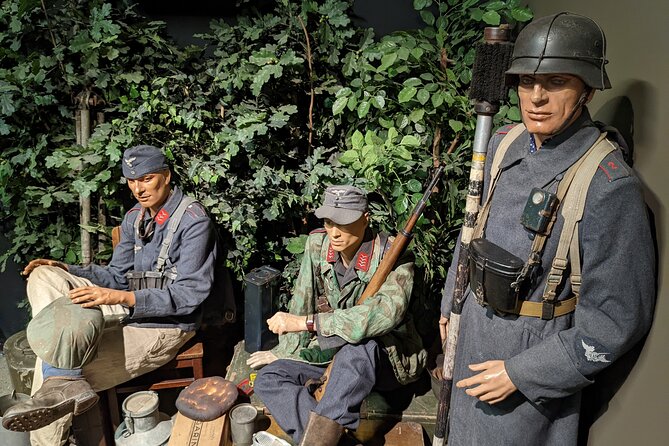
I like the life-size scenes and the sheer number of original objects. I also like that this is not only a room of weapons and uniforms: civilian life, military life, vehicles, sound effects, and personal stories all share space. The main drawback is that some displays rely heavily on written panels, and one screen with veterans’ memories was hard to hear beside nearby sound effects.
Key points at a glance
- Battle of the Hedges focus: Learn about the fighting after D-Day, a part of the Normandy campaign that can be overlooked.
- Twenty full-scale scenes: Walk through realistic wartime settings rather than viewing only cases of objects.
- More than 10,000 original items: Expect uniforms, equipment, household pieces, and other artifacts from the 1940s.
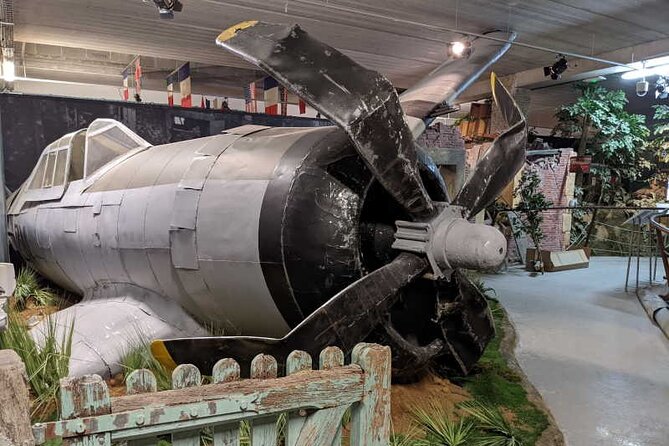
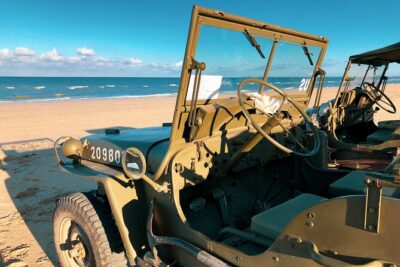
- Vehicles add real weight: Jeeps, trucks, a Sherman tank, a Thunderbolt, and other military vehicles help put the collection into physical perspective.
- Good for families: Children aged 0 to 6 enter free, and the displays suit older children who can read and follow a longer story.
- Low-cost, flexible stop: The ticket is $11.95 per person, with a visit lasting about 90 minutes to two hours.
Why Carentan gives this museum its subject
The Normandy Victory Museum is in Carentan, in the Manche area of Normandy. Your booking information may show Mont-Saint-Michel as the location, but the museum itself is in Carentan, so check your route carefully before setting out.
That location matters. Carentan sits in the part of Normandy where the campaign moved inland after the beaches were taken. The museum’s story is not only about the first assault. It is about the muddy, slow, exhausting push through the hedgerows, where fields were divided by thick banks and lanes that offered cover to both sides.
I find this focus useful because many Normandy visits concentrate on the beaches, cliffs, cemeteries, and famous airborne sites. Those places are essential, but they can leave you with the impression that the outcome was decided in a single day. This museum helps explain the difficult fighting that came next.
The subject also gives the exhibits a clear thread. You are not simply walking through a collection of old military objects. You are seeing how equipment, terrain, civilians, and combat fit together during June 1944 and the period that followed.
More museums in France:
- Paris: Louvre Museum Timed-Entrance Ticket
★ 4.6 · 71,977 reviews - Louvre Museum Masterpieces Guided Tour with Access
★ 4.5 · 12,023 reviews - Paris: Louvre Museum Entry Ticket With Host and River Cruise
★ 4.6 · 9,926 reviews
Twenty scenes that put you inside the story
The museum is arranged around twenty large-scale scenes. These are designed to show wartime situations rather than present every object in isolation.
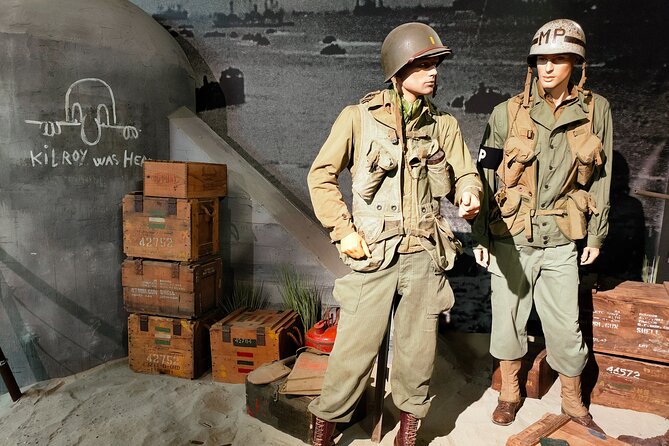
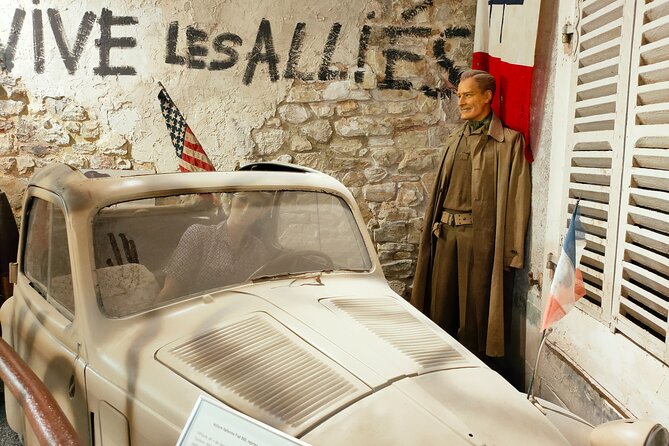
That approach works best for readers who learn through setting and visual detail. A helmet in a glass case tells you something. A helmet placed in a carefully arranged field or room, alongside period equipment and surrounding details, can help you understand how it was used.
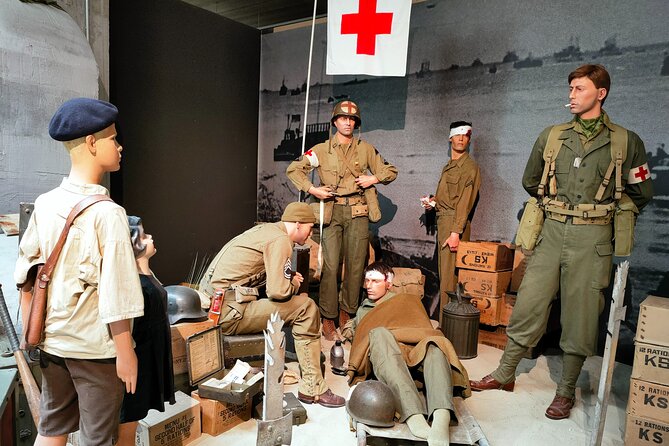
The scenes cover both military and civilian life. That balance is important. Normandy’s war was not happening only on battle maps. Families lived with shortages, damaged buildings, passing troops, fear, and uncertainty. A display that includes civilians gives the campaign a human scale.
The museum also lets you sit in some vehicles and become part of a tableau. That small interactive touch can be especially effective with children, who may connect with the subject more quickly when they can see themselves inside the setting rather than only read about it.
Sound effects form part of several scenes. Used well, they make the rooms feel active and help separate one display from the next. The trade-off is that sound from one scene may compete with a video or testimony nearby. If you want to watch a screen about D-Day experiences, listen carefully and ask staff to raise the volume if needed.
More than 10,000 original objects
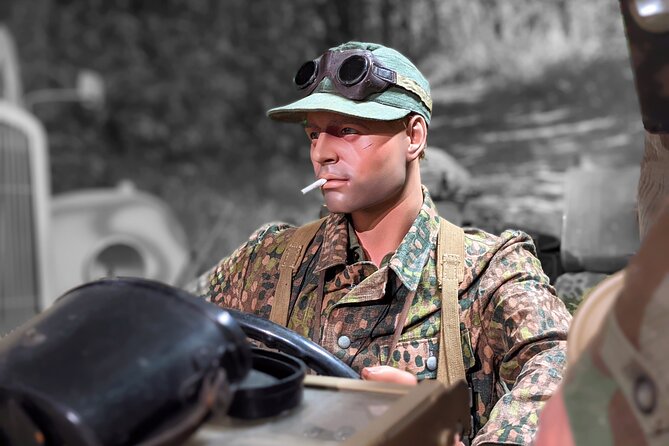
The collection contains more than 10,000 original objects from the 1940s. That does not mean you need to inspect every item closely. It means the museum can show the period through many kinds of material, not only famous weapons and uniforms.
You might find equipment linked to soldiers, domestic objects connected with civilian life, and smaller pieces that reveal how people actually lived during wartime. The value lies in the mix. Large vehicles attract your eye, but ordinary objects often explain the daily reality more clearly.
The displays are supported by information panels. If you enjoy reading, you can spend much longer than the basic 90-minute visit. If you prefer a faster tour, the scenes and vehicles still give you a strong visual outline of the story.
I would plan on 90 minutes at a brisk pace and closer to two hours if you read most panels, pause at the videos, and take time with the vehicles. The museum does not need to be rushed, but it also fits neatly into a day that includes other Normandy sites.
Military vehicles outside and inside
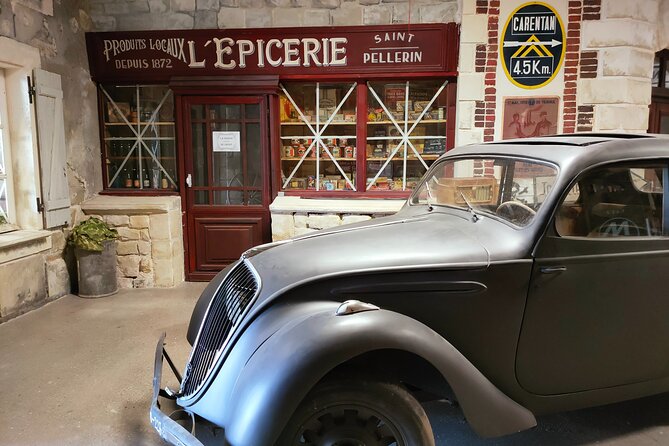
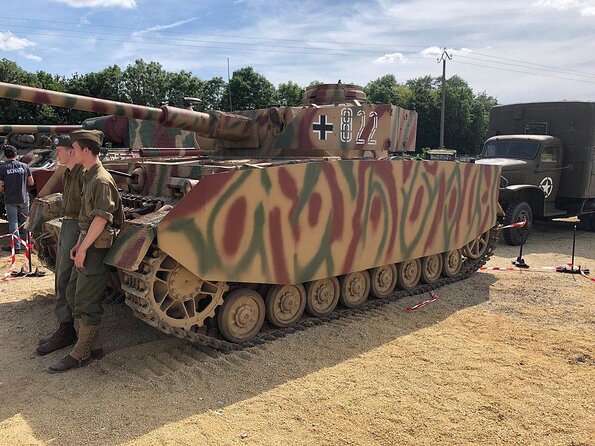
The outdoor vehicles provide an immediate welcome. Jeeps and trucks are joined by larger pieces, including a Sherman and a Thunderbolt mentioned among the collection. One particularly unusual sight is a Luchs, a German reconnaissance tank, with the museum noted as holding one of only two examples.
Vehicles matter because they show scale. Photographs can make a tank or truck seem like a flat symbol. Seeing the height, interior space, tires, armor, and mechanical bulk gives you a better sense of the conditions faced by the men who operated them.
The outdoor area also adds variety after the indoor scenes. Older children can move between the displays, while adults may spend more time studying construction and markings. If vehicles are a major reason for your visit, allow extra time rather than treating the exterior as a quick photo stop.
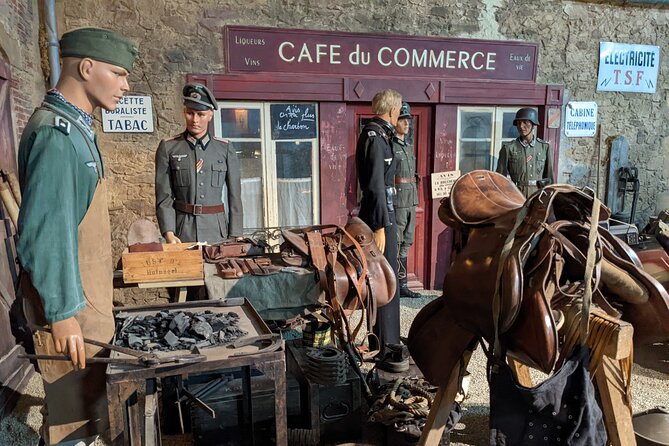
The collection is not limited to one side of the conflict. The museum presents military material from both sides, along with civilian experience. That wider approach gives the displays more context and avoids reducing the campaign to a one-sided equipment catalogue.
A few other France half-days to compare
- Disneyland® Paris 1-Day Ticket
★ 4.6 · 49,412 reviews - Paris: Versailles Palace and Gardens Full Access Ticket
★ 4.6 · 41,579 reviews - Paris: Eiffel Tower Entry Ticket with Optional Summit Access
★ 4.4 · 20,035 reviews - Paris: Moulin Rouge Cabaret Show Ticket with Champagne
★ 4.7 · 16,088 reviews
A good choice for families with older children
The museum is accessible to everyone, and most people can take part without any special arrangements. Children aged 0 to 6 enter free, while the youth rate covers ages 7 to 17 at €7. The ticket information lists a maximum capacity of 100 people, so the site can accommodate groups without being a vast, anonymous hall.
I would choose this museum for older children who can read short panels and follow a sequence of events. The vehicles, realistic scenes, and opportunities to sit in displays provide visual breaks from the text.
For very young children, the free admission makes a short visit easy to justify, but you should not expect every historical detail to hold their attention. The sound effects may also be intense for a child who is sensitive to sudden noise.
Adults who want a quiet, highly academic museum may find the staged scenes a little theatrical. That is part of the point here. The museum aims to make the period understandable and emotionally direct, not to function only as a research archive.
The human side of the Battle of the Hedges
The strongest part of the visit is the connection between objects and people. The museum’s scenes show that the Battle of the Hedges was not a neat movement across open ground. The hedgerows created enclosed spaces, blocked views, and made progress slow.
That helps explain why the period after D-Day could be so difficult even after the beaches were secured. You can look at the equipment, then consider the terrain it had to cross. The story becomes less about a single dramatic landing and more about persistence under difficult conditions.
The museum also deals with the civilian side of the war. That is one reason I would add it to a Normandy plan that already includes major military museums. It fills a gap by showing how the war reached into homes, farms, roads, and local communities.
Several exhibits include video material with personal memories of D-Day. These accounts can add a direct human voice, although the sound level may vary from one area to another. Do not hesitate to ask staff for help if a nearby scene makes a recording difficult to hear.
How much time and money should you allow?
The listed price is $11.95 per person. For a museum with this number of artifacts, twenty scenes, and outdoor vehicles, I consider that a fair price, especially if you spend the full two hours there.
The value is strongest when you treat the museum as a focused historical stop rather than a quick photo opportunity. At 90 minutes, you get the main story and the most striking displays. At two hours, you can read more, pause with the vehicles, and give the civilian exhibits proper attention.
Discounted admission of €7 is available at reception for people with reduced mobility, students, teachers, and military personnel. Children from 0 to 6 enter free, and ages 7 to 17 receive the youth rate of €7.
Food and drinks are not included in the admission ticket. The site has a café with an airfield theme, but you should plan to pay separately if you eat there. Free Wi-Fi is available.
The museum is also a practical stop on a driving route. There is plenty of parking, and the site can work well as a break while heading toward Cherbourg. Pay attention to the road signs, though. One account specifically noted that the exit can be easy to miss.
Opening hours and planning your visit
The listed opening hours change with the season:
- February 14 to April 3, 2026: 10:00 a.m. to 5:30 p.m.
- April 4 to May 29, 2026: 10:00 a.m. to 6:30 p.m.
- May 30 to August 23, 2026: 9:30 a.m. to 7:00 p.m.
The museum is listed as open every day during these periods. If your visit falls outside those dates, check the current schedule before going.
You receive confirmation at booking, and the ticket is mobile, which makes it easy to keep with the rest of your day’s plans. Free cancellation is available if you cancel at least 24 hours before the scheduled start time. Changes or cancellations inside that window are not accepted for a refund.
The museum accepts service animals and dogs. Reduced tickets are handled at reception, so bring the relevant proof if you qualify.
How it compares with a typical Normandy museum
Normandy has several large, heavily advertised museums. Some focus on one beach, one battle, or a particular branch of the armed forces. The Normandy Victory Museum takes a more intimate route, using scenes and a very large object collection to tell a broader local story.
I would not choose it as a replacement for every major Normandy site. If you have only one day, you may prefer to prioritize the places most closely tied to your family history or main interest.
But it is a strong addition to a longer stay. The museum is quieter and less formal than some major institutions, while still offering plenty to study. Its attention to civilian life and the fighting after D-Day gives you a different angle from a beach visit alone.
The gift shop is another reason to allow a little extra time. It has a vintage and military theme, with a notably wide selection. You do not need to buy anything, but it is more than a basic rack of postcards.
Who will get the most from this visit?
I would recommend the museum to:
- People who want to understand what happened after the beach landings.
- Families with school-age children and teenagers.
- Visitors interested in original equipment and military vehicles.
- Anyone already touring Carentan, Utah Beach, or the wider Manche area.
- Drivers who need a worthwhile stop on the way toward Cherbourg.
- Visitors who prefer a manageable museum visit lasting under two hours.
I would be more cautious if you want a purely chronological academic presentation with minimal staging. The museum uses atmosphere, sound, full-size scenes, and hands-on elements. That makes the subject more approachable, but it may feel less restrained than a traditional museum.
Should you book the Normandy Victory Museum?
Book it if you want the less familiar story after D-Day, especially the Battle of the Hedges and the effect of the war on civilians. The combination of twenty scenes, thousands of original objects, and outdoor vehicles gives you plenty to see for the price.
It is also a smart family stop. Young children can enter free, older children have vehicles and interactive displays to hold their interest, and adults can spend time with the written history and original artifacts.
I would skip it only if your schedule is extremely tight or if you are seeking a single landmark directly on the coast. For most visitors with a car and a little extra time in Normandy, this is a worthwhile two-hour addition. Plan for the Carentan location, watch for the exit, and bring patience for the written panels and uneven audio in a few displays.
FAQ
Where is the Normandy Victory Museum located?
The museum is located in Carentan, France, in the Manche area of Normandy. The booking information may show Mont-Saint-Michel as the location, so confirm your route to Carentan before traveling.
How long does a visit take?
Allow approximately 90 minutes to two hours. A shorter visit covers the main scenes, while a longer visit gives you time to read the panels, watch video material, and inspect the vehicles.
What is included with admission?
The ticket includes admission to the Normandy Victory Museum. Food and drinks are not included.
What are the ticket prices for children?
Children aged 0 to 6 enter free. The youth rate for ages 7 to 17 is €7. The listed adult price is $11.95 per person.
Is the museum accessible to everyone?
The museum is described as accessible to everyone, and most people can participate. Service animals are allowed, dogs are accepted, and reduced admission of €7 is available at reception for people with reduced mobility, students, teachers, and military personnel.
Can I cancel my booking?
You can cancel for a full refund if you do so at least 24 hours before the experience start time. Cancellations or changes made less than 24 hours before the start time are not accepted for a refund.
Just listed in France
- Paris: Giverny & Versailles Small Group or Private Tour★ 4.5 · 49 reviews
- Half-Day Walking Food Tour in Nice with Lunch★ 5.0 · 49 reviews
- Chartres Cathedral 5 Hours Tour from Paris with Private Transport★ 4.5 · 49 reviews
- Marseille: Frioul Archipelago Catamaran Cruise with Lunch★ 4.4 · 49 reviews
- Paris: Louvre photoshoot or Seine bridges Eiffel Tower walk★ 5.0 · 49 reviews
- Bonifacio: sunset catamaran trip and aperitif★ 4.6 · 50 reviews
- Paris: Choux Pastry and Chocolate Éclair Making Class★ 4.9 · 50 reviews
- Private tour of the Champagne area, meet local producers and taste their Champagne, start from your hotel in Paris.★ 5.0 · 50 reviews
Mont Saint Michel Tours, compared.

2-Hour Guided Walking tour of the Mont Saint Michel
Read our review →
Browse the lists this tour appears in