
Reviewed · STRASBOURG TOURS
Strasbourg Food Tour – A Taste of Tradition by Do Eat Better
Strasbourg’s food makes sense only when you taste its French and German sides together. This small-group walking tour connects an aperitif, a Winstub meal, a cheese shop, and the canals of Petite-France, giving you a useful introduction to Alsace without committing to several separate restaurant bookings.
I especially like the full-meal format, with food included at each stop, and the local guides’ habit of adding city stories and practical dining tips. The main caution is value: at $95.53, you need to arrive hungry, and some portions are tastings rather than large plates.
What makes this Strasbourg food tour worth considering
- Four or more food stops: Eat charcuterie, bretzel, choucroute garnie, cheese, and a seasonal Alsatian sweet.
- French and German flavors together: Beer, sausage, sauerkraut, Munster, and pastries explain Strasbourg’s borderland character.
- A manageable group size: The tour is limited to 12 people, which makes conversation with the guide easier.
- A useful first-day introduction: You pass Place d’Austerlitz, the cathedral area, Place de la Grande Boucherie, and Petite-France.
- Strong guide-led experience: Guides including Loubna, Raphael, JP, Daria, Riccardo, and Naha are praised for local stories and extra recommendations.
- Seasonal flexibility: The final sweet stop can change, and some tastings depend on partner availability.
A meal that moves through Strasbourg
Do Eat Better’s Taste of Tradition is best understood as a walking meal with cultural commentary, not a standard restaurant crawl. Over roughly three and a half hours, you stop at several food businesses and restaurants, eat along the way, and finish in the Petite-France district.
The route begins at Place d’Austerlitz and ends in Petite-France. That direction matters. You start with a drink and savory bites, sit down for a substantial regional dish, pause for cheese, and finish with dessert among canals and old buildings.
The tour is offered in English, but your guide may also speak French during the experience. That is normal for a local outing, though you should contact the operator before booking if you have food restrictions. Vegetarian choices are available, but severe or life-threatening food allergies cannot be accommodated for safety reasons.
More food tours in Strasbourg:
- Strasbourg: Traditional Food Walking Tour with Tastings
★ 4.8 · 219 reviews - Strasbourg Food Tour : Gourmet private Tour with tastings
★ 4.7 · 58 reviews - Authentic Parisian Gourmet Food Tour with 10 Local Dishes & Wines
★ 5.0 · 4,754 reviews
Place d’Austerlitz: beer, bretzel, and charcuterie
The first stop sets up the central idea of Alsatian food: it is neither simply French nor simply German. In an épicerie near Place d’Austerlitz, you begin with a local aperitif, at least one alcoholic drink for participants over 18, and a selection of charcuterie and bretzel.
This is a smart opening. You get something salty in your stomach before the longer meal, and your guide can explain how Strasbourg’s location shaped its table. The combination of cured meats, beer, and pretzel-style bread feels more Central European than Parisian, while the quality of the ingredients and shop setting keep the experience firmly tied to France.
You should expect a tasting rather than a full plate here. The tour’s total food is intended to equal a meal, but each individual stop is portioned to make room for what comes next. If you snack heavily beforehand, you may lose the point of the format.
The 45-minute timing also gives the guide room to introduce the city. Loubna, Raphael, JP, Daria, Riccardo, and Naha are among the guides associated with particularly strong experiences, with Loubna often praised for her warmth and helpful recommendations. Your actual guide will depend on the date.
The cathedral area: a proper Winstub lunch
The central meal takes place near Place de la Cathédrale in a traditional Alsatian restaurant known as a Winstub. These places are important to the region’s food culture. They are associated with hearty local cooking, regional wine, and an informal dining style.
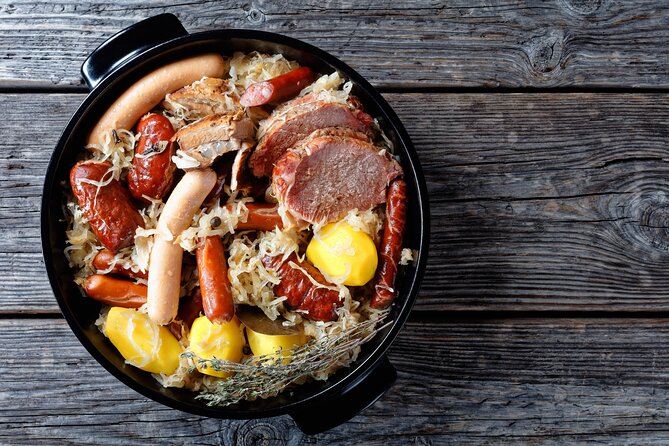
The classic plate is choucroute garnie, sauerkraut served with sausage, other salted meats, and steamed potatoes. The sauerkraut is the star, but the meat makes it filling and explains why this dish has long been suited to cold weather and hard work.
This is the point where the tour becomes more than a series of nibbles. You sit down for about an hour and eat a recognizable regional specialty in a traditional setting. A vegetarian alternative is available if you request it when booking.
The exact main dish can vary. Some tours have included spätzle or another Alsatian option, and one account found a sausage and sauerkraut or cheese-and-spätzle choice less exciting than expected. That is useful to keep in mind. The meal is regional and substantial, but this is not a menu where you select from a long list of dishes.
If you have never tried sauerkraut prepared in Alsace, this is a good first encounter. It is more than a side dish, and the combination with sausage and potatoes gives you a clear sense of the area’s traditional cooking. You can also receive a glass of wine with the meal, depending on the day’s arrangements and included tastings.
Place de la Grande Boucherie: Munster and local cheese
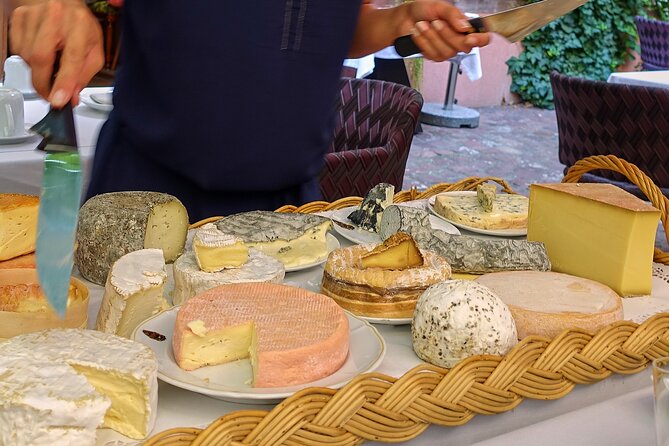
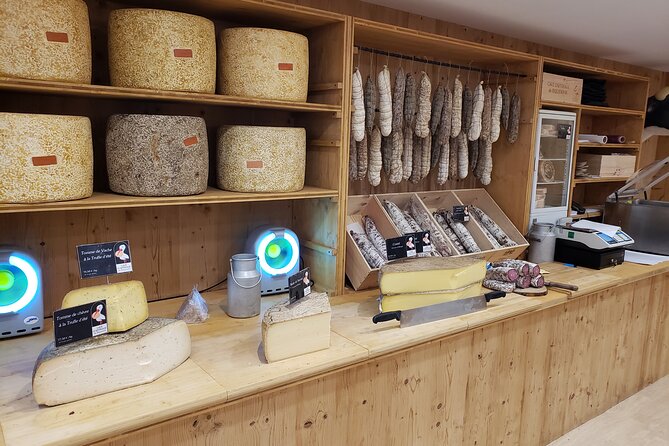
After lunch, the route moves to a cheese shop near Place de la Grande Boucherie. You taste several Alsatian cheeses, including Munster, with explanations from the guide.
Munster is the cheese most people associate with the region. It has a strong aroma and a creamy, savory character. If you are cautious around pungent cheese, this is a chance to try it in a guided setting rather than ordering a full portion blindly.
The cheese stop lasts about 45 minutes. It is also a useful pause after the heavier choucroute. You are still eating, but the pace is slower, and the guide can point out how dairy products fit into Alsatian meals.
This is one of the better reasons to book the tour instead of simply ordering lunch. A restaurant can give you a plate, but it may not give you several local cheese samples or the context to understand them. The same applies to the charcuterie stop. You get a wider range of foods in modest amounts.
A few other Strasbourg half-days to compare
- Montmartre Hill French Gourmet Food and Wine Tasting Walking Tour
★ 5.0 · 2,588 reviews - Devour Paris Ultimate Food Tour
★ 5.0 · 2,087 reviews - NO DIET CLUB – Unique Local Food in Nice !
★ 5.0 · 1,267 reviews - Private Montmartre Food Tour with Wine, Cheese & Pastries
★ 5.0 · 1,027 reviews
Petite-France: canals and a sweet finish
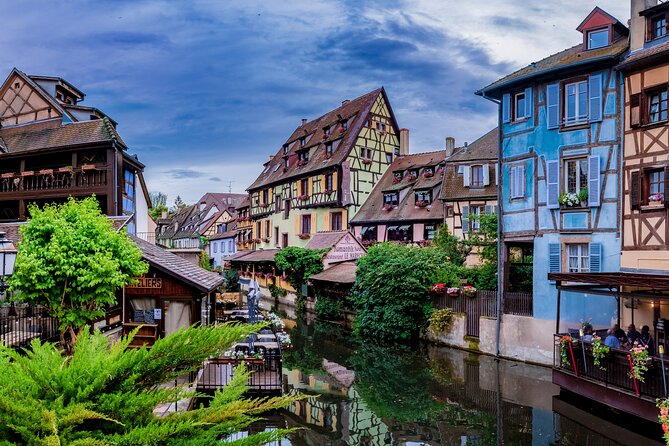
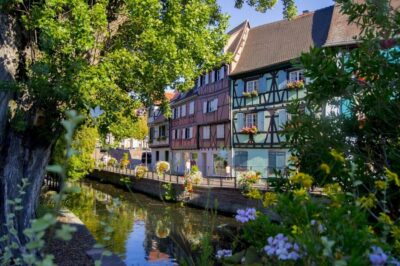
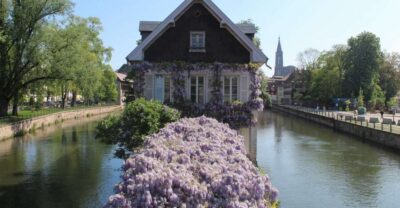
The final section takes you through Petite-France, Strasbourg’s famous district of traditional buildings and canals. The walking distance is described as short and manageable by several participants, though you should still have a moderate level of fitness because the tour moves through the city on foot.
The sweet course depends on the season and ingredient availability. Possibilities include:
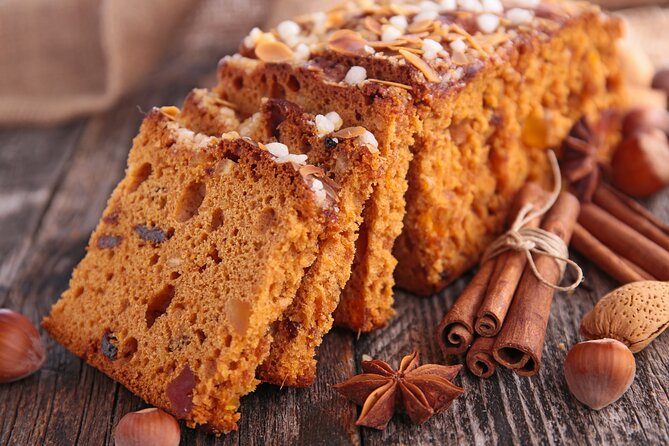
- Kougelhopf: A soft, fragrant Alsatian cake baked in a circular mold.
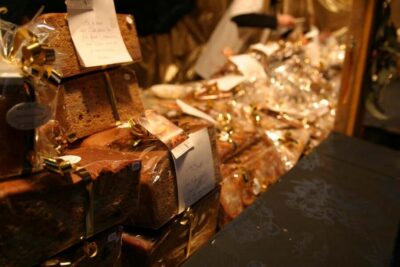
- Pain d’épice: Spiced gingerbread-style cake, offered at Christmas time.
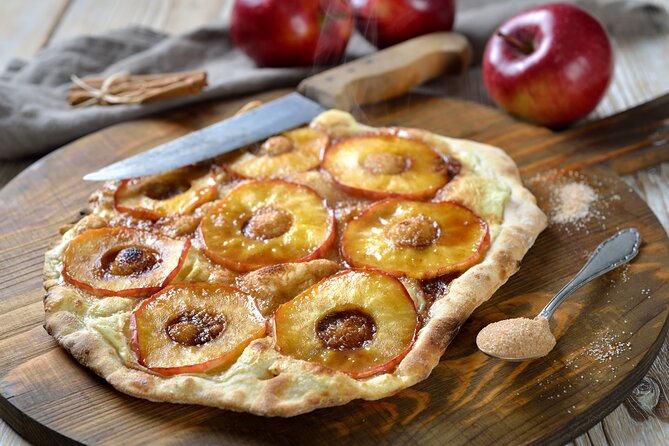
- Sweet tarte flambée: Thin bread dough topped with apples, sugar, and cinnamon.
The tarte flambée is especially distinctive. It uses the same thin base associated with savory flammekueche, but the topping turns it into a warm dessert. Apple and cinnamon make the connection familiar, while the very thin dough keeps it lighter than a thick pie.
At Christmas, pain d’épice or vin chaud may appear, though seasonal substitutions are possible. If you have already been drinking mulled wine at the Christmas Market, tell your guide. One unhappy experience came from receiving a familiar drink after already having it earlier in the day. The operator does adjust stops, but that flexibility can occasionally mean a repeat of something you have already tried.
The finish in Petite-France is well chosen. You are not only eating dessert, you are walking through one of Strasbourg’s most scenic areas at the end of the route. The exact end point can shift slightly depending on the partner businesses.
How much food do you actually get?
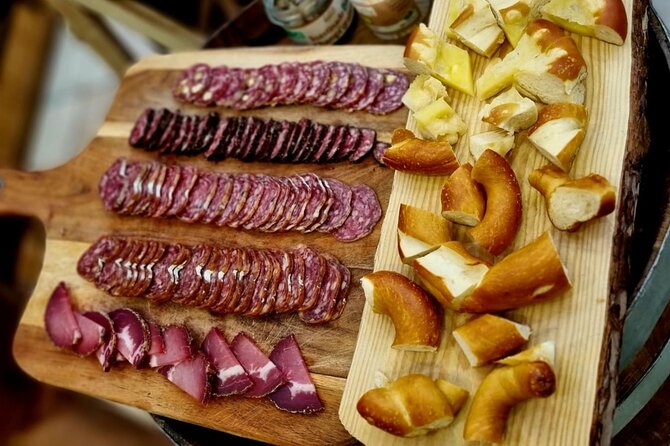
The tour promises the equivalent of a full meal across at least four stops, and the overall menu supports that claim: charcuterie and bretzel, a main dish, several cheeses, and one or more sweets. Water is included, along with at least one alcoholic drink for people over 18. Nonalcoholic choices are available.
Still, do not imagine four restaurant-sized courses. The strength of this format is variety. You try several local specialties without ordering full servings of every one. If your priority is maximum food quantity for your money, a restaurant meal will likely feel more straightforward.
The tour works best when you value access and explanation as much as calories. You avoid making separate reservations, skip the work of choosing unfamiliar dishes, and get a guide who can explain what is on the table. You also finish with enough food to count as lunch or dinner, depending on the departure time.
Arrive hungry, but not desperately so. The opening charcuterie and the choucroute are filling, and cheese arrives before dessert. A light meal beforehand is sensible if you are unsure how much you will eat.
The guide is a major part of the value
The food is fixed only in broad terms. The guide determines how much the tour feels like a connected experience rather than a sequence of handoffs.
Loubna is repeatedly praised for being friendly, attentive, and generous with restaurant and sightseeing suggestions. Raphael is noted for explaining both local food and city history, while JP receives praise for being personable, careful, and helpful with further ideas for Strasbourg and Colmar. Daria, Riccardo, and Naha are also described as engaging local guides who add cultural detail.
That personal element matters. Strasbourg is compact enough to explore on your own, but a good guide helps you notice the French-German blend in ordinary dishes, understand why Munster matters, and place the Winstub meal in local life.
The tour also serves as a practical orientation. Guides have offered advice about popular sights, restaurants that accept walk-ins, and places to visit after the tour. I would book it early in your stay if you want to use those suggestions for the rest of your visit.
Small group, walking route, and timing
The maximum group size is 12 people. That is small enough for a guide to answer questions and check that everyone is keeping up, while still large enough for the experience to feel social.
The walk links major central areas rather than requiring private transportation. You start at Place d’Austerlitz, visit the cathedral district and Place de la Grande Boucherie, and end around Petite-France. The route includes sightseeing, but it is not a dedicated city tour. You will get useful stories and views, not a full survey of every major monument.
The stated duration is about three hours and 30 minutes. Individual stops are listed as roughly 45 minutes, one hour, 45 minutes, and one hour, although real timing can vary. Give yourself room before and after the tour, especially if you have a train or timed museum visit.
A mobile ticket is provided, and the activity is near public transportation. Service animals are allowed. The meeting point is Place d’Austerlitz, so check the exact instructions carefully before setting out. One booking problem involved inconsistent meeting-point information between travel documents. Confirm the location in advance and keep the address available on your phone.
Is $95.53 a fair price?
At $95.53 per person, this is not a cheap way to eat in Strasbourg. The fair question is what you would otherwise spend on separate tastings, drinks, a sit-down Alsatian meal, and the time needed to arrange it all.
The price includes the food, water, at least one alcoholic drink for adults, and the English-speaking guide. It does not include extra food or drinks. If you order additional wine, beer, or dessert, budget for that separately.
I see the value in three areas. First, you sample a broad range of local food in one outing. Second, you receive a full sit-down meal rather than only market bites. Third, the guide adds city orientation and restaurant advice that you would not get from eating alone.
The value is weaker if you mainly want large portions or already have a detailed restaurant plan. It is also less appealing if you dislike sauerkraut, strong cheese, cured meat, or seasonal substitutions. The tour is designed around Alsatian tradition, not broad international variety.
The 97 percent recommendation rate and 4.9 rating from 614 reviews point to a consistently well-received experience, but the one lower assessment offers a fair warning: one-bite samples can feel too small for the price, and a changed stop may not feel special if you have already tried that item elsewhere.
Who should book this food tour?
I would choose this for a first visit to Strasbourg, especially if you want a quick introduction to Alsace before exploring restaurants on your own. It suits couples, families with older children, and small groups who like to eat while walking and asking questions.
It is also a good choice during the Christmas season, when restaurant queues and packed market stalls can make spontaneous eating frustrating. The guide handles the route and food stops, and you get a break from standing in line.
Families can take part, and one experience specifically notes that a toddler was welcomed. Still, the route involves walking, restaurant seating, and several food changes, so very young children may not enjoy every stop.
Vegetarians should request the alternative in advance. People with severe allergies should not book this activity. Adults who want alcohol can expect at least one included drink, while nonalcoholic options are available.
The tour is less suited to anyone seeking a deep culinary workshop, a long wine tasting, or a luxury dining experience. You are learning by eating and walking, not cooking or sitting through a formal meal.
Practical advice before you go
Book ahead if your schedule is fixed. The tour is often reserved well in advance, with an average booking lead time of 43 days. That suggests popular dates can fill, particularly around Christmas.
Wear comfortable shoes and leave space between the tour and your next appointment. The walking is manageable, but you will be on your feet between stops.
Tell the operator about dietary needs before booking, not only when you arrive. Ask for vegetarian arrangements at that stage. Also remember that tastings can change with the season and partner availability, so the exact dessert or drink is not guaranteed.
Free cancellation is available until 24 hours before the start time. A cancellation inside that window is not refunded. Poor weather or failure to reach the minimum number of participants can also lead to a different date or a full refund.
Should you book Strasbourg Food Tour: A Taste of Tradition?
Book it if you want a guided first taste of Alsace, a proper local meal, and an easy route through central Strasbourg. The strongest part is the combination of food and place: beer and charcuterie near Place d’Austerlitz, choucroute in a Winstub, Munster near Place de la Grande Boucherie, and dessert in Petite-France.
Skip it if portion size is your main concern or if you want complete control over the menu. At this price, the tour earns its keep through variety, convenience, and the guide’s personal knowledge rather than oversized servings.
For most first-time visitors, I would schedule it early in the stay. Come hungry, request dietary accommodations ahead of time, verify Place d’Austerlitz as the meeting point, and treat the changing menu as part of the tradeoff. You will leave with a better sense of what to order next, and probably no need for dinner.
FAQ
How long does the Strasbourg food tour last?
The experience lasts approximately three hours and 30 minutes. It includes walking between food stops and time to eat at each location.
Where does the tour begin and end?
The tour begins at Place d’Austerlitz in Strasbourg and ends in Petite-France. The final point may change slightly according to partner availability.
What food is included?
Included food can include charcuterie, bretzel, beer, choucroute garnie, Alsatian cheese, kougelhopf, pain d’épice, and sweet tarte flambée. Tastings may change by season and availability.
Are drinks included?
Water is included, along with at least one alcoholic drink for participants over 18. Nonalcoholic options are available. Additional food and drinks are not included.
Are vegetarian options available?
Yes. Vegetarian alternatives are available, but you should contact the operator about food restrictions before booking.
Can people with severe food allergies join?
No. For safety reasons, people with severe or life-threatening food allergies cannot participate in this experience.
Just listed in Strasbourg
- From Strasbourg: Half-Day Tour of Alsace Villages★ 4.7 · 50 reviews
- Medieval Villages and Wine Tasting from Strasbourg★ 5.0 · 55 reviews
- Strasbourg City Center Guided Bike Tour w/ Local Guide★ 5.0 · 57 reviews
- Strasbourg Food Tour : Gourmet private Tour with tastings★ 4.7 · 58 reviews
- Private Tour: From Strasbourg to Colmar, Eguisheim, Riquewhir★ 4.5 · 58 reviews
- Capture the Magic of Strasbourg with an Exclusive Photoshoot★ 4.9 · 61 reviews
- FULL DAY ALSACE PRIVATE TOUR : Tailored by your Friendly Driver★ 5.0 · 76 reviews
- Explore Strasbourg in 60 minutes with a Local★ 5.0 · 82 reviews
Strasbourg Tours, compared.
Colmar, Medieval Village & Castle Small Group from Strasbourg
Read our review →
Browse the lists this tour appears in